
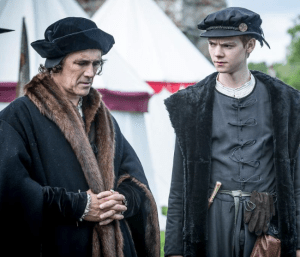
From The Private Life of Thomas Cromwell –
Thomas and Elizabeth Cromwell may not have had their own children in the early period of their marriage (just as Cromwell’s sisters did not), but they did take on a ward, young Ralph Sadler. Cromwell met Henry Sadler from Hackney, who worked with Morgan Williams for Thomas Grey, 2nd Marquess of Dorset. In 1517, Sadler’s wife Margaret died, leaving him with three young boys, Ralph, John, and infant Nicholas. Ralph, aged between seven to ten years old, went into Cromwell’s household and simply never left, becoming a son to Cromwell in all but name. Cromwell and Henry Sadler remained friends throughout their lives, the pair dying
just months apart, with Cromwell happy to aid the entire Sadler family. Ralph Sadler was Cromwell ward until 1527, when he started work as a clerk, first appearing in the paperwork on a murder case Cromwell was overseeing, the death of Isabella Watson and her unborn baby.
Following the downfall of his patron and surrogate father, in 1540, Sadler managed to maintain his position at court, proving himself indispensable through his administrative expertise and diplomatic abilities. As co-Master Secretary to the king (with Thomas Wriothesley) since April 1540, Sadler came to grief alongside Sir Thomas Wyatt in early 1541, when the pair were arrested on the king’s orders on very undefined terms. The king was still in a period of mourning Cromwell and yet suspicious of Cromwellians at court. The exact ‘crimes’ that Sadler and Wyatt committed go largely unrecorded. Sadler was given the chance to speak with Henry, and he managed to smooth-talk his way out of prison and remained in the privy chamber and Privy Council (Wyatt was sent to trial for speaking undefined slander and found innocent months later when Henry calmed down).
But Thomas Wriothesley, the great traitor, constantly bullied Ralph in his shared role as secretary. Sadler stayed out of Wriothesley’s way, and was one of the men tasked with overseeing the interrogation and execution of Queen Katheryn Howard in late 1541 and early 1542, alongside Thomas Cranmer. Sadler was removed as co-secretary in 1543 and given a figurehead role in the king’s wardrobe so he could remain close to the king, but his official position was to be a diplomat and advisor. Sadler did his best to make moves against Stephen Gardiner and the Duke of Norfolk throughout the rest of Henry’s reign in revenge for their behaviour against Cromwell. Both men continued to stir up trouble throughout the 1540s, and both men were committed to the Tower for all of King Edward’s reign.
Sadler came to grief in 1545, when his wife Lady Ellen’s first husband Matthew Barre reappeared, not dead after all, but the king had parliament ratify Sadler’s marriage and legitimise his children Thomas, Edward, Henry, Anne, Mary, Jane, and Dorothy through the Legitimation of Sir Ralph Sadler’s Children Act 1545 (37 Hen. 8. c. 30). The couple remained married for another 25 years until Ellen’s death.
After Cromwell’s execution, Sadler continued in the service of Henry VIII, who valued his experience in Scottish diplomacy. In the 1540s, he was sent as an ambassador to Scotland, where he worked to secure the Treaty of Greenwich (1543), which sought to unite England and Scotland through the marriage of Henry’s son, Edward VI, to Mary, Queen of Scots. The treaty ultimately failed due to Scottish resistance, leading to a period of military conflict known as the Rough Wooing. Sadler played a role in advising English commanders during this war, reflecting his continued importance in Henry’s foreign policy.
Henry VIII’s death in 1547 did not diminish Sadler’s influence. Under the rule of the young Edward VI, he remained active in government, supporting the Lord Protector, Edward Seymour, Duke of Somerset. He was involved in England’s ongoing military campaigns in Scotland, notably at the Battle of Pinkie Cleugh (1547). Sadler also took on key administrative roles, such as serving as Treasurer of the Army.
Following Somerset’s fall in 1549, Sadler’s career became more precarious. He briefly aligned with John Dudley, Duke of Northumberland, who took control of the government. However, when Mary I became queen in 1553, Sadler withdrew from public affairs due to his Protestant sympathies. Unlike many others associated with Edward VI’s Protestant government, he avoided execution, though he spent much of Mary’s reign in relative obscurity.
Sadler’s fortunes revived with Elizabeth I’s accession in 1558. As a Protestant, he was well-suited to serve the new queen. His deep knowledge of Scottish affairs made him invaluable during the tense negotiations between England and Scotland in the 1560s. He was again appointed as an ambassador to Scotland in 1559–1560, playing a role in securing the Treaty of Edinburgh (1560), which ended French influence in Scotland and helped establish Protestant control under James Stewart, Earl of Moray.
In the later years of Elizabeth’s reign, Sadler was tasked with overseeing the imprisonment of Mary, Queen of Scots. Though he had previously advocated diplomacy with Scotland, he recognised Mary as a potential threat to Elizabeth. In 1584, he was given the difficult role of Mary’s jailer at Tutbury Castle, though he treated her with kindness.
Sadler remained an esteemed elder statesman until his death in 1587, and he died as the richest commoner in England. His long career was marked by adaptability and discretion, allowing him to serve Tudor monarchs across a volatile period of English history. Unlike many of his contemporaries, he managed to navigate the shifting tides of court politics without suffering disgrace or execution.
The Life and Letters of Ralph Sadler will be published in 2026
 CAROLINE ANGUS