
Only three years of Thomas Cromwell’s private bank account records still exist, and February 1537 hid a little piece of gossip. On 22 February, Cromwell’s private clerk made a note:
Lady Mary’s Grace, by Mr. Wriothesley, for by cause My Lord was her Valentine, 15l.
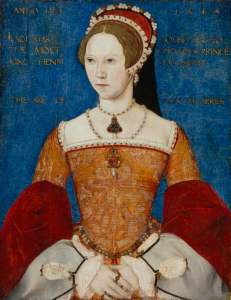
Never again, for any reason, is a Valentine mentioned in Cromwell’s paperwork. Cromwell had sent gifts and money to Princess Mary many times, and despite their extremely divided religious beliefs, they seemed to get along very well. Princess Mary’s letters to Cromwell were usually informal and kind, and they shared many godchildren, Cromwell’s grandson Henry included. Rumours that Cromwell would marry Mary had fallen from the lips of his enemies multiple times, all without basis of proof or merit, and it was used as part of the smear campaign in 1540 (along with Cromwell marrying Princess Margaret Douglas for some random reason).
Was the 15l (around £6,500 today) the gift itself, or did he spend 15l on something? A man could get a nice horse or two for that money. If it had been jewellery, it would have specified, as all of Cromwell’s payments to jewellers gave detail. Did Princess Mary need cheering up, so Cromwell sent her a gift? Her life had much improved by February 1537, reconciled with her father and Queen Jane, and spent Candlemas at Greenwich before moving onto Whitehall. Mary might have known Jane was newly pregnant, which significantly changed Mary’s life. Recently, the Pilgrimage of Grace had been calling for the king to make Mary his heir, or have her take the throne from her father, among many demands. The royal court needed to be seen as a solid unit that trusted one another, and that definitely included Cromwell’s need to be seen as in favour.
Or was the Valentine entry simply a joke? Had Thomas Wriothesley dropped off the gift to Princess Mary on St. Valentine’s Day and made a quip to Cromwell or Avery, who then wrote it in the ledger? or was the gift meant in a more simplistic pagan way, symbolising purification and health, or just the celebration of the start of spring? We have absolutely no way of knowing, but the comment was never crossed out of the ledger. Ledger entries were not always made on the day the bill was paid or money was received, so all detail is lost. But given that Wriothesley turned traitor against his master in 1540, perhaps the comment of Cromwell once sending a Valentine to Princess Mary was mentioned…
Cromwell’s ledgers are printed in full in The Letters and Remembrances of Thomas Cromwell
 CAROLINE ANGUS