
SEPTEMBER SPAIN BOOK REVIEW: ‘The Dead’ by Mark Oldfield

MADRID, 1982.
Comandante Leopoldo Guzmán has decided it is time to disappear. Franco is in his grave and there’s no place in the new order for the one-time head of the dead dictator’s secret police.

But first Guzmán needs money. Luckily, blackmail has always come easily to him – after all, he knows where the bodies are.

And so he should. He buried them.

MADRID, 2010.
Fifteen tangled corpses in a disused mine, three bound skeletons in a sealed cellar – a trail of dead that has led forensic investigator Ana María Galindez to one Comandante Leopoldo Guzmán.

Guzmán himself disappeared decades ago but she fears his toxic legacy lives on. Her investigation has revealed a darkness at the heart of Spain, a conspiracy born amid the corruption and deprivation of Franco’s dictatorship, a conspiracy that after decades in the shadows, is finally ready to bloom.

cover and blurb via amazon

~~

The Dead is a long-awaited book for me – I read The Sentinel and The Exile as soon as they were released, so I pounced on this as well. The Dead is the final in the trilogy of Franco-lover Guzman and the modern-day investigator Ana Maria Galindez, who is literally about to have history come back to bite her.

The Dead moves at such a fast pace you need to make sure you are stable in your seat. You could read The Dead on its own, but I recommend the first two just for the joy. The book lives is in three time periods; 2010, where Galindez is looking for Guzman, whom she has been tracking after forensic evidence put him in the centre of multiple murders and torturing incidents during the Franco regime. The book keeps jumping around, entering 1982, where Guzman runs the Brigada Especial; Franco is dead and the ‘glory’ days of being able to be a vicious fascist is over. Spain is concreting over its past and wants democracy to work. Guzman has one last mission, and wants to end his enemies. What I love is the little flashbacks to 1965, and Inspector Villanuevo who lives in tiny Llanto del Moro. A policeman living under Franco is bound to get caught up in something nasty.

Even with three time periods, the storyline gallops along, the flashbacks filling in details as Galindez tracks Guzman to the bitter ended. The reality of life under Franco and those fragile years post-death swaps out to Spain 2010, not exactly a prosperous time, but at least free. Those who were murdered in Franco’s name, those who are the ‘disappeared’ and the selling of babies all comes back to haunt Spain and Guzman in his final stand.

You all know I love these subjects. My own Spanish trilogy dealt with baby selling, the Brigada Espeical and the ‘disappeared’ from the Spanish Civil War onwards. Only, I like Guzman, even though he was the bad guy. I could never really root for Galindez, the history nerd in me kept referring to the other characters.

In Oldfield’s version, the story is more important than history, so it can appeal to a wide range. The series is neatly tied up and at least some of Spain’s ghost are laid to rest. Reading this made me want to dump all my own work and write another Spanish historical fiction immediately.

Click here to read my reviews of The Sentinel and the Exile

HISTORICAL BOOK REVIEW SERIES: ‘Queens of the Conquest’ by Alison Weir

No automatic alt text available.

In the first volume of an exciting new series, bestselling author Alison Weir brings the dramatic reigns of England’s medieval queens to life.

The lives of England’s medieval queens were packed with incident—love, intrigue, betrayal, adultery, and warfare—but their stories have been largely obscured by centuries of myth and omission. Now esteemed biographer Alison Weir provides a fresh perspective and restores these women to their rightful place in history.

Spanning the years from the Norman conquest in 1066 to the dawn of a new era in 1154, when Henry II succeeded to the throne and Eleanor of Aquitaine, the first Plantagenet queen, was crowned, this epic book brings to vivid life five women, including: Matilda of Flanders, wife of William the Conqueror, the first Norman king; Matilda of Scotland, revered as “the common mother of all England”; and Empress Maud, England’s first female ruler, whose son King Henry II would go on to found the Plantagenet dynasty. More than those who came before or after them, these Norman consorts were recognized as equal sharers in sovereignty. Without the support of their wives, the Norman kings could not have ruled their disparate dominions as effectively.

Drawing from the most reliable contemporary sources, Weir skillfully strips away centuries of romantic lore to share a balanced and authentic take on the importance of these female monarchs. What emerges is a seamless royal saga, an all-encompassing portrait of English medieval queenship, and a sweeping panorama of British history.

cover and blurb via amazon

~~

For far too long, queens have been overshadowed by their kings. Often married, rather than born, into the role, they are considered ‘less than’. While there are many great works now out there about queens, here is a masterpiece of a book of true rulers, ready to lead but ‘betrayed’ by their gender. Queens of the Conquest is, excitingly, the first in a new series, which chronicles war, power, betrayal, tragedy and the odd bright moment.

The first queen in the book is Matilda of Flanders, supporting William the Conqueror as he led the Norman invasion of 1066, and she has a tale just as powerful as any warring king. Instead of simply noting a woman as filled with piety or scandal, Matilda gets a real account of her life. Matilda didn’t want to marry William the Bastard, but with no choice, stood by his side when he became the first king of England.

Their son, Henry I, married Edith of Scotland, and had to change her name to Matilda. Edith/Matilda (or Godiva as she was called by the locals who were putting her down). She was made regent regularly, ran the curia and helped the sick. Edith/Matilda had a grand family lineage in her own right, was well-educated for the time and had a large influnce on articecture.  Her son was killed in a bizarre and stupid accident, meaning she could leave the crown was handed to their daughter, Empress Maude, then renamed Empress Matilda.

Maude/Matilda had married the Holy Roman Emperor, and he died, leaving her to be queen of England in her own right, as her brother was already dead. War raged under Maude/Matilda, but she fought to the very end to hold the throne as hers, not her husband’s/son’s/anyone else related. Naturally, everyone was a real dick about a woman ruling. Maude/Matilda had to marry again, to Geoffrey of Anjou, which was hard because he disliked him; Matilda had to fight wars all over Europe to stay queen. She was a woman who had ruled as queen in Germany and Italy, born to rule, but fought her life away before her son took the English throne to become King Henry II.

Also profiled is Adeliza of Louvain, Henry I’s second wife, whom he had hoped to get a son on, instead of leaving the throne to the incredible Maude/Matilda. Adeliza married Henry soon after his son was killed in the White Ship disaster, a beautiful woman from now-Belgium, a descendant of Charlemagne. Henry I was a huge traveller and Adeliza was always at his side for fifteen years. She gave the king no children, sort-of securing the throne for her stepdaughter Maude/Matilda. Adeliza then went on to marry the royal butler and give him a child.

Also portrayed is Matilda of Boulogne, who married Count Stephen of Mortain. Matilda was niece of the King Baldwin of Jerusalem. When Matilda’s husband heard of Henry I’s death, they rushed to England to take the throne ahead of Empress Maude/Matilda. She was crowned heavily pregnant when the new King Stephen took Maude/Matilda’s place, and was engaged in the battles between these two claimants for eighteen years, sometimes the queen, sometimes deposed, as they battled for control. She helped to found the Knights Templar and negotiated with Maude/Matilda in times of war between them.

None of these women should be forgotten and this book is amazing. If you are into royal history, English history, any kind of history, you should own this book.

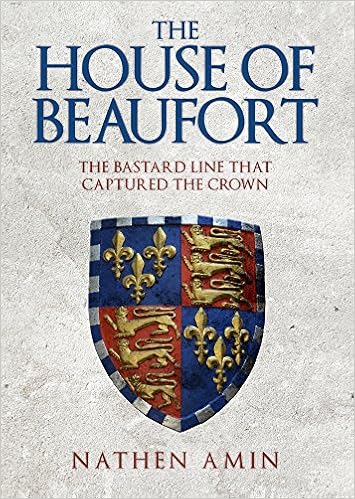
HISTORICAL BOOK REVIEW SERIES: ‘The House of Beaufort’ by Nathen Amin

The Wars of the Roses were a tumultous period in English history, with family fighting family for the greatest prize in the kingdom – the throne of England. But what gave the eventual victor, Henry Tudor, the right to claim the throne? What made his mother the great heiress of medieval England? And how could an illegitimate line come to challenge the English monarchy? Whilst the Houses of York and Lancaster battled directly for the crown, other noble families of England also played integral roles in the war; grand and prestigious names like the Howards, Nevilles and Percys were intimately involved in the conflict but arguably none symbolised the volatile nature of the period quite like the House of Beaufort. The story of the Beauforts, with their rise, fall and rise again, is the story of England during the period, a dramatic century of war, intrigue and scandal. Many books have been written about individual members of the dynasty but never has the whole family been explored as one. This book will uncover the rise of the Beauforts from bastard stock of John of Gaunt, Duke of Lancaster, to respected companions of their cousin Henry V, celebrated victor of Agincourt. The Beauforts fell with the House of Lancaster during the 1460s and 1470s, and their hopes and fortunes came to rest upon the shoulders of a teenage widow named Margaret and her young son, Henry. From her would rise the House of Tudor, the most famous of all England’s royal houses and a dynasty who owed their crown to their forebears, the House of Beaufort. From bastards to princes, the Beauforts are medieval England’s most intriguing family.

cover and blurb via nathenamin.com

~~

One family which doesn’t get enough love are the Beauforts. Nathen Amin has done everyone a favour and produced this wonderful and descriptive book to shed more light on this remarkable line. The story of the Beauforts is one that can last forever. Many families such as the Lancasters, Yorks, Warwicks are often mentioned, when the Beauforts are most important and relevant from the late 1300’s right down to today’s noble families.

Joan Beaufort was the daughter of John of Gaunt, Duke of Lancaster, and his then-mistress Katherine Swynford, remarkable people in their own right.  Joan was the only girl born to this first generation of Beauforts, named illegitimate offspring. Joan married very young and had two daughters, but by her mid-teens, her parents gained a legitimate marriage recognised by the Pope, and Joan herself was already a widow. Joan went on to marry into the Neville family, and produced 14 Beaufort-Neville babies to go with her previous two, and her husband’s eight from his first marriage. Eek!

Nathen Amin has drawn on a countless amount of resources in order to produce such an interesting level of detail, and I found I took so many notes that the whole book was in my notebook. Had the Beauforts not gone on to do so much more, the information on Joan Beaufort could be enough for a book on its own.

Joan’s children went to create the families which ruled England and fueled both sides of the War of the Roses. There was the famous Neville line, including a queen of England and multiple earldoms, including the powerful Warwick family. Joan’s blood flowed through the families of the Dukes of Westmoreland, Somerset and Exeter. Thanks to Joan’s eldest daughter they joined the Mowbray family; another daughter married into the powerful Percy lineage, another into the dynasty of the Staffords, the Dukes of Buckingham. More sons became barons, the family boasted archbishops, and the baby of the family was Cecily, married to the Duke of York, creating two kings, Edward IV and Richard III. That’s just a selection of their greatness!

But nothing destroys families like the quest for power. The 1400’s saw much wealth and success, but also death. By the time Margaret Beaufort (great niece of Joan), who married into the Tudor family, saw her son Henry defeat Richard III for the crown, the Beauforts’ power had spread out like a spiderweb of noble houses.

I am not new to the history of the Beauforts, nor their struggles to take the throne, but I found plenty to enjoy in Amin’s book. If you are new to the subject, this is the number one place to begin. The author has written a book without bias, simply presenting facts written to be entertaining, instead of heavy and academic.

Truth always beats fiction, and while I read this in ebook style, once my hardcover arrives, this book will now sit on my top shelf, where I keep all the books I go back to and reference while I work. History is filled with incredible tales, and Amin’s book brings together so many people that you too could be an expert in no time.

This Week in Spanish Civil War History – Week 62/63/64: 17 September – 9 October 1937

September 18

The battle of El Mazuco continues along the summits of the Peña Blancas. The German Condor Legion planes are brought in now the heavy fog has cleared, to assault the Republican hold over the Bedón river, which runs from the village of Vibaño right of the sea, only 12 kilometres away from the front line now. The Condor Legion bombed the Bedón river region in three waves from midday with both Fiat fighters and German Junkers. Sixteen battalions of Nationalists also stormed the ground with machine guns and grenades to fight the Republicans back further. The continuous onslaught will continue for four days.

September 22

The constant aerial bombardment has finally taken its toll on the El Mazuco Republicans. The crucial El Mazuco pass area is finally captured by the Nationalists and all the summits of the Peñas Blanca are in Nationalist hands. The death toll on both sides is unknown out in the inhospitable landscape. The Nationalists have been vastly slowed by the assault on El Mazuco, and had expected to be in Asturias much sooner. The Republicans west in Asturias have had precious time to regroup and prepare for the Nationalist invasion.

Those who have attempted to defend the El Mazuco pass are considered heroes after losing their honour in Santander, even though they have ultimately lost. Gijón in Asturias is the last Republican stronghold in northern Spain, and the Nationalists can now move into the area, as well as extra Nationalists being brought in from León the south.

September 22

The Battle of Sabiñánigo begins in the Aragon region. The Republicans 27th and 43th divisions go north from the Huesca region to the town of Sabiñánigo. They have around 14,000 men and heavy artillery. The Nationalists have 10,000 men in the area, the 1st Brigade and the 50th National Division. They are spread out over the region, as far north as Biescas 14 kilometres from Sabiñánigo. The battle marks the start of a slow-moving ground battle which will last seven weeks, and cost 6,000 lives for little gain for either side.

David Seymour – Magnum Photos Photographer Portfolio SPAIN. Asturias region. Volunteers of the International Brigades

September 27

The Nationalist which claimed the Peñas Blancas and the El Mazuco pass are now making steady process east to take Gijón and Asturias. They take the town of coastal Ribadesella, some 30 kilometres west from the mountain battles. Combined with Nationalist forces marching both from León, the city of Gijón, 90 kilometres west of Ribadesella, is preparing for battle.

October 1

Nationalist northern troops capture the town of Covadonga, 27 kilometres inland from Ribadesella, and only 75 kilometres southeast from Gijon. No area in the Asturian region has the men to repel the invading Nationalists and there is no opposition to the men taking the area.

Rations Coupons Used During Spain Civil War Asturias 1937

The UGT Unión General de Trabajadores, worker’s trade union, expels Francisco Largo Caballero, one-time Prime Minister of Spain. Caballero has been travelling through Spain holding allies against Communists and Stalinism. Current Prime Minister Jose Negrín makes no attempted to save Caballero, and Spanish parliament fires all parliament members with close ties to Caballero. While the Communists are strong Spain, they are not well liked among the vast majority of people in Republican or Nationalist areas. But the strength of the Communists, especially in the Barcelona area, cannot be defied.

October 5

American president Roosevelt denounces fascist aggression in Spain, though he does not outright denounce Franco, or support the Republican cause and government in any way. While many nations accept that what is happening in Spain needs to end, no one is prepared to step in and help. The rise of fascism in Nationalist Spain is denounced, as the rise of the Communism for the Republicans cause, leading many nations to steer clear of the war entirely, which shall come back to do harm, as Hitler and Mussolini could have been crushed before the start of WWII.

~~

This is not a detailed analysis, just a highlight (lowlight?) of the week’s events. Things get lost in translation – Feel free to suggest an addition/clarification/correction below. The more the world remembers, the better. All photos and captions are auto-linked to source for credit, and to provide further information.


This Week in Spanish Civil War History – Week 61: 10 – 17 September 1937

September 10

Still under the thick fog, the Nationalists take the hill at Biforco, below the El Mazuco Pass, but the mountain of Llabres is still in Republican hands, where they machine gun Nationalist troops and roll down barrels of explosives. The day is marked with the first delivery of hot food for the Republican men. If the Nationalists cannot take this pass, they will be forced to climb much steeper mountains to claim El Mazuco.

on the hills at El Mazuco

September 11.The Nationalists are still stuck in the valley below the El Mazuco pass, and change their plans. They spend two days heading along the mountain range to hike up Pico Turbina,  height of 1315m, a rocky cliff face with 40° slopes.  No tracks have ever been made up Pico Turbina and no mules have ever made the trek. The Nationalist men are forced to carry everything as they scale the cliffs. They are hidden in thick fog and no aircraft can see them overhead.

September 13

Constant bombardment on the northwest edge of El Muzuco has weakened the Republicans at the top, and they have to surrender the Sierra Llabres to the Nationalists. At the top of the village of El Mazuco itself, which has no defenses.

El Mazuco village © José González Fernández.

September 14

Nationalists climbing the Pico Turbina have almost reached the top of the mountain but are attacked by Republicans with hand grenades, aided by the thick fog, which prevents the Nationalists from taking the peak.

Pico Turbina

September 15

El Mazuco village is surrounded by Nationalists so the Republicans retreat back to Meré, six kilometres west along the mountains pass. Pico Turbina is taken by the Nationalists at last and nearby Peñas Blancas peak is also taken, along with the villages of Arenas Arangas.

September 16

The three summits of the Peña Blancas (Peña Blanca, Pico Turbina and El Mazuco) are all now surrounded  by the Nationalists. There are still Republican men at Pico Turbina, not yet ready to surrender. If they can hold the Nationalists on the south side of the Peña Blancas and the El Mazuco pass until winter, then the remainder of the north will be safe from the Nationalists. Casualties are unknown at this point in the wild terrain, but with the Nationalists starting with 33,000 men and the Republicans with only 5,000, the Republican hopes of the Basque, Cantabrian and Asturian men are fading fast.

nearby Arangas

~~

This is not a detailed analysis, just a highlight (lowlight?) of the week’s events. Things get lost in translation – Feel free to suggest an addition/clarification/correction below. The more the world remembers, the better. All photos and captions are auto-linked to source for credit, and to provide further information.