OTD with Thomas Cromwell – 30 September 1535: Cromwell writes to the Dowager Countess of Oxford

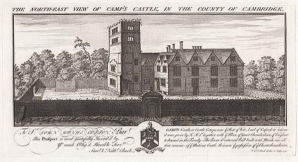
The North-East View of Camp’s Castle, Cambridge, by S & N Buck 1730.

Cromwell wrote to Anne Howard, Dowager Countess of Oxford (sister to the Duke of Norfolk) about her property at Castle Camps. Unlucky Anne Howard married the heavy-drinking John de Vere,  Earl of Oxford, when she was 11, he 12, as her father owned his wardship, though the pair were not a couple as such until 1520. The marriage was a nightmare, and safeguards were put in place to control the ‘incompetent wastrel’ John had become, though luckily he died in 1526. Lady Anne had no children, but still had a claim Castle Camps, the Oxford estate granted by William the Conqueror, but as soon as her husband was dead, the new Earl of Oxford and his men were constantly breaking in, stealing, killing her deer, and generally being an endless, entitled pain. Cromwell had helped out Lade Anne a number of times, including letting her stay at Austin Friars. In this letter, Lady Anne had removed Mr Tirrell from his role of bailiff around Castle Camps and its parks, which he was resisting, and Cromwell wrote to Lady Anne, telling her she had to obey the King and restore Mr Tirrell. Lady Anne persevered, and lived until 1559 without a husband to bother her.

SECRETARY CROMWELL TO THE COUNTESS OF OXFORD, 30 SEPTEMBER 1535 (LP ix no 485i)

To the right honourable and my good lady my Lady Anne Countess of Oxford by this given.

In my most hearty manner, I commend me to your good ladyship. And whereas there has of long time depended between you and this bearer Master Tirrell certain controversies, as well concerning his claim to the park and Bailiwick of Camps, as a certain copy hold, which he bought in the same town, from all the which you have expulsed him, I shall most heartily desire and pray you at the especial contemplation hereof, to restore him again to the same. Which request I make not only to you because I think you have, upon displeasures conceived against him, perchance in some part by the misgivings of himself towards you, done to him, in his expulsion from the same park, Bailiwick and copy hold and your detinue (detention) thereof all together wrong and injury. But because it should be dishonourable to you, to have the same in open Court of Audience tried against you, and likewise displeasant to be, that way disappointed of your will and pleasure, which as I now friendly and frankly write to you, because that I would be glad, you should without constraint do as shall appertains to your honour, and justice. So, I am enforced to advertise to you, as your poor friend, that the king’s highness, like a prince of honour, is minded to have justice proceed without respect in that cause. Eftsoones (again) therefore, requiring your good ladyship, the rather for my sake, without any extremity to be good lady to him, who I dare affirm will be glad to do to you during his life that service and pleasure that shall lie in his little power. As knows God, who sends your good ladyship long life and fare you well. From Winchester the last day of September.

Your ladyshyppis assuryd

THOMAS CRUMWELL

OTD with Thomas Cromwell – 22 September 1524: Cromwell opens a court case for Cardinal Wolsey

The keep of All Saints’ Church, Worthen, Shropshire

This is a very old letter of Cromwell’s, written on behalf of Thomas Wolsey, likely as a draft, as it bears no one’s signature. Cromwell wrote up the petition of yeoman Robert Leighton, the porter at the Tower, of London, against two men who assaulted his cousins in Shropshire. As it was sent under Wolsey’s signature, there is little way to find out the outcome of the case, as much of Wolsey’s work has been destroyed. John Corbett did go on to be the steward of Worthen from 1536 onwards, so clearly there was no punishment given out for the beating of Margaret Bayley. The only other recording of Margaret Bayley is of her being deceased, previously being a widow, as of 1527.

MASTER CROMWELL ON BEHALF OF CARDINAL WOLSEY TO ROBERT LEIGHTON,  22 September 1524 (LP iv no. 681)

Petition of Robert Leighton, gentleman porter of the Tower of London, and yeoman of the Crown, to Wolsey, against John and William Corbett, of Worthen parish, Shropshire, who have assaulted William Bayley and Thomas Leighton, the petitioner’s cousins, to whom he had granted the parsonage of Worthen.

On Sunday 21 August, 1524, they entered the church during divine service with 14 armed people, and would have killed Thomas Leighton and Margaret, (William) Bayley’s wife, who were in the chancel, if the parishioners had not prevented it. After that, John and William Corbett, and Joyce, wife of the former, with 12 others, went to the parsonage, pulled Margaret Bayley out of the house, and beat her, being great with child, so that she is like to die, and boasted that they would slay her husband, who was advised not to return home. He (Bayley) went to Sir Richard Herbert, steward, asking him to see the King’s peace kept. Herbert sent for the Corbetts and their accomplices, but they would not appear before him. He then sent Bayley home with servants of his own, but he dared not stay in the house, but went to the sessions at Shrewsbury, 22 September 1524, and presented bills before the judges, which were thrown out by the jury, as the foreman was Corbetts’ cousin, and several jurymen said they could not live in the country if they did otherwise.

OTD with Thomas Cromwell – 10 September 1535: Cromwell writes to Eustace Chapuys

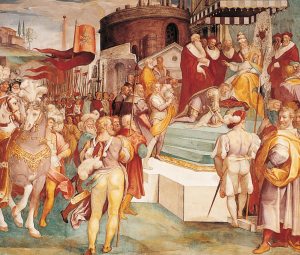
Charles wins Tunis for Pope Paul III by Taddeo Zuccari

Not many letters between Thomas Cromwell and Eustace Chapuys survive, so sadly their relationship can feel rather one-sided, despite all the information we can gather from Chapuys’ catalogued correspondence. This letter was written to share King Henry’s congratulation to Chapuys’ master Emperor Charles and Chancellor Granvelle, on their defeat of the Ottomans at the battle of Tunis (Tunisia), Charles had overseen an army of 60,000 men from Spain, Germany, Italy, Portugal, Malta, and the Low Countries, and saw 30,000 Ottomans killed, 10,000 Muslims enslaved, though another 20,000 Christians were released. This was considered a huge victory for Christianity over ‘Infidels’, though like most wars, it was largely useless, as the area was plunged into multiple bloody wars every century until the early 1800s.

The first half of the letter reads like a copied propaganda pamphlet, but then Cromwell deviated to talking about Princess Mary, who was usually at the centre of all correspondence between the men, with Cromwell eager to tell Chapuys he would soon get the king’s permission to visit Mary, who was primarily moving between Hatfield and Hunsdon in 1535. Chapuys was able to get a servant to Mary about once a week, but he wanted to visit her personally. 

The letter was written in Latin, this is my own translation featured in my Cromwell book of letters. At the time of writing, Cromwell was famously visiting Wolf Hall with the king.

SECRETARY CROMWELL TO AMBASSADOR EUSTACE CHAPUYS, 10 September 1535 

Magnifico atque observando domino Eustachio Chapuysio Cesare matis oratori.

My magnificent lord and ambassador, I send hearty greetings, respect, and commendations. In the same manner, your, happy, and may show celebration, repeated by every Christian, for Emperor Charles’ success. As he had so often done before, my lord the king’s highness wishes to signify the happy news more recent than the most beautiful one adorned with the letters of the same. From the reading, that Charles planned well with Lord Granvelle and writes to the whole Christian world, of the most wholesome defeat of the Tunis. The assault portrayed is a well solid joy, and your lord the Emperor had a glorious victory, and is by no means affected by being unable to get help from anyone, and has been spared by God now, as Charles took on the issue of the best campaign that has ever been offered. It is, therefore, the victory of the whole of existence worthy of praise, and once again congratulations on the salvation of the public with Christian prayers, to whom they prayed from their hearts above others, so that if any sense on the occasion, through their own efforts, will be able to experience.

I have heard nothing from the most gracious lord the king’s highness after the last letter about Mary has previously been in vain, despite when you write sincerely so often and declared most positively. The king’s highness added, however, that the letters are now in his own hands, and to represent this, namely that there many, so far as I understand, with the goods of the king’s Majesty’s forgiveness. It is lawful from him, that you shall receive the promises to visit the Lady Mary. I begged the king’s highness, travelling in his dominions, that upon our return, the king’s highness shall grant your satisfaction in this request in this regard, as well with all my present your arguments to satisfy the expectations of most successfully. The court in the Wolf Hall, 10 September.

Ex animo amicissimus

THOMAS CRUMUELL

OTD with Thomas Cromwell – 7 September 1532: Cromwell prepares the king’s trip to France

Calais in the time of Henry VIII, British Library MS Cotton, Augustus I, ii, 70, lithographic facsimile published by John Gough Nichols, 1846

This letter to the king discusses the jewels being prepared for the royal trip to France, as new collars and various other pieces were being made by Cornelis one of the royal jewellers. Cromwell also interrupts himself to mention the case of Edmund Knightley, a man perpetually in trouble with the law. In 1532, Knightley teamed up with his brother Richard and their sister Lady Susan Spencer, whose husband had just died. The three attempted to defraud the king by claiming Sir William Spencer of Althorp (yes, those Spencers) died with nothing, that the lucrative wardship of their eldest son, John Spencer could not go to the king as expected, and that many valuables could not be given to those listed to inherit. Sir Edmund Knightley took the blame for the scam, and was put in Fleet prison, but was released when a judge in the Common Pleas asked Cromwell to let him go. The complaining and attempts to claim various inheritances swirled for years around the Knightleys, to no avail. Edmund Knightley’s attempt to become a judge in the late 1530s went nowhere, because Cromwell remembered this case, and many more disputes his family had caused. The young John Spencer became a ward of the king and grew up to be a lawyer and head of the Althorp estate without any issues.

MASTER CROMWELL TO KING HENRY VIII, 7 September 1532 (LP v. no. 1298)

Please it your highness to be informed that according to your gracious commandment, I have caused patrons (the jewellers) to be drawn after your Grace’s device, albeit I have willed your goldsmith not to proceed to the making of anything in perfection until your gracious pleasure shall be further known. For the which purpose, both he and I shall return to your highness on Saturday night or Sunday morning, and with the intent your Grace may determine your pleasure. I have sent by this bearer the patron of your collar of balasses (red ruby-like spinels) and diamonds drawn according to your Grace’s first plan.

Touching a certain matter in variance between the executors of Sir Thomas William Spencer, deceased, and Mr. Edmund Knightley, (and) my Lady Spencer, information was made to your highness that great spoils of the goods of the said Sir William Spencer was made by the executors, and how that the executors would have put out my lady, late the wife of William from the execution of the testament. The matter has been heard here, before my lord the Keeper of your Great Seal, Sir William Paulet, and me with oath of your Grace’s counsel. And as it appears by the examination of the executors, as by Edmund Knightley and Richard his brother, the whole spoil and belonging of the goods and plate was made only by Edmund Knightley his brother Richard as has been had and made of the said goods and also such offences as have been committed in that behalf have been only done and executed by the said Edmond Knightley his Sister and such other of that part and none otherwise and the said Lady Spencer, their sister, notwithstanding that there was agreement made between the executors, and the Lady Spencer that she should enter into bargain with your highness and also into the execution of the testament with them as an executrix, which undoubtedly she had done if Edmund Knightley had not been.

Edmund Knightley has not only travailed as much as in him is to set a pike between the said lady and the executors, and to defeat your Grace of your title to the heir of Spencer, but also justified the same before the lord Keeper of the Great Seal, where on the other part it was openly proud that your Grace had good title, and all his allegation untrue, yet nevertheless for the reducing of the same his untrue purpose to effect, and to the intent to slander your Grace’s title and others, he has caused to be made certain proclamations in your counties of Warwick, Leicester and Northampton in diverse of your highness’ towns there, to the high contempt of your Grace and your laws. For it has not been seen nor heard that any subject within this realm should presume to make proclamation within your realm, but only in your Grace’s name. Wherefore, for his offences and other contempt against your highness, in that behalf my lord the Keeper of your Great Seal, taking that matter to be a grievous offense against your crown and imperial majesty, has committed Edmund Knightley to your prison of the Fleet where he now remains until your high pleasure shall be further known in that behalf.

As touching the cup of gold and corporas (communion cloth) case, I sent your highness’ word by Thomas Alvard, the truth whereof this bearer Stephen Vaughan can advertise your Grace who has made perfect books as well of the said cup and corporas case, as also of all other your highness’ jewels, now being in the hands of Cornelis, to be ordered according to your Grace’s pleasure. And thus, the holy trinity preserve your most royal estate of your most excellent majesty.

OTD with Thomas Cromwell – 18 August 1530: Cromwell Writes to Calm Thomas Wolsey

John Seymour Lucas, Cardinal Wolsey in Disgrace, 1901, Richmond Borough Art Collection.

 Cromwell wrote to Wolsey yet again on 18 August 1530, this time to calm the cardinal. The letter is similar to the previous letter, the earlier one likely an initial draft, this one being the full letter sent. Cromwell spends the first half writing to Wolsey about what he needs to do to help himself and then follows up with news from court and a heartfelt attempt to ensure Wolsey still feels remembered and loved. Cromwell also mentions Thomas Strangwish/Strangways, the Porter of Berwick, who kept writing to Wolsey and the court about a huge sum of money owed by Wolsey. This message travelled with a well-informed bearer, who is unnamed, but whoever went, Cromwell dispatched someone close to him. It could have been Ralph Sadler who had undertaken the trip to York before.

THOMAS CROMWELL to CARDINAL THOMAS WOLSEY, 18 August 1530 (MSS. Jesus Coll. in Bibl. Bodl. Oxon. c.74, pp. 262 ff)

my lorde Cardenall

Please it your grace to be informed, that perceiving after the receipt of your letters dated at Southwell on Saint Laurence Day (10 August), I perceived how your Grace remained in some displeasure and anxiety of mind. My letters had before certified you of the finding certain offices concerning your bishopric of York, the finding whereof, as I perceive by your letters, you do suppose should be much to your dishonour and detriment. For which intent that your Grace may put yourself in repose and quietening of mind, I have sent to you this bearer who shall at length declare to you, besides the demonstration of the copies of such offices as be drawn for that purpose that the finding of said offices, saving only that in the preamble is touched by the conviction of your Grace in the premunire, which all the world already knows shall be for your good only profit and avail.

And yet your pardon and restitution stand in good and perfect effect, so that your Grace shall have no need neither to be in fear of loss of any your spiritual or temporal goods, or to be troubled about these being put to any new suit in the obtaining of any other pardon or restitution. And if in case your said pardon and restitution were in any part insufficient, I assure your Grace I know that the king’s highness would see it be made good as by any council. It could be devised and doubt not that his Highness is your gracious and benign sovereign lord and would in no ways see you be grieved, molested, or troubled. Wherefore, it may please your Grace to quiet yourself and to take the finding of these offices patiently and upon the return of the same, there shall be such orders taken that your Grace shall not be interrupted in the receiving of your revenues, nor otherwise be molested in any manner or case for any new suit.

As touching your colleges, the offices shall be found, however the dean and such others as have sued to the king’s highness have had very good answers, whereof I think they have certified your Grace for this time. As touching the 1000 marks (about £45,000 today) of the revenues of Winchester, I doubt not it shall be obtained at the audit. And concerning Battersea, it may please your Grace that such copies of may be sent hither under seal, for we will trust no friends, and also that search may be made for Bishop Bothes’ will concerning the same.

(Thomas) Strangways continually cries and makes exclamation in the court of you, so much that the lords of the council have determined to write to you on that behalf, so our lord your Grace are rid of that man. As concerning the prebends of Wetwang (parish in York), doubt it not, all things shall be ordered to your good contention. Sir, I assure your Grace that you be much bound to our lord God that in such ways has suffered you so to behave and order yourself in these parties to attain the good minds and hearts of the people in the whole country there. The reports in the courts and elsewhere in these parts is, and has been, your great good to the acquiring and augmenting the good opinions of many persons towards your Grace. Beseeching your Grace therefore to continue, after such sort and fashion by your approved high wisdom as you lose not, the well and benefit for you may daily increase, not only in the favours of the people there but also here and elsewhere, to the pleasure of God and the Prince. And notwithstanding your good, virtuous, and charitable demeaning and using yourself there, I assure your Grace you have in these parts not your enemies, which do and will not interpret all your doings in the best part, alleging that your only desire interpreted, after the best fashion, is always as follower and pursuer of worldly affections. I shall serve to stand best with the pleasure of God and the King.

Sir, some there say that your Grace keeps too great a house and family and that you are continually building. For the love of God therefore I eftsoones (again), as I often have done most heartily, beseech your Grace to have respect to everything and consider the time to refrain yourself for a season from all manner of building, no more than mere necessity required. I assure your Grace shall be good to yourself, shall sense and silence persons that much speak of the same.

For the geldings which your Grace did send me, I do most humbly and heartily thank you, beseeching your Grace to give further credence to this bearer, who shall declare to your Grace other things not written. I do realise your Grace is happy that you are now at liberty to serve God, and to learn to experiment how you shall banish and exile the vain desires of this unstable world, which undoubtably does nothing else but lure every person therein. To be satisfied in finding and seeking whereof, most persons, besides the great travails and afflictions that men suffer daily, are driven to extreme repentance, and search for pleasure and felicity, and find nothing but trouble and sorrow, anxiety, and adversity. Wherefore, in my opinion, your Grace, being as you are, I suppose you would not be as you (were if you) were to win a hundred times as much as you were possessed from the Bishop of Bayonne as is daily looked for (Bishop Jean du Bellay was Wolsey’s French counterpart with King Francis).

And my lord of Wiltshire (Thomas Boleyn) is coming home saying that the Emperor has good obedience from his subjects in all things, saying that they will not dissent to the Lutheran sect. It is also said that Emperor makes musters for a great army to be prepared against the Turks, to pass into Hungary for the recovery of that region, and that the second son of the Emperor has departed this present life (Ferdinand died aged eight months). The news here is that the Germans will have a general Council for the Reformation of many things.

The Florentines do still continue to defend the power of the Pope, and it is supposed that they shall win by means, but there is a great pestilence fallen amongst them in the Pope’s party (The Siege of Florence ended in August 1530, with Florence becoming part of papal Italy). There is also a great caristie (change) in Italy of all manner of grain, in so much quarter of wheat is worth generally forty shillings. They look daily for an ambassador from the Pope who at the furthest and will be here within eight days.

The King’s Highness is this night at Ampthill and there will continue there for nine days. It may please your Grace to pardon me that I do not repair (visit) you at this time, for undoubtably it is not possible, as this bearer shall further declare to your Grace, our lord knows my will and mind. And I trust verily that your Grace does perfectly think that I would be glad to see you and unfeignedly I would have seen your Grace longer if I had not been letted (delayed) by important business, wherefore I eftsoones (again) most humbly beseech your Grace of pardon, and though I am not with you in person, be assured I am, and during my life, shall be with your Grace in heart, spirit, prayer, and service to the uttermost of my poor and simple power as knows our lord, whom I most heartily beseech to preserve your Grace in long life good health with the increase of your heart’s desire.

At London, the 28th day of August. I beseech your Grace to dispatch this bearer, whom I might evil have forbid at this time, but I was persuaded by your letters that you much desired to be put in quietation, and that besides myself I could not send any that could certify your Grace of the effects of such things as you desire to be answered. But only he eftsoones (again), beseeching your Grace, speedily returns home, for my business is such that I cannot lack him.