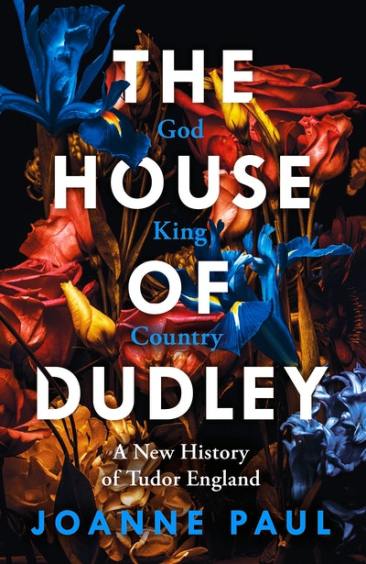
HISTORICAL BOOK REVIEW: ‘The House of Dudley: A New History of Tudor England’ by Joanne Paul

The shocking and extraordinary story of the most conniving, manipulative Tudor family you’ve never heard of—the dashing and daring House of Dudley.

Each Tudor monarch made their name with a Dudley by their side—or by crushing one beneath their feet.

The Dudleys thrived at the court of Henry VII, but were sacrificed to the popularity of Henry VIII. Rising to prominence in the reign of Edward VI, the Dudleys lost it all by advancing Jane Grey to the throne over Mary I. That was until the reign of Elizabeth I, when the family was once again at the center of power, and would do anything to remain there. . . .

With three generations of felled favorites, what was it that caused this family to keep rising so high and falling so low?

Here, for the first time, is the story of England’s Borgias, a noble house competing in a murderous game for the English throne. Witness cunning, adultery, and sheer audacity from history’s most brilliant, bold, and deceitful family.

Welcome to the House of Dudley.

¬¬

Do you love reading about the Tudors, but sometimes feel like every book is much the same (because you have read five hundred of them), even though they all promised a ‘fresh look?’ Here is a book that actually provides a new angle on the Tudors, without having to resort to flimsy claims or controversial ideas.

The Dudley family is known to all who enjoy the Tudor era, but rarely play a starring role, which is unusual given their immense depth and adventure. The names Howard, Seymour, Boleyn, or Grey always get a mention, but the Dudleys were always right there, in plain sight, and would one day make their move for ultimate power in England. Their tale is one of highs and catastrophic lows, and Dr Joanne Paul has wrapped this dramatic family into one precious book. From an author who has already created excellent academic works, this book was guaranteed to succeed from the outset.

The book starts with the funeral of Anne Windsor, Sir Edmund Dudley’s first wife, circa. 1503 after the birth of a daughter, Elizabeth. Edmund Dudley instantly remarried well to Elizabeth Grey, only to become a head shorter one year after King Henry VII died in 1509 when Henry VIII needed someone to blame for his father’s unpopular tax policies. Edmund Dudley left behind his wife Elizabeth and their three sons, John, Jerome, and Andrew. But the loss of Edmund Dudley did not hinder the family for long; John Dudley was reinstated as heir, and his mother Elizabeth married Arthur Plantagenet, the illegitimate son of King Henry IV.

While Jerome Dudley suffered a form of disability, and Andrew Dudley was destined for a life between the navy and financial admin, the eldest John Dudley was destined for a remarkable life, living close to the circles of power. The son of a traitor, Dudley had to be careful, forged quiet friendships and worked in respectful but not extraordinary roles under King Henry VIII, and was still alive to see the great king die in 1547, unlike so many other councillors. By the time young Edward VI took the throne, Dudley was to be the Duke of Warwick, close to the boy king on his regency council. As the Seymour brothers and their associated allies died or fell away, it was Dudley left close to the throne, later made the Duke of Northumberland and the head councillor beside the boy king.

John Dudley’s story could have ended there, until the dying Edward VI named Lady Jane Grey his heir. John had married one of his many sons, Guildford, to Lady Jane. Jane’s father, Henry Grey was John Dudley’s third cousin, and together, through their children, they could control the throne of England and repel Henry VIII’s Catholic daughter, Mary,

The realities of Queen Jane and the volatile aftermath are well-known, though not as often viewed through the lens of the Dudley family. This book takes you through the decades of turmoil of the Dudley family in a way that makes it feel more like a story than a set of historical facts and then goes past John Dudley to his son Robert, and the dramatic life he led with Amy Robsart and Queen Elizabeth I.

This book takes well-worn stories and shows them from an unfamiliar perspective you won’t get elsewhere. I personally have always preferred the people close to power rather than the rulers themselves, making the Dudleys (and Greys) a fantastic subject. Toss in the fact the hardback edition is absolutely gorgeous, and you have a book you will refer back to again and again. Perfect.

¬¬

This review was not given in return for a free book – buy books (or visit libraries) and make sure authors are fairly paid

HISTORICAL BOOK REVIEW: ‘The Library, A Fragile History’ by Arthur Der Weduwen and Andrew Pettegree

Famed across the known world, jealously guarded by private collectors, built up over centuries, destroyed in a single day, ornamented with gold leaf and frescoes or filled with bean bags and children’s drawings – the history of the library is rich, varied and stuffed full of incident.

In this, the first major history of its kind, Andrew Pettegree and Arthur der Weduwen explore the contested and dramatic history of the library, from the famous collections of the ancient world to the embattled public resources we cherish today. Along the way, they introduce us to the antiquarians and philanthropists who shaped the world’s great collections, trace the rise and fall of fashions and tastes, and reveal the high crimes and misdemeanours committed in pursuit of rare and valuable manuscripts.

¬¬

This book is one for all of us book nerds. The Library covers everything you could want to know about books in all their forms. The history of libraries is in-depth, patient, and genuinely interesting, as it not only tells us tales of books, it tells the story of those who owned books throughout history, whether those books were in a library, a single shelf, or just a box. As a result, the history of the book is somehow made human, as it shows from ancient times until now, and from rich to poor, books were the thing that people valued.

The book starts with a recreation of the library of Alexandria, to share the grandeur of the ancient site. A book alone could be lost to this one subject, but the book soon moves on through the creation of books, with the history of tablets, papyrus, leather, through to printed paper. Even while going through these practical elements of a physical book, The Library shows how and why decisions were made as people sought to protect their knowledge and value its physical state. The Library shows how books were considered valuable success markers for the wealthy, kept by even those who couldn’t read themselves. As libraries were often private collections, particularly Latin books, this book is able to tell the story of kings and queens, mighty rulers, and wealthy merchants in times past, it can tell us about who owns books today.

The library does stick to a European viewpoint of the history of books, though also shares eastern Mediterranean influences as well. Being Euro-centric, this also shows the catastrophic advance of colonialism, which also took books across the world. The Library is able to show us how this influenced shared knowledge, even if the physical books in question did not accurately cover the stories of the invaded and colonised nations. This book is one for those who really want to get down to the specific details of the history of books and libraries, a testament to millennia of book-loving.

You can read The Library, A Fragile History, and gain more understanding of why you love your own books today.

¬¬

This review was not given in return for a free book – buy books (or visit libraries) and make sure authors are fairly paid

THE PRIVATE LIFE OF THOMAS CROMWELL

Thomas Cromwell was King Henry VIII’s most faithful servant, the only man the king ever openly regretted executing. But Thomas Cromwell came to royal prominence late in life and had 45 years of family, friends and experiences behind him before catching Henry’s eye.

Born a common boy at a time of significant change in England in 1485, Cromwell grew up in a happy, close-knit family, before heading to Europe for dramatic adventures. Returning to England a decade later, Cromwell emerged with the skills of a lawyer and merchant, with the European language skills and connections to match. Marriage, children, friends, family and manor homes all furnished Cromwell’s life, a man happy and settled in London. But more beckoned for the Italian-Englishman, when a special friendship with Cardinal Thomas Wolsey grew, along with the attention of the king.

Tragic personal loss affected Cromwell, hidden behind the more-recorded professional accolades. But friendships remained throughout time, changes in allegiance and even religion. Men who had met the young Cromwell stuck close to him through the years, and Cromwell never forgot a single loyal friend. Cromwell’s desire to support his son saw Gregory become brother-in-law to the king himself, only for more tragedy to harm the ever-growing Cromwell family.

Far from the seemingly dour, black-clad, serious man, Cromwell lavished those around him with gifts, parties, extravagant games, entertainments, animals and outfits. But the glamour and beauty of Cromwell’s life would come to a sudden end, leaving a trail of devastated men and women, and an extraordinary manor home, Austin Friars, scattered to the wind.

Using a wide variety of primary material, this exciting biography weaves a new narrative on the indefatigable Thomas Cromwell, illustrating him more vividly than we’ve known him before.

AVAILABLE WORLDWIDE IN HARDBACK AND EBOOK FROM PEN & SWORD BOOKS 

ALSO AVAILABLE FROM

AMAZON US

AMAZON UK

THE NATIONAL ARCHIVES UK

BARNES AND NOBLE  

WATERSTONES

GOOGLE BOOKS

HENRY VIII’S CHILDREN: THE LEGITIMATE AND ILLEGITIMATE SONS AND DAUGHTERS OF THE TUDOR KING

Of the five Tudor monarchs, only one was ever born to rule. While much of King Henry VIII’s reign is centred on his reckless marriage choices, it was the foundations laid by Henry and Queen Katherine of Aragon that shaped the future of the crown. Among the suffering of five lost heirs, the royal couple placed all their hopes in the surviving Princess Mary. Her early life weaves a tale of promise, diplomacy, and pageantry never again seen in King Henry’s life, but a deep-rooted desire for a son, a legacy of his own scattered childhood, pushed Henry VIII to smother Mary’s chance to rule. An affair soon produced an unlikely heir in Henry Fitzroy, and while one child was pure royalty, the other illegitimate, the comparison of their childhoods would show a race to throne closer than many wished to admit.

King Henry’s cruelty saw his heirs’ fates pivot as wives came and went, and the birth Princess Elizabeth, saw long-term plans upended for short-term desires. With the death of one heir hidden from view, the birth of Prince Edward finally gave the realm an heir born to rule, but King Henry’s personal desires and paranoia left his heirs facing constant uncertainty for another decade until his death. Behind the narrative of Henry VIII’s wives, wars, reformation and ruthlessness, there were children, living lives of education among people who cared for them, surrounded by items in generous locations which symbolised their place in their father’s heart. They faced excitement, struggles, and isolation which would shape their own reigns. From the heights of a surviving princess destined and decreed to influence Europe, to illegitimate children scattered to the winds of fortune, the childhoods of Henry VIII’s heirs is one of ambition, destiny, heartache, and triumph.

ORDER HARDBACK AND EBOOK FROM PEN & SWORD 

ORDER AT AMAZON US

ORDER AT AMAZON UK

ORDER AT WATERSTONES

HISTORICAL BOOK REVIEW: “Do Let’s Have Another Drink: The Singular Wit and Double Measures of Queen Elizabeth The Queen Mother” by Gareth Russell

During her lifetime, the Queen Mother was as famous for her clever quips, pointed observations, and dry-as-a-martini delivery style as she was for being a beloved royal. Now, Do Let’s Have Another Drink recounts 101 (one for each year of her remarkable life) amusing and astonishing vignettes from across her long life, including her coming of age during World War I, the abdication of her brother-in-law and her unexpected ascendance to the throne, and her half-century of widowhood as her daughter reigned over the United Kingdom. Featuring new revelations and colorful anecdotes about the woman Cecil Beaton, the high society photographer, once summarised as “a marshmallow made on a welding machine,” Do Let’s Have Another Drink is a delightful celebration of one of the most consistently popular members of the royal family.

via amazon

__

Amidst the glut of royal biographies recently released or republished, “Do Let’s Have Another Drink: The Singular Wit and Double Measures of Queen Elizabeth The Queen Mother” by Gareth Russell has managed to create a book that could spawn a thousand copycats about other famous characters. You don’t need to be a royalist or a monarchist to enjoy this book, it is the perfect story for anyone interested in the history, culture, and traditions of the House of Windsor. I found it to be incredibly insightful, with relevant information on all that has happened within the family throughout The Queen Mother’s life. Anyone who reads it will not only feel like they know her better but will also have a renewed interest in this iconic family.

The format, a life told through 101 anecdotes in chronological order, it’s possible to learn so much about Queen Elizabeth. From a historical perspective, the book is full of great facts about her life and offers insight into her personality. This book shows all the wit, wisdom, and charm I would expect from a royal like the Queen Mother. Rather than being a standard biography heavy on detail, this book offers flashes of the queen’s remarkable life, those she cared for, those she loathed (notably Wallis Simpson, and in later years, Princess Diana), and how she treated those around her. The Queen Mother was not afraid of a drink, and that is immediately obvious throughout the book, and she would think nothing of overruling her guests when they didn’t want a refill.

Queen Elizabeth The Queen Mother’s life is well-known; her devotion to her husband, her angst at being thrust into the queenship she never expected, her love for her daughters, and her despair at the loss of her husband. This book is fast-paced, and many of the things we know of Elizabeth are quickly left behind, instead given a book showing her life in a more lighthearted way, flashes of her life around people who were treated to time in her company. While Elizabeth endured much in her impressive 101 years, Russell has (mostly) given us Elizabeth’s brighter moments.

Russell is an extraordinary author, and I would read anything he created, and this book is another to add to an essential collection. This book is a little walk through the past, showing a woman born during the rule of Queen Victoria, and living until after the turn of the millennium. An old-world woman living in a new world was always bound to create an interesting lifetime.

__

NB: This book is released as “Do Let’s Have Another Drink!: The Dry Wit and Fizzy Life of Queen Elizabeth the Queen Mother” in the United States.

This review was not given in return for a free book – buy books (or visit libraries) and make sure authors are fairly paid