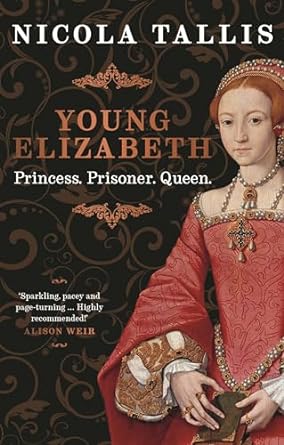
BOOK REVIEW: Young Elizabeth: Princess. Prisoner. Queen by Nicola Tallis

Elizabeth I is one of England’s most famous monarchs, whose story as the ‘Virgin Queen’ is well known. But queenship was by no means a certain path for Henry VIII’s younger daughter, who spent the majority of her early years as a girl with an uncertain future.

Before she was three years old Elizabeth had been both a princess and then a bastard following the brutal execution of her mother, Anne Boleyn. After losing several stepmothers and then her father, the teenage Elizabeth was confronted with the predatory attentions of Sir Thomas Seymour. The result was devastating, causing a heartbreaking rift with her beloved stepmother Katherine Parr.

Elizabeth was placed in further jeopardy when she was implicated in the Wyatt Rebellion of 1554 – a plot to topple her half-sister, Mary, from her throne. Imprisoned in the Tower of London where her mother had lost her life, under intense pressure and interrogation Elizabeth adamantly protested her innocence. Though she was eventually liberated, she spent the remainder of Mary’s reign under a dark cloud. On 17 November 1558, however, the uncertainty of Elizabeth’s future came to an end when she succeeded to the throne at the age of twenty-five.

When Elizabeth became queen, she had already endured more tumult than many monarchs experienced in a lifetime. This colourful and immensely detailed biography charts Elizabeth’s turbulent and unstable upbringing, exploring the dangers and tragedies that plagued her early life. Nicola Tallis draws on primary sources written by Elizabeth herself and her contemporaries, providing an extensive and thorough study of an exceptionally resilient youngster whose early life would shape the queen she later became. The heart racing story of Elizabeth’s youth as she steered her way through perilous waters towards England’s throne is one of the most sensational of its time.

Young Elizabeth is another excellent book by Nicola Tallis, which provides a compelling and detailed account of the formative period in the life of one of England’s most remarkable monarchs. The author offers a captivating exploration of Elizabeth’s upbringing, education, and startling early experiences, shedding light on the scandalous events and influences that shaped her into the iconic queen she would become.

The book begins by immersing readers in the world of Tudor England, setting the stage for understanding the complexities of Elizabeth’s early life. With meticulous attention to historical detail, the author paints a picture of the political, religious, and social dynamics of the time, providing essential context for understanding Elizabeth’s place within the Tudor dynasty.

Central to the book is the examination of Elizabeth’s childhood and adolescence. Tallis delves into her family background, her relationships with her parents, Henry VIII and Anne Boleyn, and the challenges she faced as a young princess navigating the uncertainties of the Tudor court without the guidance of a parent. Through careful analysis of contemporary sources and historical records, the author offers valuable insights into Elizabeth’s character, temperament, and early ambitions. I have always wondered about Catherine Parr’s decision-making in 1548; did she turn against Elizabeth, or did she look to save the girl? I won’t spoil anything, but the book helps a reader reach their own conclusions.

One of the most intriguing aspects of the book is its exploration of Elizabeth’s education and intellectual development. Young Elizabeth discusses the tutors and mentors who shaped Elizabeth’s mind, including scholars like Roger Ascham, who recognised her exceptional intelligence and thirst for knowledge. By examining Elizabeth’s studies in languages, history, and philosophy, the author reveals how her early education prepared her for the demands of leadership. But surely nothing could prepare Elizabeth for the betrays she suffered during her brother’s reign, and the mark of traitor placed upon her under her sister’s reign. By the time Elizabeth was crowned, she had already lived several lifetimes of difficulty.

Young Elizabeth provides a fascinating glimpse into the political and religious turmoil of Elizabeth’s youth. As always Nicola Tallis gives us a masterful and illuminating tale of the formative period in the life of one of England’s most legendary monarchs. The author’s engaging prose, combined with meticulous research and scholarly rigor, make this book an essential read for anyone interested in Tudor history, remarkable women, and the dynamics of power and politics in early modern Europe. It would be unwise to miss out on a book by Nicola Tallis.

Young Elizabeth is available everywhere, including Amazon
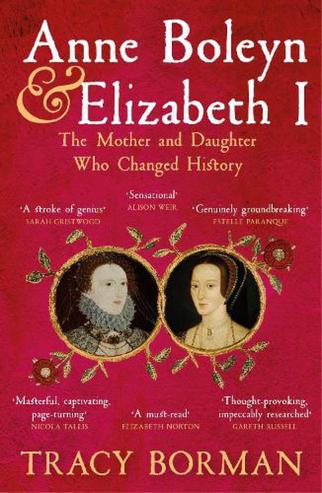
BOOK REVIEW: Anne Boleyn & Elizabeth I – The Mother and Daughter Who Changed History by Tracy Borman

Anne Boleyn may be best known for losing her head, but as Tudor expert Tracy Borman reveals in a book that recasts British history, her greatest legacy lies in the path-breaking reign of her daughter, ElizabethMuch of the fascination with Britain’s legendary Tudors centers around the dramas surrounding Henry VIII and his six wives and Elizabeth I’s rumored liaisons. Yet the most fascinating relationship in that historic era may well be that between the mother and daughter who, individually and collectively, changed the course of British history.

The future Queen Elizabeth was not yet three when her mother, Anne Boleyn, was beheaded on May 19, 1536, on Henry’s order, incensed that she had not given him a son and tired of her contentious nature. Elizabeth had been raised away from court, rarely even seeing Anne; and after her death, Henry tried in every way to erase Anne’s presence and memory. At that moment in history, few could have predicted that mother and daughter would each leave enduring, and interlocked, legacies. Yet as Tracy Borman reveals in this first-ever joint portrait, both women broke the mold for British queens and for women in general at the time. Anne was instrumental in reforming and reshaping forever Britain’s religious traditions, and her years of wielding power over a male-dominated court provided an inspiring role model for Elizabeth’s glittering, groundbreaking 45-year reign. Indeed, Borman shows how much Elizabeth–most visibly by refusing to ever marry, but in many other more subtle ways that defined her court–was influenced by her mother’s legacy.

In its originality, Anne Boleyn & Elizabeth I sheds new light on two of history’s most famous women–the private desires, hopes, and fears that lay behind their dazzling public personas, and the surprising influence each had on the other during and after their lifetimes. In the process, Tracy Borman reframes our understanding of the entire Tudor era.

In Anne Boleyn and Queen Elizabeth I: The Mother and Daughter Who Changed History, Tracy Borman offers a captivating exploration of the complex and enduring long-distance relationship between two of the most iconic figures in English history. This  work delves into the intertwined lives of Anne Boleyn, the ill-fated second wife of Henry VIII, and their daughter Queen Elizabeth I, one of England’s most celebrated monarchs.

Borman begins by providing an essential background on Anne Boleyn in her classic style of bringing out details others tend to miss, tracing Anne’s rise from a young courtier to Henry VIII’s queen consort. With meticulous attention to detail, the author paints a vivid portrait of Anne’s intelligence, charm, and ambition, as well as the political and religious forces that shaped her life. By exploring Anne’s influence on Henry and her role in the English Reformation, the author sets the stage for understanding her impact on her daughter, Elizabeth.

The heart of the book lies in the examination of the relationship between Anne Boleyn and Queen Elizabeth I, given they knew one another for less than three years. Borman delves into how Anne’s brief but tumultuous reign left a lasting imprint on her daughter, shaping her personality, her politics, and her approach to governance. Through meticulous analysis of historical records and contemporary accounts, the author uncovers how Elizabeth both emulated and distanced herself from her mother’s legacy.

One of the most fascinating aspects of the book is its exploration of Elizabeth’s upbringing and education. The author discusses how Elizabeth’s early years were marked by uncertainty and danger, as she navigated the treacherous political landscape of Tudor England. By examining the influence of Anne’s teachings and example on her daughter, the author offers valuable insights into Elizabeth’s development as a ruler and a woman.

Anne Boleyn and Queen Elizabeth I sheds light on the ways in which Elizabeth’s reign was shaped by her mother’s memory. Borman explores how Elizabeth used Anne’s legacy to her advantage, presenting herself as the rightful heir to the Tudor dynasty and emphasizing her connection to her mother’s royal lineage. Through careful analysis of Elizabeth’s speeches, portraits, and public persona, the author reveals how Anne’s ghost haunted and helped the Elizabethan court.

Anne Boleyn and Queen Elizabeth I is a captivating exploration of the enduring influence of Anne Boleyn on her daughter, Queen Elizabeth I. Borman’s engaging prose makes this book a must-read for anyone interested in Tudor history, the lives of remarkable women, or the dynamics of power and politics in early modern Europe. It is a pleasure to read about such powerful women, written by a masterful female author.

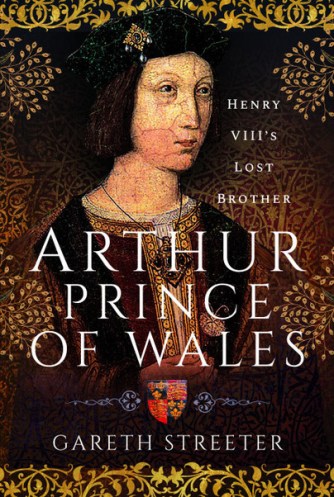
BOOK REVIEW: Arthur, Prince of Wales by Gareth Streeter

For too long, Arthur Tudor has been remembered only for what he never became. The boy who died prematurely and paved the way for the revolutionary reign of his younger brother, Henry VIII.
Yet, during his short life, Arthur was at the centre of one of the most tumultuous periods of England’s history. At the time of his birth, he represented his father’s hopes for a dynasty and England’s greatest chance of peace. As he grew, he witnessed feuds, survived rebellion and became the focal point of an international alliance.
From the threat of pretenders to West Country rebellions, the dramatic twists and turns of early Tudor England preoccupied Arthur’s thoughts. At a young age, he was dispatched to the Welsh border, becoming a figure head for a robust regional government. While never old enough to exercise full power in his dominion, he emerged as a figure of influence, beseeched by petitioners and consulted by courtiers. While the extent of his personal influence can only be guessed at, the sources that survive reveal a determined prince that came tantalisingly close to forging his future.
Finally, after years of negotiation, delay and frustration, the prince finally came face to face with his Spanish bride, Katharine of Aragon. The young couple had shared a destiny since the cradle. Securing the hand of this prestigious pride for his son had been a centre piece of Henry VII’s foreign policy. Yet, despite being 14 years in the making, the couple were to enjoy just five months together before Arthur succumbed to a mysterious illness.
Arthur’s death at the age of 15 was not just a personal tragedy for his parents. It changed the course of the future and deprived England of one of the most educated and cultivated princes in their history. Arthur would never wear the crown of England. But few Princes of Wales had been better prepared to rule.
‘Arthur, Prince of Wales: Henry VIII’s lost brother’ shows that Arthur Tudor was more than a prince who died. He was a boy that really lived.

In Arthur, Prince of Wales Gareth Streeter meticulously reconstructs the life and legacy of one of Tudor England’s questioned royal figures. What sort of king would Arthur have been? It is an interesting question, but the fifteen years Arthur spent alive are often forgotten in the wonders of what could have been. Drawing on historical sources and archival material, this book offers a portrait of Prince Arthur’s life, his childhood, upbringing,  and education, and his lasting impact on English history.

Streeter begins by tracing Arthur’s early years, from his birth in 1486 as the first son of King Henry VII and Elizabeth of York, to his education and training as the heir to the English throne. Through vivid storytelling and insightful analysis, the author explores the challenges and expectations that accompanied Arthur’s position as the future king, painting a picture of the royal court and the political intrigues of the time.

One of the book’s most compelling aspects is its exploration of Arthur’s marriage to Katharine of Aragon, a union intended to forge an alliance between England and Spain. Streeter delves into the complexities of their relationship, from their initial meeting to their wedding and wedding night(s), offering insights into the dynamics of their marriage and the role it played in shaping the course of English history.

Arthur, Prince of Wales provides a detailed account of Arthur’s brief reign as Prince of Wales, a period marked by hope and anticipation for the future of the Tudor dynasty. The author examines Arthur’s efforts to establish himself as a future ruler, as well as the challenges his father faced in asserting his authority in a kingdom still recovering from years of civil war and instability.

Tragically, Arthur’s reign was cut short by his untimely death in 1502, just months after his marriage to Katharine. The author explores the circumstances surrounding Arthur’s demise, including the various theories and rumours which have surrounded his death for centuries, and the realities his death brought to Katharine, his parents, and England.

Arthur, Prince of Wales is a patiently researched biography that offers a different perspective on one of England’s most intriguing royal figures. The narrative style makes this book a must-read for anyone interested in the Tudor era and the individuals who shaped it.

Available from Pen & Sword here

HISTORICAL BOOK REVIEW: ‘Woodsmoke and Sage: The Five Senses 1485-1603: How the Tudors Experienced the World’ by Amy Licence

Traditionally history is cerebral: what did they believe, what did they think, what did they know?

Woodsmoke and Sage is not a traditional book.

Using the five senses, historian Amy Licence presents a new perspective on the material culture of the past, exploring the Tudors’ relationship with the fabric of their existence, from the clothes on their backs, the roofs over their heads and the food on their tables, to the wider questions of how they interpreted and presented themselves, and what they believed about life, death and beyond. Take a journey back 500 years and experience the sixteenth century the way it was lived, through sight, sound, smell, taste and touch.

Purchase on Amazon here

~~

It can be easy to feel a bit jaded when it comes to books on the Tudor period. They are abundant, and those of us who write for the newer generation are constantly having to come up with new ways to present the subject and find new information and sources to change old narratives. While some authors succeed and some do not, Amy Licence has yet again produced a masterstroke of Tudor writing.

Woodsmoke and Sage is an entirely new concept in the world of Tudor books, a book broken down into five parts, covering the five senses and how they were experienced in Tudor England.  This new book shows what we have in common with the (predominately) 16th century, and what has changed remarkably.

Naturally, sight is first, covering the enormous variations of daily life, from the way cloth and clothing were enjoyed and used to convey status, to the way people wrote and painted portraits of one another. Buildings and possessions are well covered, along with the way people presented themselves in public. The second section, the section I was most interested in, covers smell, something often lost when reading or watching something about Tudor England, covering from the smells of perfumes to the opposite end of pleasantries.

Sound was a sense I confess I didn’t think too much of, but apart from music and the sound of daily life, there are new things to consider such as the way news was shared. Taste is a natural feast, covering food and drink, and a handy section of which foods were considered dangerous at the time. Finally, touch covers a great deal, covering healthcare, disease, and childbirth. Another incredibly important issue was agricultural life and the weather, and the section also covers sports in the period and the realities of poverty and violence. I don’t want to share any tidbits of Licence’s research, that’s for you to enjoy for yourselves.

Woodsmoke and Sage is a bible of helpful instructions for a reader or writer. It can be read as a story, or used as a reference guide for particular subjects when needed. You can hop between sections without losing any of the book’s momentum, whether you are looking for the feel of the king’s coat, the noises wives would hear while they worked, or what salad may poison you. I personally found lots of little details new to me, despite years of research. Thomas Cromwell had plenty of perfume bottles and had plenty of handwashing facilities available, but what he was using in the bottles and basins can only be speculated, and this book offers me likely suggestions for future use (thanks!).

Woodsmoke and Sage (or Living Like a Tudor: Woodsmoke and Sage: A Sensory Journey Through Tudor England in the USA) is both interesting and engaging regardless of a reader’s knowledge of the period. I can say without a doubt that this book is going to be extremely precious to me in years to come. 

no free book or money changed hands in return for this review

HISTORICAL BOOK REVIEW: ‘Henry VII and the Tudor Pretenders’ by Nathen Amin

On 22 August 1485, Henry Tudor emerged from the Battle of Bosworth victorious, his disparate army vanquishing the forces of Richard III. Yet, all was not well early in the Tudor reign. Despite later attempts to portray Henry VII as single-handedly uniting a war-torn England after three decades of conflict, the kingdom was anything but settled. Nor could it be after a tumultuous two-year period that had witnessed the untimely death of one king, the mysterious disappearance of another, and the brutal slaughter of a third on the battlefield. For the first time in one compelling and comprehensive account, Nathen Amin looks at the myriad of shadowy conspiracies and murky plots which sought to depose the Tudor usurper early in his reign, with particular emphasis on the three pretenders whose causes were fervently advanced by Yorkist dissidents—Lambert Simnel, Perkin Warbeck, and Edward, Earl of Warwick.

Purchase on Amazon here

~~

Henry VII gets grossly overlooked in favour of his son Henry VIII, which is surprising given how dramatic his role and life truly was. Henry’s life and rise to power are largely known through the well-worn stories of the War of the Roses and the tragic reign of poor Richard III, culminating in the Battle of Bosworth. Henry Tudor became king and the wars ended, or so many tales go.

There are a few good biographies of Henry VII out there, but Amin gives a new look and refreshing enthusiasm for a king who desperately deserves the attention. The 1480s and 1490s did not give Henry a moment’s peace, punctuated by the belief he was not a true king, and several other men deserved the crown. Henry should have been able to concentrate on putting England back together – he won the crown legitimately, married the daughter of Edward IV, followed quickly birth of a son born of a dual royal line. England should have been grateful for the level of peace Henry could provide.

Instead, the Battle of Stoke and the rise of Lambert Simnel, posing as either the ‘dead’ Edward V or Edward, Earl of Warwick came in 1487, a murky battle and claim to the throne, which Amin gives in full detail. No sooner than Simnel was subdued came the murmurings of Perkin Warbeck, claiming to be Richard, the ‘dead’ Duke of York. Children and young men posing as Henry’s beloved wife’s dead brothers would have placed significant strain on Henry and Elizabeth, who were doing their best to rule England. Throughout the constant rumours of planned coups, betrayals, even relatives and close confidants changing sides, Henry had to hold his country together, and the author shows him not to be the old miser commonly portrayed, but a man of kindness, loyalty, generosity and wisdom, all while seeing off years of undermining and instability.

The final main pretender is Edward, Earl of Warwick, who had been kept alive, like all pretenders, the sad son of the Duke of Clarence, who through no fault of his own needed to be kept under guard. Henry tried for years to be merciful, but if his Tudor dynasty was ever going to thrive, Henry needed to end the claims to his throne. Even after Henry’s grand coup of bringing Katherine of Aragon to England, the wannabes did not stop, and Henry worked harder than ever to secure England for his second son. The cobwebs of the old tales of Henry being a penny-pincher, a tax-collecting tyrant and generally miserable old man can be blown away by this book, showing the true Henry VII. Without spilling details that will create spoilers, Amin has gone to great lengths to find Henry’s true nature among the endless barrage of difficulties he faced. How Henry’s wife-collecting son gets more attention, I’ve never really understood.

This book is truly wonderful, well-planned and constructed, a real labour of love and determination that is a gift to readers.

no free book or money changed hands in return for this review