
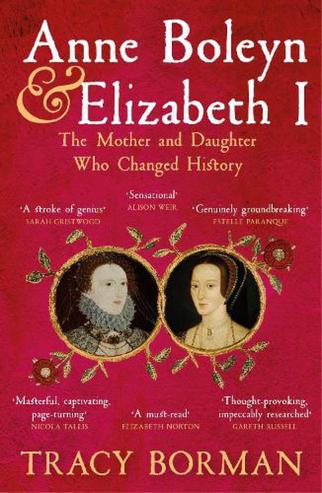
Anne Boleyn may be best known for losing her head, but as Tudor expert Tracy Borman reveals in a book that recasts British history, her greatest legacy lies in the path-breaking reign of her daughter, ElizabethMuch of the fascination with Britain’s legendary Tudors centers around the dramas surrounding Henry VIII and his six wives and Elizabeth I’s rumored liaisons. Yet the most fascinating relationship in that historic era may well be that between the mother and daughter who, individually and collectively, changed the course of British history.
The future Queen Elizabeth was not yet three when her mother, Anne Boleyn, was beheaded on May 19, 1536, on Henry’s order, incensed that she had not given him a son and tired of her contentious nature. Elizabeth had been raised away from court, rarely even seeing Anne; and after her death, Henry tried in every way to erase Anne’s presence and memory. At that moment in history, few could have predicted that mother and daughter would each leave enduring, and interlocked, legacies. Yet as Tracy Borman reveals in this first-ever joint portrait, both women broke the mold for British queens and for women in general at the time. Anne was instrumental in reforming and reshaping forever Britain’s religious traditions, and her years of wielding power over a male-dominated court provided an inspiring role model for Elizabeth’s glittering, groundbreaking 45-year reign. Indeed, Borman shows how much Elizabeth–most visibly by refusing to ever marry, but in many other more subtle ways that defined her court–was influenced by her mother’s legacy.
In its originality, Anne Boleyn & Elizabeth I sheds new light on two of history’s most famous women–the private desires, hopes, and fears that lay behind their dazzling public personas, and the surprising influence each had on the other during and after their lifetimes. In the process, Tracy Borman reframes our understanding of the entire Tudor era.
—
In Anne Boleyn and Queen Elizabeth I: The Mother and Daughter Who Changed History, Tracy Borman offers a captivating exploration of the complex and enduring long-distance relationship between two of the most iconic figures in English history. This work delves into the intertwined lives of Anne Boleyn, the ill-fated second wife of Henry VIII, and their daughter Queen Elizabeth I, one of England’s most celebrated monarchs.
Borman begins by providing an essential background on Anne Boleyn in her classic style of bringing out details others tend to miss, tracing Anne’s rise from a young courtier to Henry VIII’s queen consort. With meticulous attention to detail, the author paints a vivid portrait of Anne’s intelligence, charm, and ambition, as well as the political and religious forces that shaped her life. By exploring Anne’s influence on Henry and her role in the English Reformation, the author sets the stage for understanding her impact on her daughter, Elizabeth.
The heart of the book lies in the examination of the relationship between Anne Boleyn and Queen Elizabeth I, given they knew one another for less than three years. Borman delves into how Anne’s brief but tumultuous reign left a lasting imprint on her daughter, shaping her personality, her politics, and her approach to governance. Through meticulous analysis of historical records and contemporary accounts, the author uncovers how Elizabeth both emulated and distanced herself from her mother’s legacy.
One of the most fascinating aspects of the book is its exploration of Elizabeth’s upbringing and education. The author discusses how Elizabeth’s early years were marked by uncertainty and danger, as she navigated the treacherous political landscape of Tudor England. By examining the influence of Anne’s teachings and example on her daughter, the author offers valuable insights into Elizabeth’s development as a ruler and a woman.
Anne Boleyn and Queen Elizabeth I sheds light on the ways in which Elizabeth’s reign was shaped by her mother’s memory. Borman explores how Elizabeth used Anne’s legacy to her advantage, presenting herself as the rightful heir to the Tudor dynasty and emphasizing her connection to her mother’s royal lineage. Through careful analysis of Elizabeth’s speeches, portraits, and public persona, the author reveals how Anne’s ghost haunted and helped the Elizabethan court.
Anne Boleyn and Queen Elizabeth I is a captivating exploration of the enduring influence of Anne Boleyn on her daughter, Queen Elizabeth I. Borman’s engaging prose makes this book a must-read for anyone interested in Tudor history, the lives of remarkable women, or the dynamics of power and politics in early modern Europe. It is a pleasure to read about such powerful women, written by a masterful female author.

 CAROLINE ANGUS