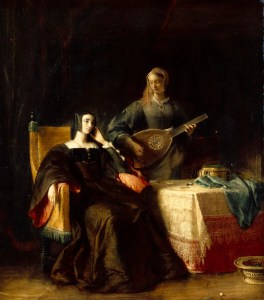
Katherine of Aragon, Charles Robert Leslie, 1826, Royal Academy of Arts 03/1361
Cromwell wrote to King Henry as the king was away from London, to tell him of the progress with sending his warrants to Queen Katharine as Cromwell was preparing to put his Queen Katharine Act through parliament, settling her income and lands from her marriages. Cromwell also mentions concerns of the ‘traitorous’ Observant Friars, and their involvement with Elizabeth Barton, the Holy Maid of Kent, who Cromwell needed to interrogate, and money owed to Henry from the Emperor.
MASTER CROMWELL TO KING HENRY VIII, 29 October 1533 (SP 1/80 f. 50)
It shall please your royal majesty to be informed how that returning homewards, one of my lord Chancellor’s servants met with me and delivered me your warrants, signed with the hand of the princess dowager (Queen Katharine), which I do send to your Grace herein enclosed. What your pleasure shall be to have done I shall right gladly accomplish.
I have also since my return to London spoken with Friar Lawrence, who has since his return to London heard several things touching the holy maid which he will declare to your highness and no other, and he showed me also that there be two strange friars of the order of Observants lately returned into this realm, which two friars have explored here. For all such books, sentences and determinations as has passed touching your highness, Matrimony, which they intend with other privy practices to convey with them, to Friar Petow who as I am credibly informed sent them into your realm. The said two friars as I am ascertained have brought with them privy letters to diverse people and now have gone to the said princess dowager. In my poor opinion it shall be right well done that they might be sent for by some trusty person, howbeit would be best that they first should be suffered to speak with her and such others of hers as would peradventure deliver to them anything, whereby their further practice might be perceived and so their cankered intents might be thereby deciphered. I am also informed that there is a merchant of London which does practice with them in this premise. I shall go very near to have knowledge therein. If it be true, he is worthy to suffer to make others beware in time if he is of good substance. I will this day go about to know the truth of these things would be met with all in time and the sooner the better. I trust your highness will, by this bearer, advertise me in writing what shall be your pleasure touching the said friars, as also touching of the said dowager’s warrants.
I have also sent to your Grace one acquittance to be assigned for the 24 thousand crowns due to your highness for the residue of the Emperor’s diet and also a warrant to your Chancellor for the sealing of the same warrant and acquittance. It may please your majesty to assign and to send the same by this bearer to Robert Fowler, who may be dispatched. The rest of the acquittances for your ordinary pension and sale been already signed and sealed. And this, the holy trinity to whom I shall continually pray to preserve your highness in long life and most prosperous health and send the same the victory with honour over all your enemies.
Portrait of Mary of Guise. c. 1537, later Queen of Scotland. by Corneille de Lyon. National Galleries Scotland, PG 1558
Cromwell informed Gardiner and Howard that Queen Jane had died, and that already they need to seek Princess Margaret of France (aged only 14), and Mary de Guise as possible new brides. Cromwell then rants to Gardiner about how giving Esher Palace to the king is not a suitable gift and then argues that Gardiner annoyed him by telling lies behind his back. Cromwell was still at Westminster, and this letter is a draft in Wriothesley’s hand.
LORD CROMWELL TO LORD EDMUND HOWARD AND BISHOP STEPHEN GARDINER, 27 October 1537 (SP viii, 368)
My very good lords, after most hearty commendations, howsoever, our affections would bear things that be adverse and contrary to our desires. Yet because (illegible) know that your wisdoms (illegible) preface reason and (illegible) that which every man to whom God has (illegible) will thankfully embrace that is his will and pleasure. I shall in few words comprehend that God has sent to us, that is with our joy, a notable displeasure and sorrow, if it may be called sorrow or displeasure, that he will permit and suffer. Our prince, our lord, be thanked is in good health and sucks like a child of his puissance, which you, my lord William can declare. Our masters, through the fault of them, that were about her, which suffered her to take great cold and to eat things that her fantasies in sickness called for, is departed to God. The king’s Majesty’s pleasure is that you shall advertise the French king of this, her Grace’s departure. Whom we be all bound to remember and pray for, having left to so goodly a pledge, as is our young master.
And forasmuch as though his Majesty is not anything disposed to marry again, albeit his highness, God be thanked, takes this chance as a man, that by reason with forteovercomes his affection, may take such an extreme adventure. Yet, as sundry of his Grace’s council here have thought it mete for us to be most humble suiters to his Majesty to consider the state of his realm, and to enter eftsoones (again) into another matrimony in place for his highness’ satisfaction convenient. So his tender zeal to us, his subjects, has already so much overcome his Grace’s disposition and framed his mind both to be indifferent to the thing, and to the election of any person from any part, that with deliberation shall be thought mete for him, that as we live in hope that his Grace will again couple himself to our comforts, so considering what parsonages in Christendom be mete for him.
Among the rest there be two in France that may be thought on, the one is the French king’s daughter, which as it is said is not the meetest. The other is Madame de Longueville (Mary de Guise), whom they say the king of Scots does desire, of whose conditions and qualities in every point his Majesty desires you both, with all your dexterity and good means, to enquire and likewise in what point and terms the said king of Scots stands towards either of them, which his highness is so desirous to know.
His Grace’s desire therein, to be nevertheless in any ways kept secret to yourselves, that his pleasure is that you, my lord William, shall not return until you may learn both how the king of Scots stands in his suit, and what the conditions and qualities of both persons be, which known as you may, by any possible means, attain to the knowledge of it, so as at the return of you, my lord William, you may well declare it and his Grace’s will that you, my lord William, shall return according to your instructions. In the searching out of which matter, his Majesty desires you both to exhibit that circumspection and diligence that may answer to his Grace’s expectation conceived of you.
Now, my lord of Winchester, yesternight arrived here your letters sent to the king’s Majesty by your servant Massey, and with the same your letters also to me, both which letters the king’s Majesty has thoroughly perused. And first, for your vigilance declared in the same, touching the investigation of the occurrences there, and specially in what terms the Emperor and the French king stand towards the peace his Grace gives to you hearty thanks, and the semblable for your gift to him of Esher, albeit the same be given with nothing but sorrow. For the assurance whereof, his highness will shortly send to you such deed or deeds to be signed with your hand, as by his learned Council shall be devised for that purpose.
Nevertheless, my lord, in your letters touching that matter of Esher, you do both me and others wrong to be angry with us without cause, and both to impute lack of memory where there was in that thing no such fault, and to think that things have been otherwise set forth towards you than indeed they have been. I am sorry, my lord to see you so contentious and to have so little care of your friends. Of what sort I have been towards you, I do refer myself to the king’s Majesty and to sundry others of his council that have known the proceedings here. And yet to be plain with you, when I wrote that the king’s Majesty took pleasure in your house and would make a chase about it, which should make it no house for your store, me thought it required at least such an answer as might have declared that you had been glad of it, in which case you should not have needed to have called to remembrance the lesson of Poseidon’s pain of doing nothing, for that is a place where there is grief.
As touching the promises you speak of, the one you say was not absolute because in the same deeds concurred not with the words, and the other is not performed for that your shamefastness let you to ask a horse before promised. Whereupon, you conclude that for a horse or anything else, wherein I may do you pleasure, you will thank me for the deed when it is done, and not for the promise or goodwill in the mean, which you do of likelihood esteem as you did my advice that is so gently returned to me, to be kept for my own store. First, I promised you no more than was in me, that was all that I could do in your suit for you, with a declaration of the hope I had to have obtained, and yet I think this alone ought neither to be so much despised that you should so earnestly refuse it hereafter, nor to be wrested to that which is not in me, that is that I should be able to do what I would. Whatsoever your opinion be of me, I marvel that you, knowing the wisdom of our Master, can think any man able to obtain things so at his hand.
Second, touching the horse, if I promised you one, I gave you one, and if I gave you one as I did according to my promise, I marvel your good memory will forget it. But to make an end of this matter, I will not be so contentious as to enter any new matters with you howsoever you use me or repute me. I shall be sorry that you can make no more of friendship, and in all things do towards you without respect as becomes me to do towards that person whom my Master puts in trust.
As concerning the abbot of Arbroath, being his master, the king’s highness’ nephew and in league with him, his Grace you should use him indifferently, like a friend as reason requires. And as for the instructions which you desire to have sent you for answer to be made to the French king. The king’s highness thinks that until his Majesty may know the covenants, he cannot grow to any resolution touching the same. And therefore, his pleasure is that, in such order as your wisdom shall think expedient, you shall practice to know the certain articles agreed on or to be agreed on if there be any such, and to certify his Majesty of the same, in the meantime sticking upon the point of his promise and bond to win his Majesty with him as a principal contrahent.
Finally I shall with speed take order for money to be delivered to your servant Peter Lark as in my former letters I wrote I would, and as for the rest of your suits the king’s Majesty will make you answer by his next letters
The Death of Jane Seymour by Eugène Devéria, 1847, Valence Museum
The same morning as the birth of Prince Edward at Hampton Court Palace, Cromwell’s hastily wrote to Wyatt to tell him of the good news, addressing the letter in French. Cromwell would have been thrilled with the news; a son and heir was finally secure for the king and his realm, and it would make his own son Gregory an uncle to the future king of England.
LORD CROMWELL TO SIR THOMAS WYATT, 12 October 1537 (Harl. MSS. 282, f. 211)
A mon tresbon et asseure amy Monsieur Wyat onseille et ambassade du Roye Dangleterre esidet en La Court Lemper.
To my very good and assured friend, Monsieur Wyatt, advisor and ambassador of the King of England, resident in the court of the Emperor. After my right hearty commendations, this shall be to advertise you that since the departure of Rougecroix, who was dispatched to you in post on Wednesday last here, be no news occurring but very good news which for surety I have received this morning, that it has pleased almighty God of his goodness to send to the Queen’s Grace deliverance of a goodly prince to the great comfort, rejoice and consolation of the King’s Majesty and of all us his most humble loving and obedient subjects. Whereof, we have very great cause to thank our most benign and gracious creator, who after so long expectation has exalted our prayers and desires. I have written this letter having the opportunity of this present courier to the intent that you shall advertise the Emperor thereof. I think that with convenient diligence the King’s highness will write to him and to other prince of the same to make them participant of his great, joy and comfort. Whereof, I shall move him tomorrow at my next being with his Grace. Thus, fare you heartily well From Saint James beside Westminster this 12th of October the 28th of his most prosperous reign.
Wolsey arrives to die at Leicestershire by Charles West Cope, 1847. RCIN 403879
Cromwell wrote to Thomas Wolsey for the last time, with Wolsey only two weeks away from his next arrest. If Cromwell wrote to Wolsey again before Wolsey’s death on 29 November, or if Wolsey wrote back, nothing has survived. This letter itself has barely survived, a mutilated partial letter, which shows no sign of concern. Cromwell writes ‘if anything shall fall,’ suggesting that something may soon go well for the cardinal, and Cromwell talks of several people he wishes the cardinal to favour should he prove successful, including the’ Cambridge scholars’ Gregory Cromwell, Christopher Wellyfed and Nicholas Sadler. After the last few letters, with Cromwell’s suggestions to Wolsey to be humble to avoid King Henry’s wrath, this letter is far calmer. If this was the last correspondence between these two friends, it is benign after all they have been through. After Wolsey’s popularity in the North, along with his arrogant behaviour, and writing to the Pope and Queen Katharine, neither Cromwell nor anyone could save the cardinal from King Henry. But these surviving notes show that Cromwell had no part in Wolsey’s eventual treasonous behaviour, rather, that he urged Wolsey to stop his actions to reclaim his titles and money. That could be why these letters remain in the archive, as a letter dated December 1530 by Eustace Chapuys describes Cromwell becoming an official councillor to the King, and Cromwell would have needed to clear his name.[1] These surviving letters would have proved Cromwell’s innocence.
CROMWELL TO THOMAS WOLSEY, 21 October 1530 (Jesus Coll. in Bibl. Bodl. Oxon. c.74, pp. 262 ff)
. . . . even three months in Chancery, howbeit your Grace shall be so provided for that you shall be out of all doubts, for all the King’s officers in the main season…
… I most humbly beseech your Grace to be a good lord to my poor kinsman Doctor Carbott and let him have some little office under your Grace. I doubt not he be somewhat simple in appearance, yet he shall discharge himself if you put him in a place of trust and a little authority. I beseech your Grace also to be a good lord to your servant Nicholas Gifford when anything shall happen to fall which may do him good, remember him for my sake. Your Grace shall find him, in my opinion, though he be young and somewhat wild youth, disposed both to truth honest and hardiness, and he is one that will love you with all his heart…
…If anything falls, I beseech your Grace to remember my scholars in Cambridge and both they and I shall pray to our lord Jesus Christ to preserve you in long life good health with increase of honour…
…The Emperor will be at Cologne in the Feast of… without fail…
…the Parliament is prorogued until the 6th day of January. The prelates shall not appear in the premunire. There is another way devised in place thereof as your grace shall further know.
The Princes of Germany will not agree with the Emperor…
…I beseech the Holy Trinity preserve your Grace . . . in quietness and contention. I beseech your . . . for this letter . . . Written for lack of . . . haste, the xxi of October
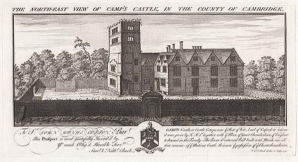
The North-East View of Camp’s Castle, Cambridge, by S & N Buck 1730.
Cromwell wrote to Anne Howard, Dowager Countess of Oxford (sister to the Duke of Norfolk) about her property at Castle Camps. Unlucky Anne Howard married the heavy-drinking John de Vere, Earl of Oxford, when she was 11, he 12, as her father owned his wardship, though the pair were not a couple as such until 1520. The marriage was a nightmare, and safeguards were put in place to control the ‘incompetent wastrel’ John had become, though luckily he died in 1526. Lady Anne had no children, but still had a claim Castle Camps, the Oxford estate granted by William the Conqueror, but as soon as her husband was dead, the new Earl of Oxford and his men were constantly breaking in, stealing, killing her deer, and generally being an endless, entitled pain. Cromwell had helped out Lade Anne a number of times, including letting her stay at Austin Friars. In this letter, Lady Anne had removed Mr Tirrell from his role of bailiff around Castle Camps and its parks, which he was resisting, and Cromwell wrote to Lady Anne, telling her she had to obey the King and restore Mr Tirrell. Lady Anne persevered, and lived until 1559 without a husband to bother her.
SECRETARY CROMWELL TO THE COUNTESS OF OXFORD, 30 SEPTEMBER 1535 (LP ix no 485i)
To the right honourable and my good lady my Lady Anne Countess of Oxford by this given.
In my most hearty manner, I commend me to your good ladyship. And whereas there has of long time depended between you and this bearer Master Tirrell certain controversies, as well concerning his claim to the park and Bailiwick of Camps, as a certain copy hold, which he bought in the same town, from all the which you have expulsed him, I shall most heartily desire and pray you at the especial contemplation hereof, to restore him again to the same. Which request I make not only to you because I think you have, upon displeasures conceived against him, perchance in some part by the misgivings of himself towards you, done to him, in his expulsion from the same park, Bailiwick and copy hold and your detinue (detention) thereof all together wrong and injury. But because it should be dishonourable to you, to have the same in open Court of Audience tried against you, and likewise displeasant to be, that way disappointed of your will and pleasure, which as I now friendly and frankly write to you, because that I would be glad, you should without constraint do as shall appertains to your honour, and justice. So, I am enforced to advertise to you, as your poor friend, that the king’s highness, like a prince of honour, is minded to have justice proceed without respect in that cause. Eftsoones (again) therefore, requiring your good ladyship, the rather for my sake, without any extremity to be good lady to him, who I dare affirm will be glad to do to you during his life that service and pleasure that shall lie in his little power. As knows God, who sends your good ladyship long life and fare you well. From Winchester the last day of September.



 CAROLINE ANGUS