SPAIN BOOK REVIEW: ‘The Spanish Civil War: A Very Short Introduction’ by Helen Graham

Amid the many catastrophes of the twentieth century, the Spanish Civil War continues to exert a particular fascination among history buffs and the lay-reader alike. This Very Short Introduction integrates the political, social and cultural history of the Spanish Civil War. It sets out the domestic and international context of the war for a general readership. In addition to tracing the course of war, the book locates the war’s origins in the cumulative social and cultural anxieties provoked by a process of rapid, uneven and accelerating modernism taking place all over Europe. This shared context is key to the continued sense of the war’s importance. The book also examines the myriad of political polemics to which the war has given rise, as well as all of the latest historical debates. It assesses the impact of the war on Spain’s transition to democracy and on the country’s contemporary political culture.

Cover and blurb via Amazon

~~

The Oxford University Press has a series of short introductions to a vast array of subjects, and the Spanish Civil War version has been put together by Helen Graham, a professor at Royal Halloway, University of London. Putting together a short book on a massive subject would be no easy task. But when Paul Preston hails a book as ‘far and away the best short introduction to the Spanish Civil War’, the praise doesn’t get any higher. If a reader wished to start learning about the war, reaching for a hefty Preston, Thomas, or Beevor tome could be daunting, and the subject can drive even the most knowledgeable person to distraction.

A Very Short Introduction is cut into seven sections. The book lays out the foundation in a short slice, no easy task, and dedicates a chapter to the early days of the war, explaining the reality of executions on both sides of the conflict and the vigilante-style operations Spain was running in the quest for power and freedom. The book manages to cover Franco’s rise to prominence through a combination of will and luck, as well as how Spain was won through the help of Hitler and Mussolini. With all these aspects, and the huge array of groups pushing their own agendas, the war is impossible to simplify, yet the book gives the initial details without overwhelming readers. A Very Short Introduction lays out the people, the major events, the reality of Spain at the time, everything needed to help a newbie understand why Spain collapsed the way it did in 1936.

This book is written in a simple style, without a strong voice but rather an academic view of the facts. This book has drawn criticism, especially from being marked as biased (which I dared to read), and, 1 ) being unbiased about a Spanish Civil War is nigh impossible, and 2 ) those decrying the book as biased and rabidly left-wing seem to be free and easy with the facts themselves. The book may not jump up and down with a passion, and that is not its purpose; it is a clear and simplified version a horrendously difficult subject, and perfect for its initial goal. A Very Short Introduction was promised and delivered.

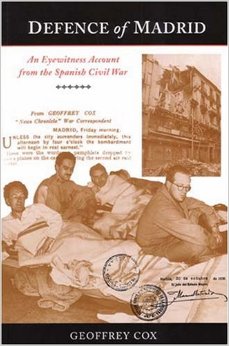
SPAIN BOOK REVIEW: ‘Defence of Madrid’ by Geoffrey Cox

COX

Goodies and baddies take some sorting out in this tale of the siege of Madrid by Franco’s right-wing forces supported by the Nazis and the fascist regime of Mussolini (the ‘rebels’), against the civilian population and its government representatives, just elected, who happened to be left-wing. Once sorted, Cox’s account of the city under attack, in one of the twentieth century’s first urban wars, has all too many echoes today. This new edition, with an introduction and selection of historical photographs, as well as samples of Cox’s journalism from the front, will confirm its position as one of the classics of twentieth-century reportage. Foreword  by Paul Preston, introduction by Michael O’Shaugnessy.

Cover and blurb for 70th anniversary edition from Amazon

~~

Geoffrey Cox’s Defence of Madrid (1937, republished in 2006) is the New Zealander’s eyewitness account of his time in Madrid from October to December 1936, during the siege of the city. In this brief six-week stint, Cox managed to see the fighting in Casa del Campo, the battles at the university and the bombing of everyday civilians.

Born in New Zealand’s South Island in 1910, Cox moved to study at Oxford in 1932 after a tour through Europe. With Europe under dramatic change in this time, he studied the political state of the continent, including spending time in a Nazi youth camp. Soon, journalism took over his desire for an academic life. In 1936, the News Chronicle had their Madrid-based correspondent taken hostage by Franco’s rebels, and a replacement was needed – Geoffrey Cox had the opportunity no one else wanted.

Defence of Madrid is a stark and honest account of Madrid during those early months of the war as Franco’s forces marched unabated through Spain. Cox landed in Madrid prepared for the rebel’s onslaught, only to land in a city in wait, a city far more complex than imagined, given the social and political state. Cox started writing down his account as soon as he arrived, every sight and sound recorded. Almost immediately, his account was being broadcast, as one of just two British correspondents holed up in the city. Cox soon became immersed in the air of Madrid and was the first writer of explain to the world what it felt like to be part of the war, and what everyday people were feeling and experiencing. The combination of the turmoil and collective desires to defend Madrid were published by Cox, who quickly became recognised as a good judge of character. While in Spain for just six weeks, Cox managed to cover major events before any other – covering the assault on the university and Casa del Campo as the Republicans fought back Franco’s army, honest accounts of the aerial bombings and covered the arrival of foreign volunteers in Spain to help the cause.

Defence of Madrid is the first in a long line of books by Cox, who went on to cover World War II and much more. The book is written with total honesty, a lack of bias, seen through eyes destined to tell the truth. Any author would be proud to be able to produce such work. New Zealanders participated in all aspects of the Spanish Civil War, most totally unrecognised. Geoffrey Cox should not ever be one of these.

SPAIN BOOK REVIEW: ‘Franco: Biography of the Myth’ by Antonio Cazorla Sánchez

Antonio Cazorla Sanchez

General Francisco Franco, also called the Caudillo, was the dictator of Spain from 1939 until his death in 1975. His life has been examined in many previous biographies. However, most of these have been traditional, linear biographies that focus on Franco’s military and political careers, neglecting the significance of who exactly Franco was for the millions of Spaniards over whom he ruled for almost forty years.

In this new biography Antonio Cazorla Sánchez looks at Franco from a fresh perspective, emphasizing the cultural and social over the political. Cazorla Sánchez’s Franco uses previously unknown archival sources to analyse how the dictator was portrayed by the propaganda machine, how the opposition tried to undermine his prestige, and what kind of opinions, rumours and myths people formed of him, and how all these changed over time. The author argues that the collective construction of Franco’s image emerged from a context of material needs, the political traumas caused by the Spanish Civil War (1936-1939), the complex cultural workings of a society in distress, political manipulation, and the lack of any meaningful public debate. Cazorla Sánchez’s Franco is a study of Franco’s life as experienced and understood by ordinary people; by those who loved or admired him, by those who hated or disliked him, and more generally, by those who had no option but to accommodate their existence to his rule.

The book has a significance that goes well beyond Spain, as Cazorla Sánchez explores the all-too-common experience of what it is like to live under the deep shadow cast by an always officially praised, ever-present, and long-lasting dictator.

Cover art and blurb from amazon

~~

I saw Franco: Biography of a Myth on the shelf and grabbed it while collecting other Franco books. Reading the little blurb on the back cover which states the book is part of a series of ‘engaging, readable and academically credible biographies’, I thought it would be worth a read. Then I read the chapters headings – Military Hero, Saviour of Spain, Man of Peace, Moderate Ruler, Bestower of Prosperity…. and I wondered what I had stumble onto. No one, other than those, let’s say, fanatical about Franco would use any of the terms to describe a man who killed and controlled with enjoyment. It was going to be hard to give a decent review after reading just the contents pages.

Biography of a Myth starts off with a an introduction, an overview of the man himself, and facts and perceptions of his rule. An excerpt from the book of Luis Bolin, Spain’s once-tourism minister, shows how opinion of Franco was perceived by those who believed in him – His ambition was to serve. All thoughts were for the people. He wished to improve the lot of the working man and the position of the middle classes, both of which had so many times been deceived by Republican promises…. This about a man who condoned the swift punishment of said people in the south of Spain, in an example detailed just one page earlier. This is a book written not from simply the facts, but the facts as they were handed down to the people.

The first chapter tells of Franco’s time in the army, not just as a man good at what he did, but as a man of opportunistic timing. The chapter talks of right up until the day civil war began, with Franco’s ‘crude opportunism’ and through a series of accidents, how his name would quickly become feared, when it could have easily been another man leading the charge in war. The second chapter tells of the civil war from the Nationalists point to view as Franco swept through the country, and how the propaganda machine was already at work. Franco’s name was kept out of stories where possible, instead focusing on others, or local heroes in publications. Once he was proclaimed Head of the Spanish State and Commander and Chief of the Army did the news stories change, to anoint him the illustrious Caudillo General Franco. People could only believe what they heard and all that was carefully planned. Each story on his victories was selected and mistakes neatly erased. History was already being written by those who decided what the future would believe. The book also touches on the sanitised versions of events printed in international news.

The book goes on to talk of the delicate peace created after the civil war. With starvation of the traumatised public, and corruption and ineptitude, these things didn’t hurt Franco, as underlings took the blame. Publications in ensuing years, including a 1947 article which claimed Franco had too been a victim of the Nazis, helped to preserve Franco’s prestige. The years described in chapter four, through the fifties and sixties, describes Franco as ‘a walking skeleton that refused to go into the closet of European history.’ Franco needed American and European opinion to sway in his favour, and propaganda was written to suit. As a result, through trade and negotiations, Spain was allowed to flourish, all based on what people knew of the man himself. The chapter titled ‘Moderate Ruler’ may ring true if you consider Franco a man with absolute power, and no idea what to do with it.

Chapter five talks of the calmer years under Franco’s reign as the country began to prosper, and his belief he had a successor in the form of Prince Juan Carlos, who would carry on his vision after his death. But with factions starting to speak out in the mid to late sixties, such as ETA, Franco’s grip on the nation, and the opinion of the people, started to wane.  Only with his death in 1975 did opinion change as new stories would emerge, giving a more realistic picture of Franco and his reign, as freedom to discuss the past opened wide. Perceptions are also opened, with details of publications made since his death, of who wrote what and why, and what perceptions are like today, based on propaganda.

When I started reading this book, I thought I was going to get a mouthful of Franco love, but Biography of a Myth is not that straight-forward. It swings between those who loved and hated Franco, though does brush over atrocities at an astounding rate (perhaps because it could be a subject for another book). The information on Franco is not new; anyone who knows anything of Franco’s history will find themselves in common territory. This book does spear off in a new direction, away from the likes of Paul Preston’s magnificent biography, but would make a good read for anyone looking for a different point of view. This book doesn’t talk about Franco from one side or the other, it talks of Franco through perceptions during his reign. In the end, the book tells us something we all know – history is the opinion of the winners.

SPAIN BOOK REVIEW: ‘1984 and the Spanish Civil War’ by Paul Read

1984

In 1937, George Orwell spent six months in Catalonia, witnessing the rise and fall of the popular revolution on the streets of Barcelona and Catalonia. Alone amongst his contemporaries, Orwell understood what the success or failure of that Spanish Revolution would mean for the rest of the world. The lessons he learnt, were explained in the three books he wrote upon his return.

1984 And The Spanish Civil War – the 2nd book in the ‘Forgotten Spain Series’ – tells the story of Orwell’s relationship with Spain and the legacy he has left us:

*How far was ‘1984’ and ‘Animal Farm’ the inevitable conclusion to all Orwell had witnessed in those brief months he spent in Spain?
*Why was his work so unanimously rejected by his contemporaries in England?
*Was the revolution Orwell witnessed in Barcelona crushed forever by the end of the war, or did it slide into hibernation, awaiting the present conditions for revival?

If you want to understand Spain today, you need to understand Orwell. If you wish to understand the work of Orwell, you need to understand the history of Spain in 1937.

~~

1984 and the Spanish Civil War is the second book in Paul Read’s Forgotten Stories from Spain series. George Orwell, now synonymous with ‘privacy, procedure and responsibility’ has much to thank from his time in Spain in regards to his greatest works. His theory on the ‘thought police’ , of big brother and their CCTV cameras are part of common culture, and he was the man who gave a face to big corporates and hierarchies that control the populace. While the reclusive Orwell (real name Eric Blair) died aged just 46, his work lives on.

His work, Homage to Catalonia, is the best piece of work that embodies the Spanish Civil War from a personal point of view, by a man who didn’t fall for ideals of either side of the fight, and dared to stand up and question Spain’s situation. With suspicion from the right and criticism from the left, he was able to produce three of his great works – Homage to Catalonia, Animal Farm and 1984.

Between 30-35,000 people joined the civil war as volunteers, the International Brigades, organised mostly by the Communist Party, but Orwell slipped into Spain through a Marxist militia and fought for the POUM, which would eventually be his downfall in Spain. He was able to assess the different sides of the left in the war – Socialists, Anarchists, Communists, Republicans, Basques, Catalonians and the big unions in Barcelona, the UGT and CNT. 1984 and the Spanish Civil War is a great way to understand why Orwell came to the conclusions he did, what he faced in his desire to fight and come to grips with Spain unlike anyone before him. The book also details what Orwell and his wife went through in escaping Spain.

1984 and Spanish Civil War discusses how criticism of Homage to Catalonia led Orwell to use satire in writing both Animal Farm and 1984 to relate his ideals and knowledge. In learning how power can destroy ideals and morals, and seeing the left coalition the civil war collapse under ‘folding lies’, fighting for something to save face rather than believing in the facts, Orwell was able to produce these stunning works.

The book also goes on to talk about how, in many ways, Spain has not changed. In these times of austerity, many of the original ideas that spurred the civil war have come alive again: the left wing and anarchism in its root form – with the indignados, occupation movements, desahucios (evictions and related occupations) and also escrache, calling people to account in public settings (humiliation protests if you will). Orwell may be proud that some of his ideas are alive and in practice today, who knows.

Paul Read has written an excellent book on the subject of Orwell and the effect of the war on the Englishman. 1984 and the Spanish Civil War is insightful, well-researched and written in a smooth, satisfying pace, giving out so many details, and informing the reader on many certitudes that they may not have known. A highly recommended book.

See book one in the series – Forgotten Stories from Spain: The Ambulance Man and the Spanish Civil War

See more from Paul Read on Speaking of Spain

SPAIN BOOK REVIEW: ‘Hotel Florida: Truth, Love, and Death in the Spanish Civil War’ by Amanda Vaill

Hotel Florida

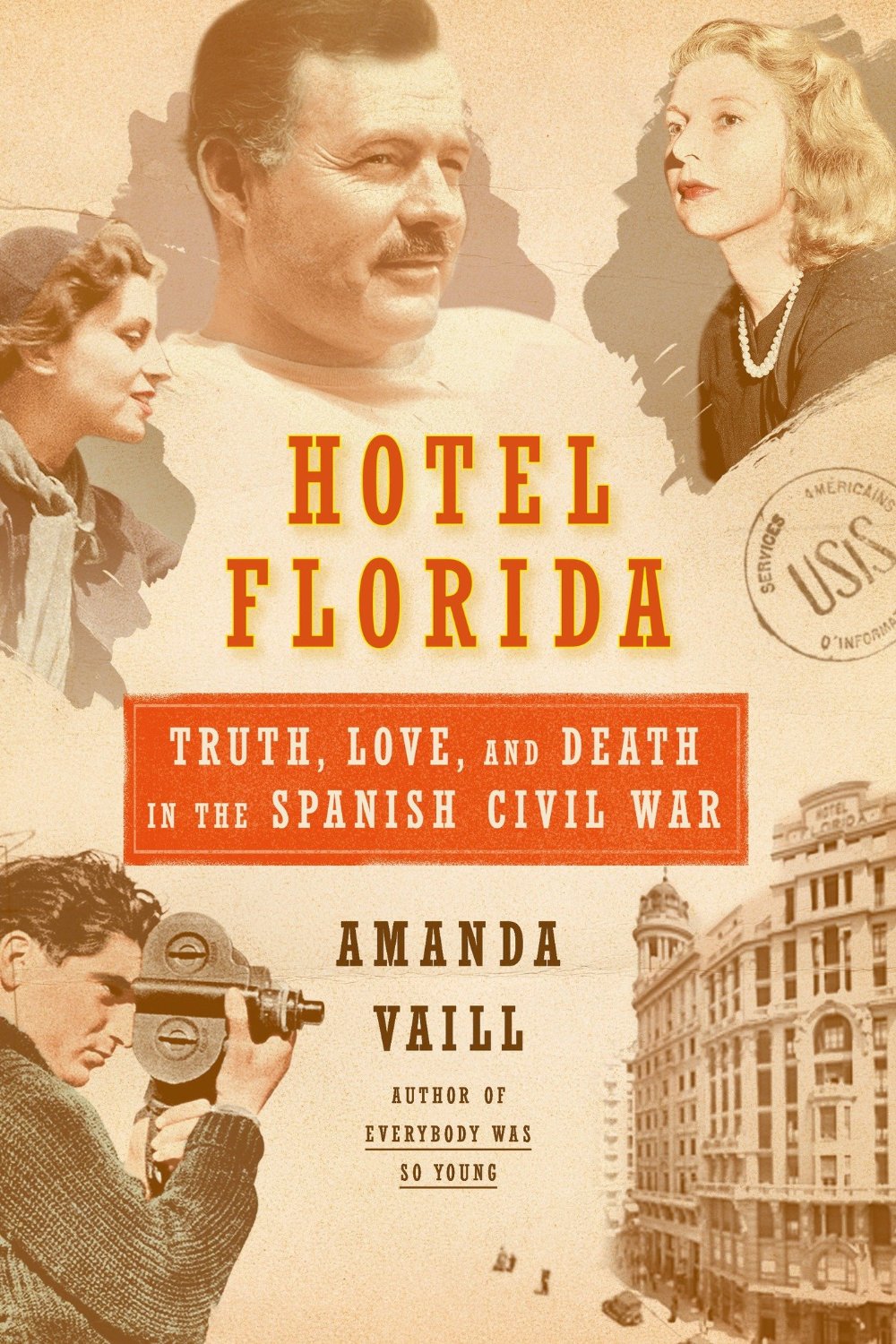
Madrid, 1936. In a city blasted by a civil war that many fear will cross borders and engulf Europe—a conflict one writer will call “the decisive thing of the century”—six people meet and find their lives changed forever. Ernest Hemingway, his career stalled, his marriage sour, hopes that this war will give him fresh material and new romance; Martha Gellhorn, an ambitious novice journalist hungry for love and experience, thinks she will find both with Hemingway in Spain. Robert Capa and Gerda Taro, idealistic young photographers based in Paris, want to capture history in the making and are inventing modern photojournalism in the process. And Arturo Barea, chief of Madrid’s loyalist foreign press office, and Ilsa Kulcsar, his Austrian deputy, are struggling to balance truth-telling with loyalty to their sometimes compromised cause—a struggle that places both of them in peril.
     Hotel Florida traces the tangled wartime destinies of these three couples against the backdrop of a critical moment in history. As Hemingway put it, “You could learn as much at the Hotel Florida in those years as you could anywhere in the world.” From the raw material of unpublished letters and diaries, official documents, and recovered reels of film, Amanda Vaill has created a narrative of love and reinvention that is, finally, a story about truth: finding it out, telling it, and living it—whatever the cost.

~~

I rarely read reviews before I start reading a book, so they don’t influence my opinion while reading. However, Hotel Florida seemed to pop up everywhere just prior to its release, with reviews written by those with advance copies and the like. Once I received my own copy of the book, I already had the opinions of others going around in my head. For once, it’s not a big deal, and the word that seems to be thrown at this book is ‘compelling’. With characters like Hemingway, Capa, Taro and Gellhorn, how could it be anything but compelling? Given that these characters are not new to anyone, how can pre-conceived stereotypes of characters not interfere with reading? There was only one way to find out.

For those without knowledge of the Spanish Civil War, the book starts out with timelines and facts of the who/what/ where/why’s of the conflict. I must confess I skimmed over these since I already knew the details, but this would prove invaluable to those who need to be shown the way through the civil war. They immediately show a reader that the author has gone to a great deal of effort to produce a quality read.

The book has a stellar cast – Ernest Hemingway, (the man who needs no introduction, booze, girls, writing and fighting), Martha Gellhorn (the hardest character to like, known for being lazy and lying), Robert Capa (brilliant but also fluid with the truth), Gerda Taro (young, intelligent, easy to root for, killed in her prime), Arturo Barea (a budding Spanish writer, a character who could have a whole book to himself) and Ilsa Kulcsar (a brave and intelligent Austrian leftist assisting Barea in his pursuits).

These three couples don’t have a large deal of interaction in the books, and the reader gets to jump from the mind of each character chapter by chapter, in a book which moves at a quick pace. The danger faced in Spain as intensely real and would leave a mark on each of these people forever. Hemingway folds into the role he is known for – brash, loud, writing well enough to tell the world what was happening in Spain, but also jealous and petty around other people. Gellhorn wiggles her way into Hemingway’s life, and his marriage, always possessing the air of someone who can’t be trusted, but could be a good writer with more effort. No one could ever suggest going to Spain during the war was an easy task, and these two were changed by their experiences, but at times seemed to be enjoying the war. It was a grand adventure, of front line reporting and loud Madrid parties. Fans of Gellhorn may enjoy her role in this book, though to the less informed reader, she seems like a privileged girl who lives on her whims. Only after her time in Spain did Gellhorn really come into her own, which only served to crush her marriage to Hemingway.

Capa and Taro are an infamous pair, escaping unsafe homelands in Germany and Hungary, changing their names, and setting out to make a massive impact on how the world saw the Spanish Civil War. The iconic moment when Capa (may or not may not – the book doesn’t say) faked the shot of the falling soldier weaves its way into the narrative as the pair photograph the war. It’s been said that Taro was the genius of the pair, but her death was cruel and left a deep wound in Capa, who had found a soul-mate in Taro in more than a romantic sense. The pair makes for reading that would interest even those who don’t know their exploits and photographs.

Arturo Barea is the best character in the book. The Madrileño, who opens the book contemplating how he doesn’t love his wife or mistress, has a quality different to the others. Barea has more faith in the telling the truth and doesn’t enjoy twisting the facts to make reports sound more favourable for the ever losing Republicans. While Hemingway, Gellhorn, Capa and Taro are not fixated on the truth, rather getting published, Barea is left at odds with them all. Barea finds Hemingway and is ilk to be ‘posturing intellectuals’, and Barea better understands what is stake during the conflict. The Spaniard can see the fate of the Republicans as the war unfolds and realises all Spaniards are going to pay and suffer as a result of the fighting. While others can flee, it is Barea’s home that has to live with the realities of war. He engages in an affair with Ilsa Kulcsar, who had come to Spain from Austria in an attempt to aid the Republicans, and Barea divorced his wife to be with Ilsa, which meant he never saw his children again. By the end of the war, Barea and his disdain for the war and those around him made him an outcast, and he and Ilsa had to flee to Paris with little more than the clothes on their backs. They made lives in Britain with their knowledge of Spain, war and languages in what appeared as a life long love affair.

I wasn’t sure what to expect when reading Hotel Florida – fitting all these larger-than-life characters into one book can’t be easy. It is described as ‘a narrative rather than an academic analysis’, which gives the possibility for rich, engaging characters. All the reviews I have read rave about the work, no doubt because of the level of effort Vaill has exuded while writing. While reading, I couldn’t be sure how I felt about the book – the pace made me feel as if I had fact after fact tossed to me, with so many details to absorb as the characters sped along. The book has an ode to Hemingway with some  long sentences – I counted one at 76 words, just as in the style of the big man himself. Being a narrative, I expected to be shown the story rather than to be told the tale, but this did not happen. The story of Hotel Florida is told to the reader; it does not unfold in any way, rather all the details are laid out and presented. Readers do not need to imagine anything, nor put the pieces together, rather everything is laid on the table with sharp sentences. While you cannot doubt the level of devotion Vaill has for her characters, they don’t have personalities, and readers need to rely on the details given out when engaging with these well-known people. Anyone who has edited a book knows the irritation of having to reduce adverbs or fix sentences ending in a preposition, and these basics haven’t been done in this book, but it makes the story more relaxed as a result.

The book ends with forty pages of notes (around 25% of the book on my Kindle), which shows how much effort the author put into this book. The attention to detail is meticulous, and much credit should go to Vaill for her hard work and commitment to perfection. If you are looking for a sweeping tale of wartime Spain this may not be the book for you, but if are looking for a tell-all of famous faces, then you have come to the right place. An added bonus is the cameo roles of powerhouses such as George Orwell, Kim Philby and others who also made their names in Spain in this era. Whether you want war, idealism (foolish or otherwise), love, lust and sex, or celebrity jealousy and pettiness, Vaill has rolled them together in Madrid’s Hotel Florida.