HISTORICAL BOOK REVIEW SERIES: ‘Pustules, Pestilence and Pain: Tudor Treatments and Ailments of Henry VIII’ by Seamus O’Caellaigh

Henry VIII lived for 55 years and had many health issues, particularly towards the end of his reign.

In Pustules, Pestilence, and Pain, historian Seamus O’Caellaigh has delved deep into the documents of Henry’s reign to select some authentic treatments that Henry’s physicians compounded and prescribed to one suffering from those ailments.

Packed with glorious full-colour photos of the illnesses and treatments Henry VIII used, alongside primary source documents, this book is a treat for the eyes and is full of information for those with a love of all things Tudor. Each illness and accident has been given its own section in chronological order, including first-hand accounts, descriptions of the treatments and photographic recreations of the treatment and ingredients.

cover and blurb via amazon

~~

The title doesn’t exactly make someone dash to the store for this book, but to miss out would be a real shame. O’Caellaigh has dived into a complex subject and combined it with a visually stunning piece of work to create a detailed life story of Henry and his illnesses, a book which came in very handy for me personally, as well as a great read.

Much is known of Henry’s health, combined with letters written by his doctors and those who were close to the king. Henry’s health changed dramatically throughout his life and had a stark impact on the relationship he had with his wives. Because of this behaviour with these queens, the Tudors have become infamous.

Anyone who has looked for info on Henry’s health will know there is much out there, and not all of it accurate. The author has tried to use primary sources, a great challenge for the time period, as doctors did not keep records as they now do. But through sheer determination it seems, O’Caellaigh has tracked down Henry’s prescription book as well as handwritten records from the Royal British Library. This is combined with letters in the court at the time, and the author has had to push through the accounts to separate truth from rumour.

One original and lucky bonus in this book is the photographs. As Henry was a handsome man, then a huge man, physical appearance would have been important in Tudor times. So this book has been dressed accordingly, with lavish photos of Tudor medicine and history. The photos are a welcome addition to the book.

While there are numerous books that look at Henry’s wives and the destruction of the church, this book looks at Henry from a unique angle, and also catalogues the changes and advancements made during Henry’s life. As Henry’s health and recovery from injuries made such a  difference to his reign, to makes sense to write a book on the details of how people survived during this period. I got a copy of this book not expecting a long read, and yet, to my delight, found it to be fascinating and well-researched. I am extremely pleased to have this book in my digital library and will definitely go back to it time and again.

 

HISTORICAL BOOK REVIEW SERIES: ‘The Raven’s Widow: A Novel of Jane Boleyn’ by Adrienne Dillard

The river was as calm as I had ever seen it. Ordinarily, the tide would have been wild by this time of year, and woe unto any man unfortunate enough to fall into the fierce currents of the Thames. Tonight the tides were still, and the surface of the water appeared glassy. When I peered down into the dark depths, I saw my tired, drawn face wavering in the reflection. I quickly turned away as I fought back a wave of nausea, frightened by the anguish I saw etched there.

“Only a few moments more my lady, the Tower is just ahead.”


Jane Parker never dreamed that her marriage into the Boleyn family would raise her star to such dizzying heights. Before long, she finds herself as trusted servant and confidante to her sister-in-law, Anne Boleyn; King Henry VIII’s second queen. On a gorgeous spring day, that golden era is cut short by the swing of a sword. Jane is unmoored by the tragic death of her husband, George, and her loss sets her on a reckless path that leads to her own imprisonment in the Tower of London. Surrounded by the remnants of her former life, Jane must come to terms with her actions. In the Tower, she will face up to who she really is and how everything went so wrong.

cover and blurb via amazon

~~

No one with the name Boleyn has fared well through history or fiction, and Jane Boleyn is definitely no exception. In recent times, Jane has been pained as a snitch, a mean, meddling and jealous woman, one who helped get her husband beheaded. Here, Dillard sets out to paint a very different woman.

Jane Parker was born in around 1505 to Henry Parker, Baron Morley and Alice St John (so through her mother’s family, a distant relative of King Henry). By 1520 Jane was in service to Queen Katherine, and considered an attractive woman for her time. By 1525, marriage had been arranged to George Boleyn, brother of two women, Anne and Mary Boleyn, whom also served Queen Katherine. As the Boleyn family were of little consequence at the time, little is recorded about the marriage, or Jane herself. It seems they had a loving marriage, though no children were ever born to the pair. Here, possible miscarriages and losses are added to the book to gain a different insight with artistic licence.

After Mary Boleyn’s time as the king mistress ended, it was Anne’s turn to fall prey to Henry, whom loved her deeply right through the 1520’s, and it was then that the Boleyns rose in the court and public eye. By 1533, Anne was queen of England, and Jane was in her service, now Viscountess Rochford. No part of Jane’s life could have prepared her for such circumstances. Jane is written as caring, emotional, irrational but interesting through the trials of being the queen’s sister-in-law, through the eyes of a courtier not often chosen as a main protagonist.

History remembers Jane as the one who told Cromwell that Anne and George were committing incest to gain a child to claim as King Henry’s. But Jane n reality was a woman married to a man who was a womaniser (though is portrayed as kinder and more chaste in this book), and, when George lost his head, she had to plead and bow to regain favour.

In this book, as in life, Jane is a character who manages to survive, to serve Anne of Cleves and then Katherine Howard as queens, before Jane too loses her head for helping Queen Katherine set up dates with her secret lover in 1542. The twist in this book is how Jane is not written as the scheming bitch who happily served her husband and sister-in-law to the axe so she could continue to survive. Also, Jane’s breakdown right before death is also given a fresh look. A book for those who are on the look out for something new.

HISTORICAL BOOK REVIEW SERIES: ‘Anne Boleyn: Adultery, Heresy, Desire’ by Amy Licence

Anne Boleyn’s unconventional beauty inspired poets ‒ and she so entranced Henry VIII with her wit, allure and style that he was prepared to set aside his wife of over twenty years and risk his immortal soul. Her sister had already been the king’s mistress, but the other Boleyn girl followed a different path. For years the lovers waited; did they really remain chaste? Did Anne love Henry, or was she a calculating femme fatale?

Eventually replacing the long-suffering Catherine of Aragon, Anne enjoyed a magnificent coronation and gave birth to the future Queen Elizabeth, but her triumph was short-lived. Why did she go from beloved consort to adulteress and traitor within a matter of weeks? What role did Thomas Cromwell and Jane Seymour of Wolf Hall play in Anne’s demise? Was her fall one of the biggest sex scandals of her era, or the result of a political coup?

With her usual eye for the telling detail, Amy Licence explores the nuances of this explosive and ultimately deadly relationship to answer an often neglected question: what choice did Anne really have? When she writes to Henry during their protracted courtship, is she addressing a suitor, or her divinely ordained king? This book follows Anne from cradle to grave and beyond. Anne is vividly brought to life amid the colour, drama and unforgiving politics of the Tudor court.

cover and blurb via amazon

~~~

Are you thinking, oh God, another biography of Anne Boleyn? Is there anything else to know? I can tell you that, yes, there is more to know and you should be thrilled to get this one. Amy Licence has practically handed a perfect account of Anne’s life to readers on a silver plate. Come bask in its glory.

Regardless whether you think Anne stole the throne, was a home-wrecking schemer, or she was the king’s love, this book covers all angles, all details and all possibilities. Licence starts with Anne’s family and background, to see how a woman could be so loathed for her background compared to more noble beginnings, despite the fact Anne had a wonderful education abroad, enough for any noble man. The time period of Anne’s life was one where, as a young girl, the royal family of England was relatively stable; Henry married to Katherine, the odd mistress thrown in for good times (his at least). But when Katherine hit menopause and religious opinion was suddenly flexible, Anne’s life could never be the same.

The realities of the time are not romanticised by the author – being a woman was not all gowns and chilling with your lady friends. These people, with their lives dictated by custom, ceremony and family loyalties, were still real people. They loved, they loathed, they hurt like anyone else. The Boleyn family, while not as noble as others (only Anne’s mother was noble born), had their own plans in this world.

Anne served the archduchess of Austria, and Henry’s sister Mary when she was Queen of France. She also then served mighty Katherine, Queen of England. Anne was no fool, no commoner, yet not quite ever noble enough. Her family wanted better, and could you blame them? But the portrayal as the Boleyns as scheming, as pushing daughters forward as whores under the king’s nose has done Anne no favours, and this book can make Anne lovers feel safe she is not portrayed as some witch.

Women routinely became mistresses, as the social order gave this is an avenue, yet was frowned upon (um, who was sleeping with these girls, gentlemen?), and a route Anne’s sister Mary took with Henry, and we shall never know for sure if Mary really wanted the job. But Anne knew, regardless, that she would not do the same thing. She loved Henry Percy, and wanted to have a real marriage, real love, only to have it dashed away thanks to that same social order.

The book delves into Anne’s rise to power as Henry’s paramour, and discusses whether she played him as part of a strategy or whether she was forced into a ridiculous game with no option but to play along. No woman can say so no to a King; Anne had to be his love, his mistress-without-benefits (or did they share a bed? The book discusses), and Henry’s selfish nature sent him down a path Anne couldn’t have imagined. She wanted to be a man’s wife, not whore. Henry, in turn, got Thomas Cromwell to destroy the social order and religious boundaries. Even the most scheming woman couldn’t have predicted that.

Licence uses excellent sources for her biography, and as a person hungry for minor details on certain periods of Anne’s life, I fell upon these pages with great excitement. Anne was smart, she had morals, she had a temper and a strong will, so much so that king chased her long enough to create divorce from the Catholic Church and make her a queen. No one does that for any mistress.

Anne married Henry, and received a coronation with the crown only meant for ordained kings, and gave Henry the Princess Elizabeth. Anne should have had full control of her life by then, only to find she was more helpless than ever. Having given up her virginity but given Henry no son, she fell from favour, and when Henry asked Cromwell to remove Anne to make way for another virgin with a womb, poor Anne was destroyed in a way everyone knows, never learning what a glorious queen her daughter would become. What people didn’t know was the truth over the whole debacle that brought Anne to the executioner’s sword.

As a woman, a spurned one at that, Anne’s history became sullied with lies and cruelty – that she was a femme-fatale who turned into a whore and witch, that she gave birth to a monster child, that she had disfigurements. History was not ready to tell the truth about a smart, powerful woman. Thank God we live in a time where historians like Amy Licence are able to guide readers through Anne’s real history without forcing conclusions on readers.

HISTORICAL BOOK REVIEW SERIES: ‘Edward II the Man – A Doomed Inheritance’ by Stephen Spinks

Edward II is one of the most controversial kings of English history. On numerous occasions he brought England to the brink of civil war.
Author Stephen Spinks argues that Edward and the later murdered Piers Gaveston were lovers, not merely ‘brothers-in-arms’. Influenced by successive royal favourites and with a desire for personal vengeance, his rule became highly polarised and unstable. His own wife took a lover and invaded his kingdom resulting in his forced abdication; the first in British history. Edward’s prevailing legacy remains the warning that all kings can fall from power.

And yet … war, debt and baronial oppression before 1307 ensured that Edward II inherited a toxic legacy that any successor would have found almost impossible to wrestle with. Stephen Spinks explores that legacy using contemporary and later sources. By focusing on Edward’s early years as much as on his reign, and exploring the conflicting influences of those around him, Stephen shows the human side of this tale against a backdrop of political intrigues and betrayals. He peels back the layers to reveal the man who wore the crown. Edward’s belief in his unchallengable right to rule, increasingly at odds with those at his court, and his undeniable thirst for revenge, creates a fourteenth-century tragedy on a grand scale.

cover and blurb via amazon

~~

Poor Edward II; he constantly gets spoken of in negative terms. I confessed to not knowing Edward II in much detail, so to receive this book was much appreciated.

The rule of Edward II suffered from war, famine and betrayal, though Edward inherited a troubled kingdom from his father, Edward I, in 1307. By the time he became king, Edward was already very close to Piers Gaveston, long considered to be Edward’s lover. The incredible closeness of the pair would trouble Edward for many years.

Edward’s troubles increased when he married Isabella of France when she was just 12. Edward was able to continue loving his buddy Piers, and also women of his court, before Isabella was old enough to bear their first child at around the age of 16. The author uses primary sources to discuss these issues, and while nothing can ever be proved around Edward’s sexuality, the author’s suggestion of a homosexual relationship seems very likely.

Edward’s initial troubles came from within, barons around the country pushing against his plans to reform the country and secure money and favour. Edward and Gaveston effectively ruled together, and the nobles disliked the king’s lover. The book tells the story of Gaveston’s eventual capture and murder in 1312 in detail.

Edward forged on without Gaveston, seeking peace with France and money from various sources, only to face war against Robert the Bruce in 1314, followed by bad weather which crippled and starved England for seven long years. Many saw this as a punishment from God, and civil war broke out in 1321, and by the time this was quashed, the Scots were at it again, followed by the French.

By late 1326, Edward had fallen from his wife’s favour, thanks to having to flee the Scots and the ever-rising power of Hugh le Despenser at court (and his also-horrid son of the same name). With Edward in a relationship with the horrible younger Hugh, Isabella set off to France on a mission and would not come home. Isabella fell in love with Roger Mortimer and they prepared to invade England from France, succeeding in 1327 when Edward’s support collapsed. The Despenser father was killed, and Edward’s lover Hugh the Younger was castrated and beheaded. Edward was imprisoned while Isabella and Mortimer ruled, with many nobles executed.

Edward II died imprisoned in September 1327, and Isabella and Mortimer continued to rule with her son Edward III named as king. By 1330, young Edward had disposed Mortimer from his place of wealth and power and executed. Rumours of Edward II’s murder swirled, with graphic depictions of torture. While this dramatic life is written up, the book tells the story of Edward as a person rather than simply a ruler. The book ends with copies of letters written by Edward II to his son and the king of France, and a letter written about the suspected survival of Edward after his supposed death.

The author has gone into great detail to tell the story of Edward II as the facts and evidence present themselves. While history is littered with speculation, the author leaves his own assumptions out, leaving the reader to decide based on facts, not opinion. Congratulations to Stephen Spinks on a wonderful read.

This Week in Spanish Civil War History – Weeks 77-81: Teruel and Cáceres, January 1938

James Neugass accompanying Cuban volunteer Pablo Carbonell, killed in action in Teruel

January 1

It is Republicans versus Nationalists in hand-to-hand combat in the Convent of Santa Clara, where the original Nationalist garrison are held up on the western edge of Teruel. All the Nationalist fighters in the Convent are killed.

January 3

Another of the initial Nationalist hold-out spots is destroyed, the Civil Governor’s Building. They fight the Republicans floor to floor in the building, the fight witnessed and reported by Ernest Hemingway. All Nationalists in the building are eventually killed, and soon after, the Seminary of Santa Clara is overrun by Republicans when the defenders have no water or food, are low on supplies and the buildings themselves are destroyed by the fighting.

January 8

Colonel Domingo Rey d’Harcourt is still holding out, with only a Bank of Spain building in Nationalist hands inside Teruel, while the reinforcements are still kept outside of the small city. Because of the horrific cold weather, Franco’s troops cannot get into Teruel, and finally Colonel d’Harcourt and his men surrender, along with Bishop Anelmo Polanco. Teruel is officially in Republican hands. The Colonel and Bishop will be sent to Valencia, and then towards Barcelona along with the remaining 40 Nationalist men captured. All will be executed on February 7 en route to France.

January 17

The weather has finally cleared over Teruel. The Nationalist garrison inside the town, which was at 9,500 men when the Republicans first attacked, are all dead. However the 100,000 reinforcements continue to attack the city.

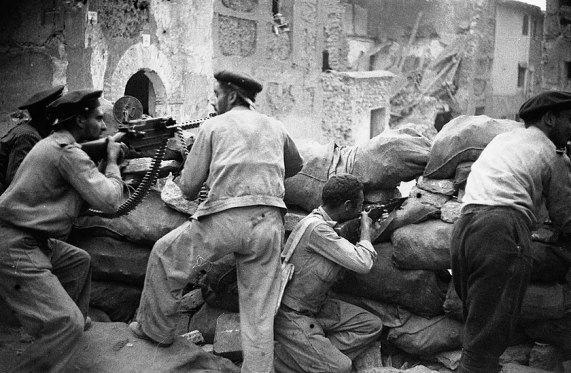
Republicans in Teruel

January 19

The Republicans, despite having similar numbers to the Nationalists, are concerned they cannot hold Teruel, with low supplies and equipment. The International Brigades, who have been in the area, are officially called in to help. The enormous numbers of men on both sides leads to fierce fighting and dramatic damage done to Teruel, though little gains are made for either side. Civilians in the town have now fled, or been killed in the crossfire as the Republicans become surrounded in Teruel.

January 21

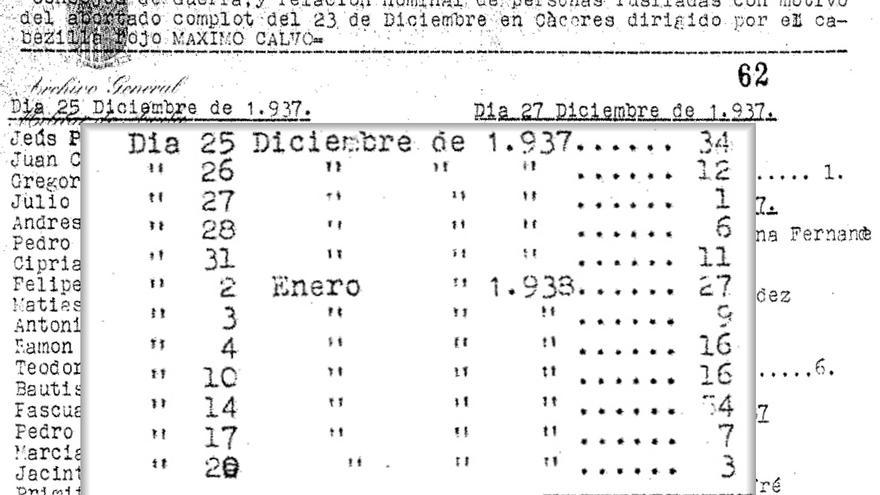
The killings in Cáceres have continued though the first weeks of 1938. By the 20th, a total of 196 Republican civilians have been executed. Among the dead are forty Francoist soldiers who were accused of being secret Republicans. The killings, which started at Christmas, continued over New Year and sixteen miners were killed on The King’s Day, the Epiphany, the most celebrated Spanish day of January 6. The tiny nearby village of Navas del Madroño had 54 people killed in one day, and Malpartida de Cáceres lost twelve men. Men, women and children are lined up and executed through the region, and any orphans left over are sent to brutal Francoist orphanages. A total of 675 people are killed in this tiny region during the war, including the 196 victims of these killings, people killed over rumours and outright lies. Their bodies were not be recovered or given a memorial for nearly 80 years.

Numbers of people killed, in date order.

January 23

Back in Teruel, the Nationalists have finally pushed the Republicans off the Teruel Tooth mountain ridge over the city. The Nationalists still hold the train station and bullring in the southwest area but cannot make any more gains.

January 25

The Republicans launch a huge counteroffensive to take back the Teruel Tooth ridge and the train station, so they can be again connected to Valencia. While numbers are massive on both sides, the Nationalists cannot break into Teruel any further, and the Republicans cannot beat them back. The south of Teruel is where heavy fighting occurs. This bloody fighting without gain for either side will continue for another two weeks. If the Republicans lose Teruel, they will lose their hold over Franco being cut off from the Mediterranean.

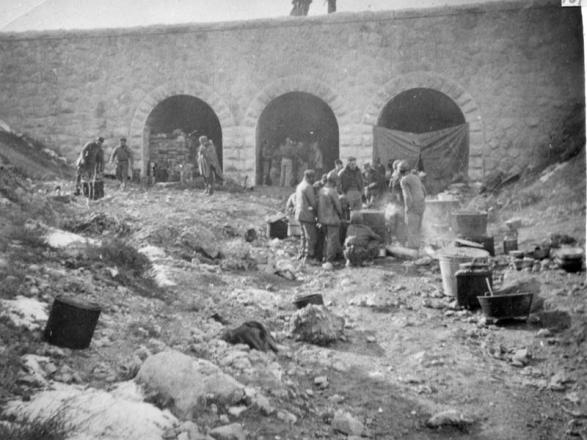
The Lincoln Brigade stationed outside Teruel

~~

This is not a detailed analysis, just a highlight (lowlight?) of the week’s events. Things get lost in translation – Feel free to suggest an addition/clarification/correction below. The more the world remembers, the better. All photos and captions are auto-linked to source for credit, and to provide further information.