
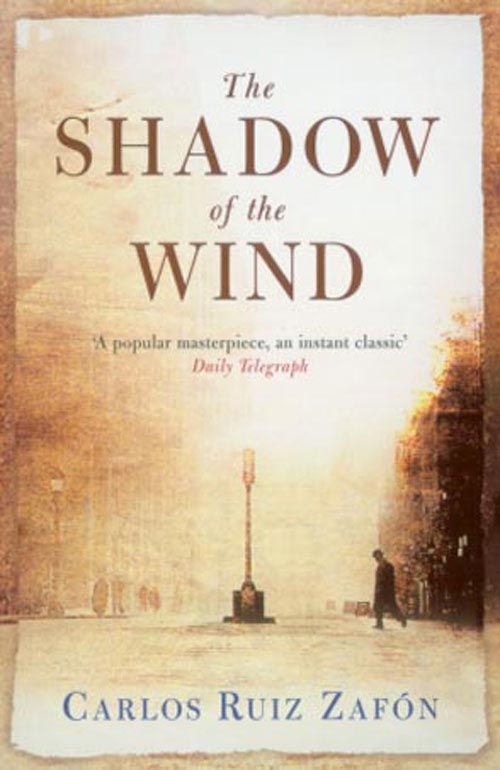
Hidden in the heart of the old city of Barcelona is the ‘Cemetery of Forgotten Books’, a labyrinthine library of obscure and forgotten titles. To this library, a man brings his ten-year-old son, Daniel, one cold morning in 1945. Daniel is allowed to choose one book and from the dusty shelves pulls The Shadow of the Wind by Julián Carax. But as Daniel grows up, several people seem inordinately interested in his find. What begins as a vase of literary curiosity turns into a race find out the truth behind the life and death of Julián Carax and to save those he left behind.
~~
With this number one bestseller, I will admit that I had high hopes when I finally sat down to read this book. Despite the the fact that the book has been available for several years in English, I only bought the book, along with its companions, The Angel Game and The Prisoner of Heaven, a few months ago. The Shadow of the Wind opens in 1945 in Barcelona, a city whose history I know well, and life under the regime of Franco is of particular interest to me. As soon as you begin to read, you get a feeling of darkness, of a life and time where things are tough, and people are simply getting by, the way they know best. Young Daniel Sempere finds a book, The Shadow of the Wind by Julián Carax, in a secret bookstore which changes his life. His father, a bookstore owner, introduces him to the larger-than-life Don Gustav Barceló, a book lover and buyer, which leads Daniel into a friendship and long-term crush on Barceló’s niece, Clara, a beautiful blind woman ten years his senior. Daniel reads to Clara and comes up with plenty of reasons to spend time with her over several years. At this point, I had to wonder where the storyline was attempting to take me, as the characters, while vivid, were not terribly endearing. I stopped reading at 100 pages and took a long beak.
But then the story beckoned me back. When Daniel is violently booted out of Clara’s life, he stumbles upon the book’s greatest character, Fermín Romero de Torres, a homeless man who comes to work in Daniel’s father’s bookstore. Fermín Romero de Torres, who is regularly identified with his full name, is a tremendous enriching character who always has the right thing (or, at least, the most amusing thing) to say. Daniel remains besotted with the books of Julián Carax, which sold poorly but somehow continued to be published throughout the 1930’s. Carax was shot dead in 1936 at the start of the Spanish Civil War in Barcelona, and all copies of his books have been destroyed, most notably by a fire. Daniel has a remaining copy, and there is a man who is desperate to get it from him, a terrifying stalker with no face, just the charred remains of skin that hangs from his bones. Throughout the book he constantly appears, under a false name, as a gruesome and soulless person who is prepared to hurt people for the sake of novels.
Through a series of well-described and easy to follow investigations, Daniel and Fermín unravel Carax’s short life, in the form of his schoolmates – a group of boys with rich fathers, along with several downtrodden boys who have managed to get into a well-to-do school. Each of these boys go about intertwining themselves in each other’s lives, and a vendetta is placed over Carax when he falls in love with his friend’s sister, to the disgust of another schoolboy friend, who is a vile and vicious individual named Francisco Javier Fumero. Fumero is a real villain, first a troubled boy, then a double-crossing spy and killer in the civil war, and now a policeman in search of violence and revenge on none other than Daniel’s friend, Fermín Romero de Torres. Daniel and the dead Carax’s lives continue to be punctuated with many coincidences, both culminating in scary and life-altering moments in The Angel of the Mist, a haunted house that has many secrets waiting for those who are ready to find them out. I have to admit, I figured out the mystery and the twist about halfway through, but that may not happen for everyone.
This book is dark, no question, but also exceedingly intriguing, regardless of whether you understand Spain, its history and its way of life. The prose of this book had been described as ‘florid’, and it certainly is. You cannot go a single page without a lyrical metaphor and/or simile being thrown at you. At times, it can be a little annoying, but some lines are genius. When Fermín speaks, you can imagine a light coming on, illuminating the dark world around him. When reading, you feel as if you are wandering the cold streets of Barcelona, with the feeling that something will jump out at you. You can feel the nervousness the damp, the worry and the angst. One character I loved is Nuria Monfort, one-time lover of Julián Carax, who endures a difficult life, knowing that she would not ever truly gain Carax’s heart, but my favourite character is Miquel Monfort, Carax’s best friend, and a tortured soul. This book is a love story, of Julián Carax and his Penélope, and of young Daniel Sempere and his Beatriz, whose love affairs take eerily similar twists despite being parted by time, and while romance has to hide in the shadows of much bigger issues, love comes to be one of the biggest dangers that these coming-of-age characters have to face.
I have read many reviews about this book, most praising the work, but I also took the time to read reviews from those who were disappointed. It is a long read at a shade under 500 pages, and there are slow points, particularly in the beginning. However, you cannot fault the quality of the work produced and attention to detail. In terms of the finer detail of the writing style, I read and felt as if I had come across something similar to my own, and that was unusual. I have yet to read something that feels so familiar in its approach (I’m not suggesting I’m as good as Zafón!). The characters all have back stories and personalities of their own, each has a part to play, and in turn, Barcelona is filled with an vast mix of people, all from different walks of life, all connected by a single book from a library that nobody ever visits.
Given the time periods and the lives portrayed this book, it is easy to feel the author’s political leanings, or at least, for what he envisions for the characters. Fermín Romero de Torres once worked for Lluís Companys, the Catalan leader during the Spanish Civil War, who is murdered and is seen as a martyr. Fermín is clearly a man who believes in the freedom of Catalonia, and Fumero, the blood-sucking officer who tortured him during the war, and now has murder in mind, is portrayed as a Franco loving right-wing fanatic (and a well-written one at that). However, anarchists, fascists and communists are all portrayed in a negative light, despite being vastly separate from one another on the political spectrum. There are references throughout the book, by multiple characters, that they hate Franco and fascist dictatorship, and that their lives have been harmed or destroyed by his reign, but they do not appear to be living in fear of him. There is no reference to the language spoken by the characters, which may be a by-product of the translation into English. The Catalan language was banned under Franco, so one might assume they spoke Castilian (traditional) Spanish, but perhaps not. We will never know.
Not only has Carlos Ruiz Zafón written a piece of art, but it has been translated in an excellent manner. There were certain things that I read and thought, ‘that’s not an expression that a Spaniard would use’, but it is what would be the best expression to use in a translation from the original, and as anyone who translates knows, literal translation would not make for an easy-to-read book. If you don’t have a keen understanding of Spain or the Spanish, you probably won’t notice this at all.
My rating for this book is 5/5. Lovers of 1950’s Spain will adore this, as will casual readers looking for a fine mystery.

 CAROLINE ANGUS