SPAIN BOOK REVIEW: A Englishman in Madrid by Eduardo Mendoza

An Englishman in Madrid

Anthony Whitelands, an English art historian, is invited to Madrid to value an aristocrat’s collection. At a welcome lunch he encounters José Antonio Primo de Rivera, founder and leader of the Falange, a nationalist party whose antics are bringing the country ever closer to civil war.

The paintings turn out to be worthless, but before Whitelands can leave for London the duque’s daughter Paquita reveals a secret and genuine treasure, held for years in the cellars of her ancestral home. Afraid that the duque will cash in his wealth to finance the Falange, the Spanish authorities resolve to keep a close eye on the Englishman, who is also being watched by his own embassy.

As Whitelands – ever the fool for a pretty face – vies with Primo de Rivera for Paquita’s affections, he learns of a final interested party: Madrid is crawling with Soviet spies, and Moscow will stop at nothing to secure the hidden prize.

~~

An Englishman in Madrid has been in my reading pile since it was released two years ago. When I posted on Twitter last week about starting to read, I expected (at least those interested in Spain) to scoff that I was last to read it. But it seems not. Perhaps they had the same hesitations that I did – an ageing academic goes abroad and bound to have an unlikely affair with some girl a third of his age. We’ve read that before, more times than we care to remember. Was this book the same? Actually, it was combo I have never read before.

Anthony Whitelands, the ‘hero’ of the story, is fresh from Cambridge university, an art nerd of undetermined age, but with the usual male middle-aged thoughts of life and his career. An ex-wife in the distance, Anthony is busy dispatching with his married lover, Catherine. Perhaps she has made a lucky escape. From the beginning, the police are tracking him, only he is too thick to notice.

Anthony is an art specialist, who loves to compare literally anything – paintings, conversations, people, probably shrubs, to Velazquez (who was a painter in Spain in the 1600’s, if painting isn’t your thing). Anthony is no stranger to Madrid, but in the spring of 1936, shiz is going down all over the place, the prelude to the civil war, which broke out in July that same year. Our hapless character knows all is not well as soon as he arrives, but he is fairly dim, so it takes him a long time to figure out the realities of wandering into an-almost war zone.

The book covers everything, from toffs of the upper class, to the poverty of the times and the social and political realities everyone is facing. The prelude to war is described brilliantly by an author who has taken the time to get things right. Between protests, street killings and strikes, Spain is preparing for implosion and bumbling Anthony has wandered into the eye of the storm.

Our self-confessed art genius finds himself at the beck and call of the Duke of La Igualada, who wants to offload his Spanish art collection, to pay to get his family out of Spain. Selling off the family silver (literal and proverbial) isn’t something particularly legal, but the Duke is a chatty dude, and has Anthony dancing to his tune soon enough. If Anthony’s description is ever written, I have already forgotten it. But he must have been one hell of a looker, because the Duke’s teenage daughters are taken with him in a heartbeat, ready to profess their love before dinner’s first course is even served. Anthony wouldn’t win them over with charm, let’s just say. As an author, I realise how convenient ‘love at first sight’ is for moving a story along, but this group is a crazy set-up, with minimal interactions, yet pounding hearts (real or imagined, anyway). Between the charming Duke, his dim-witted duchess (sticking to stereotype here), the two daughters and the up-and-coming wannabe fascist son, and heir to the money, Anthony accidentally walks into the history books.

The Duke’s paintings are duds, and also a cover-up. Because Paquita, the eldest daughter (with wandering thoughts and as cold as a fish) lures Anthony to see the real treasure – an undiscovered Velazquez in the basement of the palace. Anthony sees his name in lights with the discovery, but knows he simply can’t steal a 300-year-old treasure. He is so blinded by the thought of fame and his never-that-apparent love for the girl he met five minutes ago, Anthony makes mistake after mistake.

The author of this book moves the story on Spain-time, but no matter what others think, this book blows away many similar books written by British authors. I would take on stories with this buffoon-style protagonist before many I’ve read before him. The author wanders into chit-chat about Velazquez so often he is almost holding an art class, and I admit to skipping pages because of it. This is not a criticism, because I admire the author’s research. When it comes to the realities of Spain, Madrid in particular, in that dangerous spring of 1936, the quality is excellent. It can’t be faulted. It is this setting that kept me going.

I like to think I’ve eaten pretty much anything Spain can throw at a stomach, but Anthony, our so-called gent, has weird things like beer and squid in the morning. Um, eww, bit early, my gentleman colleague. He is ethically clueless at times, like giving his passport and wallet to a stranger, who took him to an underage prostitute, whom he bones at her mother’s place. WTH, Anthony? You have no class sometimes. He parties with the hooker and her family, he parties with the Duke (snore-fest), his daughters, and also José Antonio Primo de Rivera, leader of the Falange fascist party, who will eventually align with Franco and be with the rebels (read: baddies of the civil war). The Duke won’t let all-talk, no-action José Antonio marry Paquita, but she loves him while dancing around Anthony (maybe, she doesn’t know herself half the time). She has as little sense as everyone else. Don’t get me started on the little sister, Lilí.

Running with the fascists, the elite, the working class, the police, and hanging with the Prime Minister himself, and pretty much everyone in the mess called Madrid, Anthony nearly gets his head blown off, sees others suffer the fate, and generally can’t figure out who the Communist Russian spy trying to kill him really is. But all because he wants to the art historian who found a Velazquez, he finds himself vying for an item that could invoke an entire civil war.

This book is part art history, part Madrid history teller, part war correspondent, all laced with fictional and not-so fictional characters who make you shake your head (or hope they get theirs blown off). I love the author’s use to detail to set the scene for war, and his use of French-farce type characters lost in world completely screwed in a mess of its own making, makes for something better than the usual old academic/hero and young duchess/whore/idiot that graces these types of books. Sometimes you want Anthony to escape, sometimes you wish someone would just pull the trigger. Will the end satisfy you? Is this book a thriller, a history lesson, or a comedy? The whole lot. Definitely recommended.

SPAIN BOOK REVIEW: ‘The Anatomy of a Moment (Anatomía de un instante)’ by Javier Cercas

In February 1981, just as Spain was finally leaving Francos’ dictatorship and during the first democratic vote in parliament for a new prime minister – Colonel Tejero and a band of right-wing soldiers burst into the Spanish parliament and began firing shots. Only three members of Congress defied the incursion and did not dive for cover,: Adolfo Suarez the then outgoing prime minister, who had steered the country away from the Franco era, Guttierez Mellado, a conservative general who had loyally served democracy, and Santiago Carillo, the head of the Communist Party, which had just been legalised.

In The Anatomy of a Moment, Cercas examines a key moment in Spanish history, just as he did so successfully in his Spanish Civil War novel, Soldiers of Salamis. This is the only coup ever to have been caught on film as it was happening, which, as Cercas says, ‘guaranteed both its reality and its unreality’. Every February a few seconds of the video are shown again and Spaniards congratulate themselves for standing up for democracy, but Cercas says that things were very quiet that afternoon and evening while all over Spain people stayed inside waiting for the coup to be defeated …. or to triumph.

Cover and blurb via Amazon

~~

Anatomy starts off with a prologue, explaining how the author set out to write a novel regarding the 23 February 1981 coup attempt on the Spanish government. But with events of the time already muddy in people’s memories, instead Cercas set out to instead write a book designed to set straight the events of the fateful day. What started as a novel set in the time period became an expertly studied piece of non-fiction, complete with photos, capable of explaining what really happened in 1981.

The ‘moment’ of the book is when Lieutenant Colonel Tejero and his huge moustache storm the Cortes (parliament) while full of MPs on February 23, 1981. While the Guardia Civil start shooting warning shots, three men –  Prime Minister Adolfo Suárez, Communist Party leader Santiago Carrillo and Deputy Prime Minister General Gutiérrez Mellado, refuse to bow down to the Colonel.

Anatomy tells the story of these three men, who become the main characters. Prime Minister Suárez comes into view, chosen by King Juan Carlos to lead after Franco’s death in 1975. In his years as Prime Minister, Suárez turned Spain into a democracy, with elections held, army rebellions quashed and heeding all political parties across the divide to come together for the sake of Spain and its new democracy. However, with Suárez failing at leading Spain in these early years, and the ever-increasing threats from ETA, the time has come where people question Suárez’s leadership.

Every book needs a villain and Anatomy gets three – Tejero, ready to bend reality to favour himself, plus soldiers General Milans del Bosch and General Armada, who each in their own way think they have a chance at succeeding in the coup. They wanted to take Spain back to its Francoist state, military rule, Catholic suffocation, and total power.

Anatomy tells of success and failure; the coup failed and democracy continued, but on a  cold night the coup had one success; it showed the shaky new start for Spain could hold its own. The nation sat in the cold and waited for news, a night where their fates could have been different. The book delves into the background and motivation of each of the main characters, something which could come up for debate, depending on a reader’s opinion. The book does give a real picture of what happened in 1981, when legends and stories float around all too easily. The translation isn’t perfect (they never are) and that leaves some very long sentences for readers to swallow, but the book is enthralling on the subject matter. The book has more accolades and awards than you can poke a stick at, and definitely worth a reader’s time. If you love Spain, if you live in Spain, you need to know what happened on the night of February 23.

SPAIN BOOK REVIEW: ‘The Spanish Civil War: A Very Short Introduction’ by Helen Graham

Amid the many catastrophes of the twentieth century, the Spanish Civil War continues to exert a particular fascination among history buffs and the lay-reader alike. This Very Short Introduction integrates the political, social and cultural history of the Spanish Civil War. It sets out the domestic and international context of the war for a general readership. In addition to tracing the course of war, the book locates the war’s origins in the cumulative social and cultural anxieties provoked by a process of rapid, uneven and accelerating modernism taking place all over Europe. This shared context is key to the continued sense of the war’s importance. The book also examines the myriad of political polemics to which the war has given rise, as well as all of the latest historical debates. It assesses the impact of the war on Spain’s transition to democracy and on the country’s contemporary political culture.

Cover and blurb via Amazon

~~

The Oxford University Press has a series of short introductions to a vast array of subjects, and the Spanish Civil War version has been put together by Helen Graham, a professor at Royal Halloway, University of London. Putting together a short book on a massive subject would be no easy task. But when Paul Preston hails a book as ‘far and away the best short introduction to the Spanish Civil War’, the praise doesn’t get any higher. If a reader wished to start learning about the war, reaching for a hefty Preston, Thomas, or Beevor tome could be daunting, and the subject can drive even the most knowledgeable person to distraction.

A Very Short Introduction is cut into seven sections. The book lays out the foundation in a short slice, no easy task, and dedicates a chapter to the early days of the war, explaining the reality of executions on both sides of the conflict and the vigilante-style operations Spain was running in the quest for power and freedom. The book manages to cover Franco’s rise to prominence through a combination of will and luck, as well as how Spain was won through the help of Hitler and Mussolini. With all these aspects, and the huge array of groups pushing their own agendas, the war is impossible to simplify, yet the book gives the initial details without overwhelming readers. A Very Short Introduction lays out the people, the major events, the reality of Spain at the time, everything needed to help a newbie understand why Spain collapsed the way it did in 1936.

This book is written in a simple style, without a strong voice but rather an academic view of the facts. This book has drawn criticism, especially from being marked as biased (which I dared to read), and, 1 ) being unbiased about a Spanish Civil War is nigh impossible, and 2 ) those decrying the book as biased and rabidly left-wing seem to be free and easy with the facts themselves. The book may not jump up and down with a passion, and that is not its purpose; it is a clear and simplified version a horrendously difficult subject, and perfect for its initial goal. A Very Short Introduction was promised and delivered.

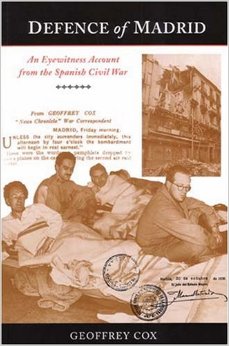
SPAIN BOOK REVIEW: ‘Defence of Madrid’ by Geoffrey Cox

COX

Goodies and baddies take some sorting out in this tale of the siege of Madrid by Franco’s right-wing forces supported by the Nazis and the fascist regime of Mussolini (the ‘rebels’), against the civilian population and its government representatives, just elected, who happened to be left-wing. Once sorted, Cox’s account of the city under attack, in one of the twentieth century’s first urban wars, has all too many echoes today. This new edition, with an introduction and selection of historical photographs, as well as samples of Cox’s journalism from the front, will confirm its position as one of the classics of twentieth-century reportage. Foreword  by Paul Preston, introduction by Michael O’Shaugnessy.

Cover and blurb for 70th anniversary edition from Amazon

~~

Geoffrey Cox’s Defence of Madrid (1937, republished in 2006) is the New Zealander’s eyewitness account of his time in Madrid from October to December 1936, during the siege of the city. In this brief six-week stint, Cox managed to see the fighting in Casa del Campo, the battles at the university and the bombing of everyday civilians.

Born in New Zealand’s South Island in 1910, Cox moved to study at Oxford in 1932 after a tour through Europe. With Europe under dramatic change in this time, he studied the political state of the continent, including spending time in a Nazi youth camp. Soon, journalism took over his desire for an academic life. In 1936, the News Chronicle had their Madrid-based correspondent taken hostage by Franco’s rebels, and a replacement was needed – Geoffrey Cox had the opportunity no one else wanted.

Defence of Madrid is a stark and honest account of Madrid during those early months of the war as Franco’s forces marched unabated through Spain. Cox landed in Madrid prepared for the rebel’s onslaught, only to land in a city in wait, a city far more complex than imagined, given the social and political state. Cox started writing down his account as soon as he arrived, every sight and sound recorded. Almost immediately, his account was being broadcast, as one of just two British correspondents holed up in the city. Cox soon became immersed in the air of Madrid and was the first writer of explain to the world what it felt like to be part of the war, and what everyday people were feeling and experiencing. The combination of the turmoil and collective desires to defend Madrid were published by Cox, who quickly became recognised as a good judge of character. While in Spain for just six weeks, Cox managed to cover major events before any other – covering the assault on the university and Casa del Campo as the Republicans fought back Franco’s army, honest accounts of the aerial bombings and covered the arrival of foreign volunteers in Spain to help the cause.

Defence of Madrid is the first in a long line of books by Cox, who went on to cover World War II and much more. The book is written with total honesty, a lack of bias, seen through eyes destined to tell the truth. Any author would be proud to be able to produce such work. New Zealanders participated in all aspects of the Spanish Civil War, most totally unrecognised. Geoffrey Cox should not ever be one of these.

Valencia Photos of the Month: Horchaterías in Plaza de Santa Catalina


Plaza Santa Catalina in 1837, 1860, 1895 and 2013. Horchatería Santa Catalina is on the left, across the church entrance and El Siglo is on the right just before the church entrance. 

Plaza de Santa Catalina (named after the Santa Catalina church), off Plaza de la Reina, located in the heart of Valencia since forever, is home to two of Valencia’s long-standing and iconic stores, all-but across the tiny pedestrian street from one another and selling the same product – horchata.

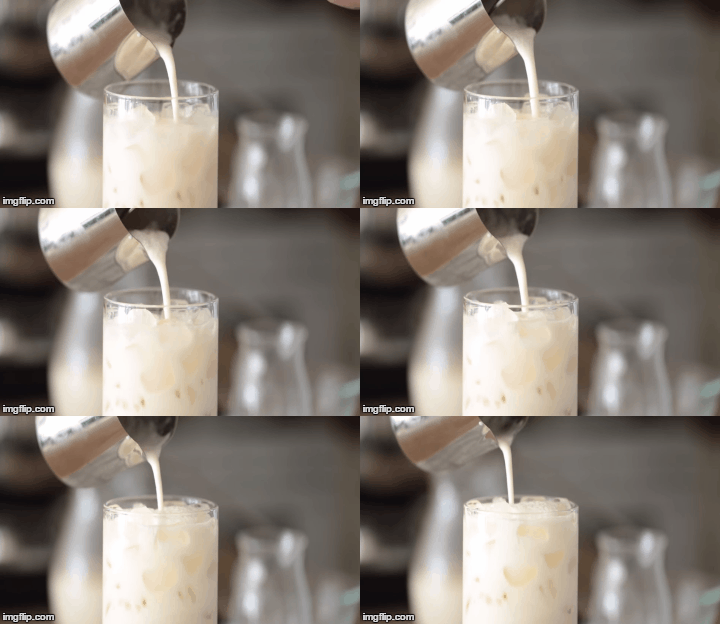
Horchata (orxata in Valencian) is the local beverage of the ages. The drink is made of tiger nuts, water and sugar; you can get substandard versions made from almonds or rice elsewhere, but Valencia is the home of the product. When the Muslims owned/ ran/ inhabited the city from the 8th-13th centuries, they perfected the drink, made from chufas (tiger nuts) in nearby Alboraia, outside the city area. It looks as if made from milk, but dairy-avoiders have no need to shy away from the drink. It is served ice-cold and has fartons (don’t poke fun of the name), long pastry delights dipped in for extra fun.

horchata gif

Right across from the entrance to the Santa Catalina church is Horchateria de Santa Catalina, which is decorated in the traditional tile design of the area. After several hundred years and multiple royal visits, they know what they are serving. Horchata, fartons, various pastries, churros and coffees are all available, and you can get your sugar on for just a few euros. It’s one of Valencia’s quiet icons, with a handy location to everywhere in the old town.


Across the tiny street is Horchatería El Siglo, who have been serving up horchata since 1836. The same products as across the street, though with a simpler setting, and some argue, better quality horchata. They also have a nice outdoor setting area. Again, for a few euros you can have all you want and chill with the locals. Or could, because as of 31 December 2014, thanks to a law changing rents in Spain, disaster has struck El Siglo. While the rent increases, put up to current market rates, have been coming for the last twenty years, they have now come into force. While many of the 9000 local family-owned stores in Valencia, the classic older stores of the city, managed to negotiate rents (going up thousands of euros a month!), some, like El Siglo have instead decided to close their doors and have the owners retire. Rents have been frozen, some for up to half a century, in Spain for the aid of businesses, and that helpful time has come to an end. After all this time, a law has closed El Siglo and we’ll be seeing some ugly generic Starbucks in there, even though they are everywhere like a plague. Thousands of stores around Spain will now disappear thanks to this law change. You will be seeing more franchises and generic stores over the beautiful lace stores, shoe stores, doll repairers (yes), antique shops, tailors, cafes, basket weavers, horchaterías et al, businesses handed down through generations. And that really sucks. The time for the rent freezes came to an end, and some argue it had to happen, however the face of Spain is being changed quickly, thanks to corporations who can afford the new rents.

 RIP El Siglo