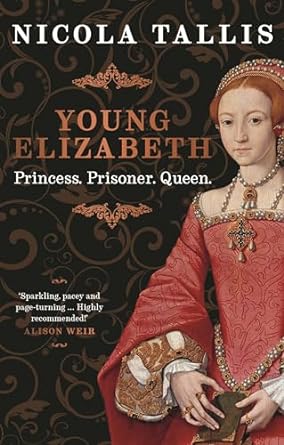
BOOK REVIEW: Young Elizabeth: Princess. Prisoner. Queen by Nicola Tallis

Elizabeth I is one of England’s most famous monarchs, whose story as the ‘Virgin Queen’ is well known. But queenship was by no means a certain path for Henry VIII’s younger daughter, who spent the majority of her early years as a girl with an uncertain future.

Before she was three years old Elizabeth had been both a princess and then a bastard following the brutal execution of her mother, Anne Boleyn. After losing several stepmothers and then her father, the teenage Elizabeth was confronted with the predatory attentions of Sir Thomas Seymour. The result was devastating, causing a heartbreaking rift with her beloved stepmother Katherine Parr.

Elizabeth was placed in further jeopardy when she was implicated in the Wyatt Rebellion of 1554 – a plot to topple her half-sister, Mary, from her throne. Imprisoned in the Tower of London where her mother had lost her life, under intense pressure and interrogation Elizabeth adamantly protested her innocence. Though she was eventually liberated, she spent the remainder of Mary’s reign under a dark cloud. On 17 November 1558, however, the uncertainty of Elizabeth’s future came to an end when she succeeded to the throne at the age of twenty-five.

When Elizabeth became queen, she had already endured more tumult than many monarchs experienced in a lifetime. This colourful and immensely detailed biography charts Elizabeth’s turbulent and unstable upbringing, exploring the dangers and tragedies that plagued her early life. Nicola Tallis draws on primary sources written by Elizabeth herself and her contemporaries, providing an extensive and thorough study of an exceptionally resilient youngster whose early life would shape the queen she later became. The heart racing story of Elizabeth’s youth as she steered her way through perilous waters towards England’s throne is one of the most sensational of its time.

Young Elizabeth is another excellent book by Nicola Tallis, which provides a compelling and detailed account of the formative period in the life of one of England’s most remarkable monarchs. The author offers a captivating exploration of Elizabeth’s upbringing, education, and startling early experiences, shedding light on the scandalous events and influences that shaped her into the iconic queen she would become.

The book begins by immersing readers in the world of Tudor England, setting the stage for understanding the complexities of Elizabeth’s early life. With meticulous attention to historical detail, the author paints a picture of the political, religious, and social dynamics of the time, providing essential context for understanding Elizabeth’s place within the Tudor dynasty.

Central to the book is the examination of Elizabeth’s childhood and adolescence. Tallis delves into her family background, her relationships with her parents, Henry VIII and Anne Boleyn, and the challenges she faced as a young princess navigating the uncertainties of the Tudor court without the guidance of a parent. Through careful analysis of contemporary sources and historical records, the author offers valuable insights into Elizabeth’s character, temperament, and early ambitions. I have always wondered about Catherine Parr’s decision-making in 1548; did she turn against Elizabeth, or did she look to save the girl? I won’t spoil anything, but the book helps a reader reach their own conclusions.

One of the most intriguing aspects of the book is its exploration of Elizabeth’s education and intellectual development. Young Elizabeth discusses the tutors and mentors who shaped Elizabeth’s mind, including scholars like Roger Ascham, who recognised her exceptional intelligence and thirst for knowledge. By examining Elizabeth’s studies in languages, history, and philosophy, the author reveals how her early education prepared her for the demands of leadership. But surely nothing could prepare Elizabeth for the betrays she suffered during her brother’s reign, and the mark of traitor placed upon her under her sister’s reign. By the time Elizabeth was crowned, she had already lived several lifetimes of difficulty.

Young Elizabeth provides a fascinating glimpse into the political and religious turmoil of Elizabeth’s youth. As always Nicola Tallis gives us a masterful and illuminating tale of the formative period in the life of one of England’s most legendary monarchs. The author’s engaging prose, combined with meticulous research and scholarly rigor, make this book an essential read for anyone interested in Tudor history, remarkable women, and the dynamics of power and politics in early modern Europe. It would be unwise to miss out on a book by Nicola Tallis.

Young Elizabeth is available everywhere, including Amazon

HISTORICAL BOOK REVIEW SERIES: ‘Elizabeth’s Rival: The Tumultuous Tale of Lettice Knollys, Countess of Leicester’ by Nicola Tallis

The first biography of Lettice Knollys, one of the most prominent women of the Elizabethan era.

Cousin to Elizabeth I – and very likely also Henry VIII’s illegitimate granddaughter – Lettice Knollys had a life of dizzying highs and pitiful lows. Darling of the court, entangled in a love triangle with Robert Dudley and Elizabeth I, banished from court, plagued by scandals of affairs and murder, embroiled in treason, Lettice would go on to lose a husband and beloved son to the executioner’s axe. Living to the astonishing age of ninety-one, Lettice’s tale gives us a remarkable, personal lens on to the grand sweep of the Tudor Age, with those closest to her often at the heart of the events that defined it.

In the first ever biography of this extraordinary woman, Nicola Tallis’s dramatic narrative takes us through those events, including the religious turmoil, plots and intrigues of Mary, Queen of Scots, attempted coups, and bloody Irish conflicts, among others. Surviving well into the reign of Charles I, Lettice truly was the last of the great Elizabethans.

cover and blurb via amazon

~~

Lettice Knollys is such an interesting person, a life filled with enough drama and excitement that anyone would envy her. One of the few women of the English court not to be named Katherine, Anne, Elizabeth or Mary, Lettice Knollys was the daughter of Catherine Carey, the so-called love child of Henry VIII and Mary Boleyn.

While Catherine Carey wasn’t formally recognised as Henry’s love-child, the odds are high, making Carey the half-sister of Queen Elizabeth, and thus Lettice was Elizabeth’s niece, rather than cousin. The two women looked much alike, and as Lettice was only 10 years younger than her aunt, she was the younger gorgeous redhead. Dressed in clothes of the period, Queen Elizabeth and Lettice look much alike, same hair, face, smile. The author of this book leans closely to the fact that Henry VIII was Lettice’s grandfather, and had she been male, would have been an illegitimate heir to the throne. Lettice was a Tudor, something fast disappearing from the world.

Lettice married well at 17 to Walter Devereux, Viscount Hereford and bore him four surviving children (out of five, pretty good). Lettice was young, happy and known as the most beautiful woman at the English court. Elizabeth, ever-vain, needed to be centre stage and could have been annoyed, but yet she and Lettice were close. Elizabeth had her own love – Robert Dudley, Earl of Leicester, whom she could not marry. This is how two Tudor women became bitter rivals.

Lettice’s husband, now Earl of Essex, shipped out to Ireland at the queen’s behest in 1573, and Lettice started an affair with the queens’ favourite, Dudley. While nothing could be confirmed and most accounts are long-lost, the book tells of how rumours swirled of the affair and Lettice carrying and bearing children while her husband was away. Devereux came home after two and half years away, having heard all about his wife’s behavior. But Devereux left for Ireland again six months later, only to die soon after of dysentery while complaining about women being frail.

Lettice fought hard for an inheritance for herself and her children, and her affair with Dudley continued despite him being Elizabeth’s favourite. Dudley had wanted to marry Elizabeth, but was unable to for many reasons, and so had instead gone to the bed of the younger Tudor model. He married Lettice in secret in 1578, two years after she was widowed, he himself a widower for some 18 years at this point. Just two days later, Lettice sat with the queen at dinner, the secret safe, as it would be for  years, with Lettice and Dudley moving about regularly, usually separated. Lettice lost a  baby in 1580, gave birth to a son in 1581, and lost another in 1582. Their precious only son died in 1584, causing great grief to the pair.

But in 1583, all hell had broken loose. Elizabeth found out her favourite had married Lettice, and was living openly with her in his own home. A bond which had almost certainly begun in childhood was broken; Lettice was banished from Elizabeth’s presence, furious the man she wouldn’t marry had married someone else. Dudley was sent on several trips abroad, before he fell ill, possibly with malaria in September 1588 and he died with Lettice at his side.

Lettice remained out of favour with the queen, living a country life with a new husband, a young soldier named Sir Christopher Blount, former attendant to her late second husband. She struggled with the loss of her eldest son and suffered many financial troubles, and did not see her queen again until 1598, where the meeting remained icy a decade after Dudley’s death. The love triangle between Dudley and the two red-headed Tudor women never healed.

Thanks to the Essex revolt of 1601, Queen Elizabeth beheaded Lettice’s precious remaining son and her new husband , both for treason. She spent much time fighting over inheritances with a bastard son of Robert Dudley, and then lived with her daughters and their children, outliving them. She lived quietly under King James and King Charles, dying at her grandson Robert’s home in December 1634, aged 91, a symbol of  bygone age.

Lettice’s life, born under Henry VIII, a bastard grandchild to the great king, grew up under him, King Edward, Queen Mary, lived through Queen Elizabeth’s reign, then King James and King Charles, is a story of wonder, drama, intrigue, heartache and love. Why there aren’t many books on such an incredible woman is a mystery. Thank you so much to Nicola Tallis for the book I have been waiting for, a perfect read on a riveting subject.