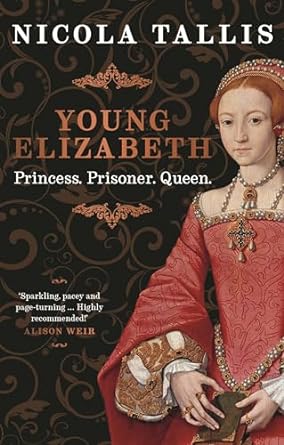
BOOK REVIEW: Young Elizabeth: Princess. Prisoner. Queen by Nicola Tallis

Elizabeth I is one of England’s most famous monarchs, whose story as the ‘Virgin Queen’ is well known. But queenship was by no means a certain path for Henry VIII’s younger daughter, who spent the majority of her early years as a girl with an uncertain future.

Before she was three years old Elizabeth had been both a princess and then a bastard following the brutal execution of her mother, Anne Boleyn. After losing several stepmothers and then her father, the teenage Elizabeth was confronted with the predatory attentions of Sir Thomas Seymour. The result was devastating, causing a heartbreaking rift with her beloved stepmother Katherine Parr.

Elizabeth was placed in further jeopardy when she was implicated in the Wyatt Rebellion of 1554 – a plot to topple her half-sister, Mary, from her throne. Imprisoned in the Tower of London where her mother had lost her life, under intense pressure and interrogation Elizabeth adamantly protested her innocence. Though she was eventually liberated, she spent the remainder of Mary’s reign under a dark cloud. On 17 November 1558, however, the uncertainty of Elizabeth’s future came to an end when she succeeded to the throne at the age of twenty-five.

When Elizabeth became queen, she had already endured more tumult than many monarchs experienced in a lifetime. This colourful and immensely detailed biography charts Elizabeth’s turbulent and unstable upbringing, exploring the dangers and tragedies that plagued her early life. Nicola Tallis draws on primary sources written by Elizabeth herself and her contemporaries, providing an extensive and thorough study of an exceptionally resilient youngster whose early life would shape the queen she later became. The heart racing story of Elizabeth’s youth as she steered her way through perilous waters towards England’s throne is one of the most sensational of its time.

Young Elizabeth is another excellent book by Nicola Tallis, which provides a compelling and detailed account of the formative period in the life of one of England’s most remarkable monarchs. The author offers a captivating exploration of Elizabeth’s upbringing, education, and startling early experiences, shedding light on the scandalous events and influences that shaped her into the iconic queen she would become.

The book begins by immersing readers in the world of Tudor England, setting the stage for understanding the complexities of Elizabeth’s early life. With meticulous attention to historical detail, the author paints a picture of the political, religious, and social dynamics of the time, providing essential context for understanding Elizabeth’s place within the Tudor dynasty.

Central to the book is the examination of Elizabeth’s childhood and adolescence. Tallis delves into her family background, her relationships with her parents, Henry VIII and Anne Boleyn, and the challenges she faced as a young princess navigating the uncertainties of the Tudor court without the guidance of a parent. Through careful analysis of contemporary sources and historical records, the author offers valuable insights into Elizabeth’s character, temperament, and early ambitions. I have always wondered about Catherine Parr’s decision-making in 1548; did she turn against Elizabeth, or did she look to save the girl? I won’t spoil anything, but the book helps a reader reach their own conclusions.

One of the most intriguing aspects of the book is its exploration of Elizabeth’s education and intellectual development. Young Elizabeth discusses the tutors and mentors who shaped Elizabeth’s mind, including scholars like Roger Ascham, who recognised her exceptional intelligence and thirst for knowledge. By examining Elizabeth’s studies in languages, history, and philosophy, the author reveals how her early education prepared her for the demands of leadership. But surely nothing could prepare Elizabeth for the betrays she suffered during her brother’s reign, and the mark of traitor placed upon her under her sister’s reign. By the time Elizabeth was crowned, she had already lived several lifetimes of difficulty.

Young Elizabeth provides a fascinating glimpse into the political and religious turmoil of Elizabeth’s youth. As always Nicola Tallis gives us a masterful and illuminating tale of the formative period in the life of one of England’s most legendary monarchs. The author’s engaging prose, combined with meticulous research and scholarly rigor, make this book an essential read for anyone interested in Tudor history, remarkable women, and the dynamics of power and politics in early modern Europe. It would be unwise to miss out on a book by Nicola Tallis.

Young Elizabeth is available everywhere, including Amazon

HENRY VIII’S CHILDREN: Part 1 – The Royal Lockdown of 1517-18

Ahead of the release of Henry VIII’s Children: Legitimate and Illegitimate Sons and Daughters of the Tudor King on 30 May (Pen & Sword Currently have a 30% off special throughout May) , I am doing a 15-part series on some of the smaller, lesser-known details that are covered in the book. These details played out in the background of the defining moments of the lives of each of Henry’s children.

PART 1: The Royal Lockdown of 1517-18

King Henry, in his typically luxurious manner, hosted a banquet at Greenwich on 7 July 1517, to celebrate England’s new League in Defense of the Church, a three-sided treaty with King Charles of Spain and Holy Roman Emperor Maximilian. This treaty specifically excluded France, but also defended the Catholic faith. The festivities of St Thomas’ Day celebrated the alliance; dinners, banquets, jousts, dancing, music, and a buffet thirty feet long, with meals brought out on elephants, panthers, and lions. But, among the glorious celebratory jousts, the worst possible scenario occurred, a huge outbreak of sweating sickness. The international pageant was not over, but ominous news of sudden deaths arrived at the court. While the disease did periodically spring up in England, it is also possible the hundreds of international visitors may have transported the illness. Two of King Henry’s younger privy chamber men, Thomas Baron Clinton, and Lord Grey of Wilton, died suddenly at Richmond.

Windsor Castle, via wikimedia commons

Henry and Katharine fled immediately to Windsor and did not see their eighteen-month-old daughter Princess Mary for months. The last thing they needed was their precious daughter succumbing to the illness, not unlike the illness that killed Prince Arthur fifteen years earlier. The illness spread through England and then Europe, and deaths quickly ran into the thousands. Cardinal Wolsey fell sick with the illness for the fourth time and vowed to take a pilgrimage to Walsingham if he survived. The illness killed noble and common-born subjects with impunity, and with the king away, the locals of London planned more attacks on foreign merchants.

Farnham Castle drawbridge entrance, via wikimedia commons

Henry and Katharine passed the months in seclusion, but those around them kept dying, and they fled to Farnham Castle to allow Windsor to be cleaned. They only returned to Windsor for New Year, where they could be reunited with Princess Mary. Mary stayed on with her parents at Windsor, celebrating her second birthday, and met Venetian ambassador Sebastian Guistanian on 28 February 1518. The sweating sickness was still out of control, but the ambassador touched Mary’s hand, given more deference and respect than Katharine. It was at this meeting that Henry uttered his well-known boast that Mary never cried, and Mary’s first public word. After the meeting, Henry and Katharine, and likely Mary too, left for Woodstock Palace to continue running from the sweat.

Woodstock Palace, via wikimedia commons

While Henry started his first book in isolation, Assertio Septem Sacramentorum, a collection of claims refuting Martin Luther’s works, the quiet time for the royal couple had a better result; Queen Katharine was finally pregnant, likely conceiving in early March 1518. The queen took a private pilgrimage to St Frideswide’s in Oxford, to give an offering to Christ Church cathedral’s relics. Having multiple children gave Henry and Katharine options; if Katharine had a son, England would have an heir, and Queen Claude of France had just given birth to a son. Mary could marry him and be Queen of France.

This time, thanks to the illness and the resulting isolation, Katharine kept her pregnancy quiet, and Princess Mary was returned home to Ditton to remain safe, as even Henry’s bedchamber servants were dying. Katharine did have a few ladies to keep her company during isolation, one being twenty-year-old Bessie Blount. While still in isolation, Princess Mary’s future marriage to infant Francis, Dauphin of France was agreed upon on 30 June 1518, and at once, this upset King Charles of Spain and Emperor Maximilian, the same rulers Henry had painstakingly entertained one year earlier when the banquet unwittingly released the sweating sickness.

Bisham Manor, once attached to Bisham Priory, via wikimedia commons

Around the time of the marriage treaty, the sweating sickness infiltrated Princess Mary’s household, when one of her servants fell desperately ill. Henry ordered Mary’s household to move to Bisham, eleven miles northwest of her home at Ditton, before travelling to The More in Hertfordshire, where the king remained safe with Katharine. By this time, Katharine would have been visibly pregnant, and news of her pregnancy had spread. After time with her parents and staying well, Princess Mary’s household continued to move through summer homes, stopping at Havering, Hatfield, and Tittenhanger, before heading back to Ditton. This period of dodging the sweating sickness gave Mary one of the longest periods of her life when she could stay with both of her parents.

Havering Palace, via wikimedia commons

By September 1518, it was back to business as usual at the royal court, with a lavish banquet in honour of French delegates in London for Mary’s betrothal treaty on 2 October. England was giving away its heir in marriage; it was a massive gamble and the couple needed a son, so France did not take England’s crown when Mary married. As Queen Katharine was due to give birth to the longed-for royal son, King Henry was paired for dancing at the banquet with Bessie Blount.

Queen Katharine’s last child, a baby girl, was stillborn or died just after birth on 10 November 1518. Bessie would give birth to illegitimate Henry Fitzroy nine months after the banquet.

Up next -Part 2: The Birth of Elizabeth Tailboys