HISTORICAL BOOK REVIEW SERIES: ‘Catherine of Aragon: An Intimate Life of Henry VIII’s True Wife’ by Amy Licence

Catherine of Aragon continues to fascinate readers 500 years after she became Henry VIII’s first queen. Her life was one of passion and determination, of suffering and hope, but ultimately it is a tragic love story, as circumstances conspired against her. Having lost her first husband, Henry’s elder brother Prince Arthur, she endured years of ill health and penury, to make a dazzling second match in Henry VIII. There is no doubt that she was Henry’s true love, compatible with him in every respect and, for years, she presided over a majestic court as the personification of his ideal woman. However, Catherine’s body failed her in an age when fertility meant life or death. When it became clear that she could no longer bear children, the king’s attention turned elsewhere, and his once chivalric devotion became resentment. Catherine’s final years were spent in lonely isolation but she never gave up her vision: she was devoted to her faith, her husband and to England, to the extent that she was prepared to be martyred for them. One of the most remarkable women of the Tudor era, Catherine’s legendary focus may have contributed to the dissolution of the way of life she typified.

cover and blurb via amazon

~~

If it’s about Catherine of Aragon, it’s going in my collection. Catherine is my favourite queen/wife of the six, an intriguing woman, and not just because of what she suffered through while being the wife Henry scorned.

Books by Amy Licence are around me in all directions; in any burst of reviews I do, there will be an Amy Licence among them. The best part about Amy Licence is that she doesn’t write wives, daughters, etc, she write about women. Yes, there is a difference, boys.

This beautiful golden book is divided into seven parts, starting with a section on Catherine’s origins, her ancestry and, of course, her glorious mother, Queen Isabella, before moving onto the negotiation of Catherine’s move to England.

Catherine’s short marriage to Arthur is given ample detail as well as the question of did-they-didn’t-they. Rather than relying on words said by others, whether they considered themselves eyewitnesses or not, Licence has made practical and reasonable suggestions around the issue.

Catherine’s difficult years as a widow, left wanted and unwanted over seven painful years is detailed, which shows much of Catherine’s ever-growing strength and her Catholic devotion. The early years of her beautiful and beloved marriage is also included, before the changing years after the death of her final child.

The “Great Matter” naturally takes a large chunk of the book, and I particularly enjoyed the section on Catherine’s time in exile and martyrdom as she stuck to her beliefs and principles. There really has been no queen like Catherine, no queen as wise, astute, educated, understanding and well-nurtured as Catherine. No amount of books on the subject is enough.

Licence’s latest book is beautifully written, and Catherine is not the dour woman of many portrayals, but a learned woman who went through so much, and seemed prepared to weather all of it. I truly love this book. No review could cover this wonderful biography.

HISTORICAL BOOK REVIEW SERIES: ‘In the Footsteps of the Six Wives of Henry VIII’ by Sarah Morris and Natalie Grueninger

This book provides a fresh perspective on the lives of Henry VIII’s six wives by embarking on a journey through the manors, castles and palaces in which their lives were played out. This journey traces their steps to the Alhambra in Spain, childhood home of Katherine of Aragon; to the very room at Acton Court where Anne Boleyn and Henry VIII publicly dined; through the cobbled grounds of Hampton Court Palace, which bore witness to both triumph and tragedy for Jane Seymour; into the streets of Düsseldorf in Germany, birthplace of Anne of Cleves; among the ruins and picturesque gardens of St Mary’s Abbey in York where Catherine Howard and Henry VIII rested at the pinnacle of the 1541 progress; and to Gainsborough Old Hall in Lincolnshire, where Katherine Parr lived as daughter-in-law of the irascible Sir Thomas Brough.

Each location is described in a fascinating narrative that unearths the queens’ lives in documents and artefacts, as well as providing practical visitor information based on the authors’ first-hand knowledge of each site. Accompanied by an extensive range of images including timelines, maps, photographs and sketches, this book brings us closer than ever to the women behind the legends, providing a personal and illuminating journey in the footsteps of the six wives of Henry VIII.

cover and blurb via amazon

~~

For everything Henry VIII did, all anyone remembers is the fact he married six times. To be fair, he isn’t all that different to many guys – gets to middle-age and freaks out and wants to date younger women, usually blondes. And like most of these scenarios, who the women are doesn’t matter so much, but to those of us who do know these women, they are far more fascinating than the man they married.

Whether or not you know your Annes from your Katherines from your Jane, this book is a different take on the six queens of England. Morris and Grueninger, rather than writing the history of these women, have instead mapped out their lives, detailing the places where they lived their extraordinary lives, a tour of their time as queens.

Katherine no.1 was England’s queen, but she began her life in Spain, and the authors have included this history in the detail of her life, such as the details of the Alcazar in Seville and in the incredible Alcazar in Cordoba, and naturally, the Alhambra. On the other side of her life, Katherine’s time pushed aside as a forgotten wife is even detailed, something I found invaluable.

Anne Boleyn’s life gets a vivid recreation at Hever Castle, before she headed to Flanders and France. Of course, her time in the Tower before execution is all laid out (in fact, there is a whole extra book!). Jane Seymour led a more simple life, but the now well-known Wolf Hall is there, along with Mercer’s Hall and Chester Place in London.

Next came Anne no.2, one of my personal favourites, and what a varied life Anne of Cleves lived. She grew up by the Rhine in Düsseldorf; she and her sister were painted by Holbein himself at Schloss Hambach. Anne travelled through Antwerp, staying at England House, and onto Bruges, Calais, before she passed through Deal and Dover Castles in Kent. Anne lived in many beautiful places before being given The King’s Manor, a 100-room palace in Dartford. Oh, to see what Anne of Cleves saw in her time!

Katherine no.2, little Katherine Howard, started her life at Norfolk House in London and Horsham, where many of her problems began. Katherine’s young eyes take readers to Oatlands Palace, Grimsthorpe Castle in Lincolnshire, north into York and more before she ended her days in the Tower. Katherine no.3, the intelligent Katherine Parr, had been married and widowed twice before the king all-but forced her into marriage. She started life at Rye House in Hertfordshire, before moving between castles in Lincolnshire, Cumbia and North Yorkshire. As queen, Katherine lived in Woking Place in Surrey, including when she ruled as regent in Henry’s absence while fighting in France. The now-mythical Nonsuch Palace in Surrey also makes an entry.

I can’t tell you how many places are meticulously detailed in this book. The level of  information and attention is unquestionable in this beautiful book and there is absolutely no book which can give readers insight such as this one. I cannot thank the authors enough for this book, I originally got a copy at the library but went and ordered a copy for myself straight away.

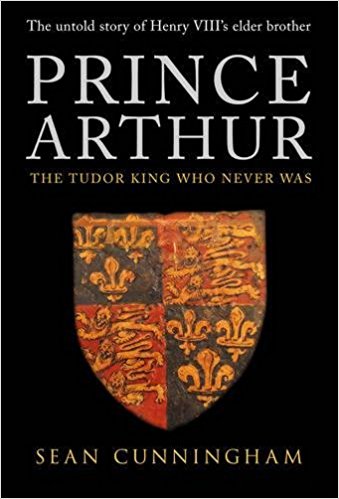
HISTORICAL BOOK REVIEW SERIES: ‘Prince Arthur – The King Who Never Was’ by Sean Cunningham

During the early part of the sixteenth century England should have been ruled by King Arthur Tudor, not Henry VIII. Had the first-born son of Henry VII lived into adulthood, his younger brother Henry would never have become King Henry VIII. The subsequent history of England would have been very different; the massive religious, social and political changes of Henry VIII’s reign might not have been necessary at all.

In naming his eldest son Arthur, Henry VII was making an impressive statement about what the Tudors hoped to achieve as rulers within Britain. Since the story of Arthur as a British hero was very well known to all ranks of the Crown’s subjects, the name alone gave the young prince a great deal to live up to. Arthur’s education and exposure to power and responsibility, not to mention his marriage to a Spanish princess in Catherine of Aragon, all indicate that the young prince was being shaped into a paragon of kingship that all of Britain could admire.

This book explores all of these aspects of Prince Arthur’s life, together with his relationship with his brother, and assesses what type of king he would have been.

cover and blurb via amazon

~~

Henry VIII is far from the only man who took a throne and went mad. Some tend to be hard on him, as if he was the only angry ruler the world saw, making it easy to say ‘what would have happened if Arthur had never died?’

Henry VIII was the king who shouldn’t have been, making Prince Arthur the king who never was. Here is the book to answer all your questions had King Arthur I taken his place in history.

Arthur was born to role. The first child of his parents, Henry VII and Elizabeth of York. Much has been made of little Arthur; some claim him fragile since birth, others draw the opposite conclusion. From a young age, Prince Arthur was given a top education, given a reigning position as Prince of Wales, close to his father the king.

Arthur was treated like a precious jewel, the king who would reign after the bloody battles of the War of the Roses. Arthur was the blood of the house of Lancaster and York combined; his existence alone suggested constant unity and peace. Given an education both in practical subjects, plus religion and humanism, Arthur got involved in local matters as a child, at his father’s side, completely prepared to take over England when the time came. Arthur had siblings, first a sister Margaret, then the spare heir Henry, and little Mary, to be followed by Elizabeth, Edmund and Katherine who all did not survive infancy. Henry and the girls were kept with their mother while Arthur was cradled for brilliance.

Officially married in 1501 after four years of being married by proxy, 15-year-old Arthur was to move to his castle in Ludlow, to rule over Wales, as his title suggested. Princess Katherine of Aragon was at his side, a Spanish princess there to ensure that Arthur’s future children would be recognised as the sole rulers of England, to soothe Henry VII’s constant fears of being usurped. Arthur boasted of bedding his new bride, words that would live for all time.

Only a few months into the marriage, Prince Arthur died at Ludlow Castle, of possible sweating sickness, leaving a widow not pregnant with the future heir. While spoiled little Henry would take the crown seven years later, along with the princess, England never got their perfect king. Queen Elizabeth died only a year after Arthur, and Henry kept his son hidden away, in the fear something might happen to his remaining son. Little Henry should have been given Arthur’s education, yet received nothing.

It is easy to suggest that Arthur’s reign would have been different. Naturally, there would have been differences. Henry broke from Catholicism in order to get rid of his wife of twenty years, on the grounds that Katherine had slept with Arthur, which she denied all her days. It is easy to say the Protestant Reformation would have never occurred in England without Henry’s need for divorce. Reformation would have come to England without Henry’s divorce, but simply would have taken a different route, as it did with other nations. Henry divorced to gain an heir with another woman, the exact same pressure Arthur would have faced if he couldn’t produce a son to inherit. For all his kindness and intelligence, Arthur could have suffered the same infertility problems as his little brother.

Cunningham’s book gives you an insight to the life of King Arthur I. It is impossible to tell for certain, but here is a good best-case scenario, with a fine leader on the throne, and a stable dynasty as a result.