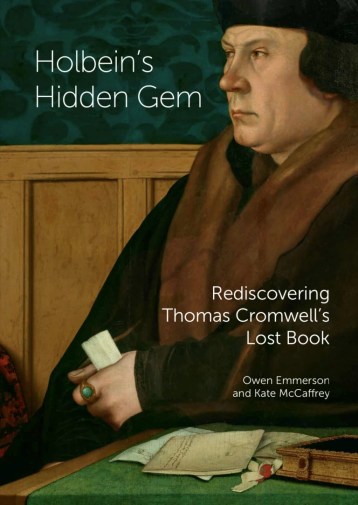
BOOK REVIEW: Holbein’s Hidden Gem: Rediscovering Thomas Cromwell’s Lost Book by Dr Owen Emmerson & Kate McCaffrey

In a discovery branded the most exciting Thomas Cromwell finding ‘in a generation’, historians Kate McCaffrey and Dr Owen Emmerson chart their discovery of a Book of Hours that once belonged to Thomas Cromwell, King Henry VIII’s Chief Minister. Hidden in plain sight, and recognised by Hever Castle’s curator Alison Palmer, the book is one of the only extant objects captured in a Tudor portrait, for it features in Hans Holbein the Younger’s celebrated painting of Cromwell.

Anyone familiar with this site or my work will surely understand how excited I was when I heard whispers of the discovery of Thomas Cromwell’s Book of Hours. To think Cromwell’s book, shown in the one and only surviving portrait of the man, could have sat undiscovered in the Wren Library for hundreds of years, only to be discovered as part of a different project, is the dream of a lifetime for any historian.

Holbein’s Hidden Gem: Rediscovering Thomas Cromwell’s Lost Book delivers a captivating exploration of a remarkable historical artefact and the discovery of the prayer book belonging to Thomas Cromwell, one of the most influential figures of Henry VIII’s court.

Emmerson and McCaffrey provide essential context about Thomas Cromwell and the work of Hans Holbein, but at the heart of the book lies in the analysis of the Cromwell Book of Hours itself. The authors take readers on a journey through the pages of this beautifully preserved book, exploring its contents, its symbolism, and its historical significance. Through detailed descriptions and insightful commentary, the authors highlight the ways the Book reflects beliefs, religious practices, and cultural interests in the Tudor period.

This book tells the story of the authors’ discovery and the evidence that links it to the Sadler family – Ralph Sadler being Cromwell’s ward, friend and protégé between 1514 – 1540. Emmerson and McCaffrey show readers  how the discovery was made, and the trail of evidence that links it to the Sadler family – Ralph Sadler was a close friend and protégé of Cromwell, and it was the wife of his grandson who donated it to the college. Emmerson and McCaffrey also examine the evidence that proves this Book to be the exact one in the famous 1532 Hans Holbein portrait of Henry VIII’s chief minister.  The book takes readers through the journey to ensuring the authenticity of the Book and its provenance, guiding readers through the various stages of how an item is proven as authentic, followed by well-written and knowledgeable insight proving what can be guaranteed in the study, and what remains unknown.

Cromwell’s Book of Hours was discovered while the authors were hosting an exhibition of the exact same Books belonging to Katharine of Aragon and Anne Boleyn on display at Hever Castle, and how this third copy came to be shown to the world once again.  These authors have literally redefined history with their work in these books, and for this Cromwell lover, it gives hope that certain items of the great man may still exist. The world should be grateful these remarkable Books, created in the late 1520s, are in such safe hands with people like Dr Owen Emmerson and Kate McCaffrey.

Holbein’s Hidden Gem: Rediscovering Thomas Cromwell’s Lost Book is only available through Hever Castle.

HISTORICAL BOOK REVIEW SERIES: ‘In the Footsteps of the Six Wives of Henry VIII’ by Sarah Morris and Natalie Grueninger

This book provides a fresh perspective on the lives of Henry VIII’s six wives by embarking on a journey through the manors, castles and palaces in which their lives were played out. This journey traces their steps to the Alhambra in Spain, childhood home of Katherine of Aragon; to the very room at Acton Court where Anne Boleyn and Henry VIII publicly dined; through the cobbled grounds of Hampton Court Palace, which bore witness to both triumph and tragedy for Jane Seymour; into the streets of Düsseldorf in Germany, birthplace of Anne of Cleves; among the ruins and picturesque gardens of St Mary’s Abbey in York where Catherine Howard and Henry VIII rested at the pinnacle of the 1541 progress; and to Gainsborough Old Hall in Lincolnshire, where Katherine Parr lived as daughter-in-law of the irascible Sir Thomas Brough.

Each location is described in a fascinating narrative that unearths the queens’ lives in documents and artefacts, as well as providing practical visitor information based on the authors’ first-hand knowledge of each site. Accompanied by an extensive range of images including timelines, maps, photographs and sketches, this book brings us closer than ever to the women behind the legends, providing a personal and illuminating journey in the footsteps of the six wives of Henry VIII.

cover and blurb via amazon

~~

For everything Henry VIII did, all anyone remembers is the fact he married six times. To be fair, he isn’t all that different to many guys – gets to middle-age and freaks out and wants to date younger women, usually blondes. And like most of these scenarios, who the women are doesn’t matter so much, but to those of us who do know these women, they are far more fascinating than the man they married.

Whether or not you know your Annes from your Katherines from your Jane, this book is a different take on the six queens of England. Morris and Grueninger, rather than writing the history of these women, have instead mapped out their lives, detailing the places where they lived their extraordinary lives, a tour of their time as queens.

Katherine no.1 was England’s queen, but she began her life in Spain, and the authors have included this history in the detail of her life, such as the details of the Alcazar in Seville and in the incredible Alcazar in Cordoba, and naturally, the Alhambra. On the other side of her life, Katherine’s time pushed aside as a forgotten wife is even detailed, something I found invaluable.

Anne Boleyn’s life gets a vivid recreation at Hever Castle, before she headed to Flanders and France. Of course, her time in the Tower before execution is all laid out (in fact, there is a whole extra book!). Jane Seymour led a more simple life, but the now well-known Wolf Hall is there, along with Mercer’s Hall and Chester Place in London.

Next came Anne no.2, one of my personal favourites, and what a varied life Anne of Cleves lived. She grew up by the Rhine in Düsseldorf; she and her sister were painted by Holbein himself at Schloss Hambach. Anne travelled through Antwerp, staying at England House, and onto Bruges, Calais, before she passed through Deal and Dover Castles in Kent. Anne lived in many beautiful places before being given The King’s Manor, a 100-room palace in Dartford. Oh, to see what Anne of Cleves saw in her time!

Katherine no.2, little Katherine Howard, started her life at Norfolk House in London and Horsham, where many of her problems began. Katherine’s young eyes take readers to Oatlands Palace, Grimsthorpe Castle in Lincolnshire, north into York and more before she ended her days in the Tower. Katherine no.3, the intelligent Katherine Parr, had been married and widowed twice before the king all-but forced her into marriage. She started life at Rye House in Hertfordshire, before moving between castles in Lincolnshire, Cumbia and North Yorkshire. As queen, Katherine lived in Woking Place in Surrey, including when she ruled as regent in Henry’s absence while fighting in France. The now-mythical Nonsuch Palace in Surrey also makes an entry.

I can’t tell you how many places are meticulously detailed in this book. The level of  information and attention is unquestionable in this beautiful book and there is absolutely no book which can give readers insight such as this one. I cannot thank the authors enough for this book, I originally got a copy at the library but went and ordered a copy for myself straight away.