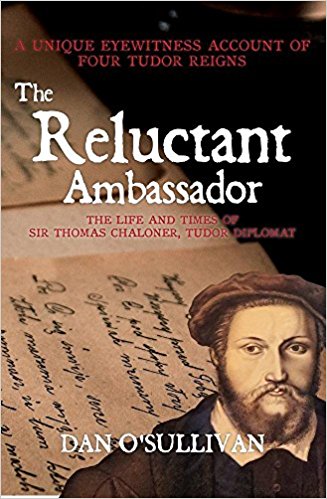
HISTORICAL BOOK REVIEW SERIES: ‘ The Reluctant Ambassador’ by Dan O’Sullivan

Sir Thomas Chaloner achieved much during his short life. As someone at the heart of four Tudor courts, his experience is fascinating.

Serving in the household of Thomas Cromwell after university, he later was entrusted with delicate diplomatic missions in France, Scotland, Flanders and finally Spain, where he was resident ambassador at the court of Philip II. His career was helped by his close friendship with William Cecil, whom he got to know at Oxford. He managed to stay employed during the religious and political upheavals of four reigns, while many close to him lost their positions and even their lives.

Chaloner was an intellectual and a humanist. He had a close circle of literary friends with whom he collaborated in the staging of court masques and other productions. He produced reams of verse and also translated several works from Latin, among them The Praise of Folly by Erasmus.

In Spain, Chaloner devoted much energy toward trying to save dozens of English sailors who had found themselves imprisoned as a result of bitter trade disputes between England and Spain. The stresses of his job weakened him physically, and he died soon after his recall, leaving a wife and young son.

Dan O’Sullivan explores the life of Chaloner and delves into the intricacies of European court life during the time of the Tudors. Chaloner, a reluctant ambassador who longed for his home in England, is a fascinating but little-known character who is here brought to life in vivid detail.

cover and blurb via amazon

~~

In 1541, Holy Roman Emperor Charles, who ruled much of Europe, went to war against the Turks and the Barbary pirates. He planned to besiege Algiers to free Christians from pirates, but could not attack Constantinople, as he did not have the numbers. One of these men onboard was Thomas Chaloner, on his first trip abroad from England. The fleet was caught in a storm, resulting in the loss of 8,000 lives as ships sank.

Chaloner was lucky; he could swim, unlike most. In fact, he had much luck in his early life. With a wealthy merchant father, Chaloner went to Cambridge and was given a job in Thomas Cromwell’s house. Still in his teen years, Chaloner could ready himself for life at court, learn politics and Latin, Italian and French. At St Johns College, he made a friend named William Cecil, which would help Chaloner again later in life.

Chaloner had sailed abroad as a diplomat, there to represent England while Charles V took on the Turks, and was one of the few who survived the Mediterranean storms. He went home to a new England – wife number five of Henry, Katherine Howard, was about to die. But change helped, as Chaloner gained a place on the privy council as a clerk, and as Henry failed to rule his country properly, or had Thomas Cromwell to fall back on, Chaloner was there with the men who ran England, while still in his early twenties.

.

Chaloner had languages, and this made him key as a diplomat, both with overseas missions as England forged wars, and at home. By 1547, Chaloner was negotiating with the Scots to stop fighting and help gain a royal marriage for his young new king. Chaloner felt high in esteem at court, already wealthy with his inheritance and marriage to a wealthy widow. He was a humanist, enjoying the Protestant reformation.

Edward IV died in 1553 and while Chaloner’s school friend, William Cecil, and countless more fled to Europe, Chaloner decided to try to stay working for the government through the Catholic changes brought by Queen Mary. Chaloner wrote poems for Jane Grey, beheaded after her nine days as queen, but quietly managed to stay alive and work for Mary.

By by 1558, Mary was dead, and many flocked home to their Protestant princess as she was crowned Elizabeth I. Constant Chaloner was sent to meet the Holy Roman Emperor  to discuss marriage for Elizabeth, her most difficult issue throughout her reign. Chaloner then travelled to the Netherlands on Her Majesty’s behalf, only to learn his school friend, William Cecil, now Elizabeth’s right-hand man, had selected him to be ambassador to Spain.
.
Chaloner hated Spain, with its Catholic soul and its intense heat. He hated Madrid with a passion; it cost too much, he never got much time with the king, and the Spanish didn’t let him be part of their secret conversations. Chaloner seemed to worry about everything, especially about being robbed of his wage as ambassador. Trouble came when Chaloner told the Spanish court that England would not support the Huguenots in France during civil war, only to find out the English had headed to battle.
.
One thing fell into place for Chaloner; he couldn’t sleep in Spain and the food made him ill. Because of this, he had many nights awake, when he got write Latin poems. The poems told much of Chaloner’s time in Spain; after four years, he was convinced he would die and worried about everything.
.
It was a bad time to be at the Spanish court. England was not popular with Spain, ships constantly were embattled, bureaucracy was, well, Spanish, the inquisitions were in full swing. Chaloner ended up with kidney stones from Spanish wine mixed with lime and chalk. His only bright spot was a woman named Audrey Frodsham, who travelled to Spain from England with a view to marry Chaloner once his first wife died. The trip must have gone well, because Audrey went home pregnant.
.
After arguing with the Spanish government over English sailors in Spanish prisons for several years, Chaloner was finally allowed to return home to England. In 1565, he landed in England to find Audrey in his house, with a young baby in tow, named Thomas jnr. Chaloner married Audrey and then died a month later of illness.
.
 Chaloner was a man able to serve in four royal households in a time when many lost their head. As much as he liked to complain, Chaloner must have been doing something right, even if it did make him into a hypochondriac. I had never even heard of Chaloner until I read this book, and a big thanks to the author for a vivid book about a lesser-known Tudor figure.

HISTORICAL BOOK REVIEW SERIES: ‘Jane the Quene’ by Janet Wertman

All Jane Seymour wants is a husband; but when she catches the eye of a volatile king, she is pulled deep into the Tudor court’s realm of plot and intrigue….

England. 1535. Jane Seymour is 27 years old and increasingly desperate for the marriage that will provide her a real place in the world. She gets the perfect opportunity to shine when the court visits Wolf Hall, the Seymour ancestral manor. With new poise born from this event, it seems certain that her efficiency and diligence will shine through and finally attract a suitor.

Meanwhile, King Henry VIII is 45 and increasingly desperate for a son to secure his legacy. He left his first wife, a princess of Spain, changing his country’s religion in the process, to marry Anne Boleyn — but she too has failed to deliver the promised heir. As Henry begins to fear he is cursed, Jane Seymour’s honesty and innocence conjure redemption. Thomas Cromwell, an ambitious clerk who has built a career on strategically satisfying the King’s desires, sees in Jane the perfect vehicle to calm the political unrest that threatens the country: he engineers the plot that ends with Jane becoming the King’s third wife.Jane believes herself virtuous and her actions justified, but early miscarriages shake her confidence and hopes.

How can a woman who has done nothing wrong herself deal with the guilt of how she unseated her predecessor?

~~

Jane’s story begins in 1525, where at age 18 is still unmarried and becomes a maid of honour for mighty Katherine of Aragon. Jane is a quiet girl, keen to be part of the court instead of being a lowly spinster at home. But Jane’s tuition at court is placed in the hands of two other maids to the queen – Anne and Mary Boleyn. They are distant cousins to Jane, but quiet Jane finds the pair to be disingenuous – Mary is already the king’s mistress, and rumours swirl of Anne’s virtue also. Jane, who sees herself as fair and perfect, considers her cousins to be intimidating and foolish, and they care not for the company of boring Jane. Years pass and Jane works in the court, slowly rising in favour until poor Katherine is ousted.
 .
 But then Jane’s cousin Anne Boleyn is finally elevated from mistress to Henry’s side as queen. Jane is still unwed, a seemingly boring woman in the company of Queen Anne, who sees nothing in her lady. But trouble soon comes when Anne gives birth to a daughter for Henry.
 .
Jane isn’t the only Seymour at court; her young sister Elizabeth found a husband quickly and the Seymours decide to swap out Jane for another sister, Dorothy. Quiet Jane needs a plan; she goes home to Wolf Hall, where the king plans to stay on summer progress, to host the royal party, and in return her brother will find her a decent husband.
 But while everyone thinks they know Jane Seymour, quiet Jane is a totally new woman. Only she can interest Henry; not brash like Anne Boleyn, but no weakling as her family assumes. Jane has a plan all of her own. Jane goes into training; she will be no whore, and she will be no Anne Boleyn either. Jane wants better for herself and she is no pawn any longer. Jane is ready to stand up, and play her part at court, all to claim what she wants – the crown itself.
 .
Jane is always written as the boring queen and I enjoyed reading a book where she was anything but. Jane plays the games at court well, ready to scheme her way onto the throne, rather than being shoved on by her brother. Her brother Edward is a likable man, a product of his time, and young brother Thomas is a cad, as history suggests. Everyone knows of Edward’s second wife Anne, the bitchy sidekick of her husband. This time, Anne is a kinder woman, while my book-husband Thomas Cromwell is a man who can work with anyone, always ready to come out on top. Cromwell’s POV is used a little too, which was a bonus for me.
 .
 It was fun to read Jane’s perspective, who is sometimes seen as appearing from nowhere to take a king, when she was instead in the background, understanding court politics. And this book is the first in a series, so make room on your shelf!

HISTORICAL BOOK REVIEW SERIES: ‘Young and Damned and Fair: The Life of Catherine Howard, Fifth Wife of King Henry VIII’ by Gareth Russell

Written with an exciting combination of narrative flair and historical authority, this interpretation of the tragic life of Catherine Howard, fifth wife of Henry VIII, breaks new ground in our understanding of the very young woman who became queen at a time of unprecedented social and political tension and whose terrible errors in judgment quickly led her to the executioner’s block.

On the morning of July 28, 1540, as King Henry’s VIII’s former confidante Thomas Cromwell was being led to his execution, a teenager named Catherine Howard began her reign as queen of a country simmering with rebellion and terrifying uncertainty. Sixteen months later, the king’s fifth wife would follow her cousin Anne Boleyn to the scaffold, having been convicted of adultery and high treason.

The broad outlines of Catherine’s career might be familiar, but her story up until now has been incomplete. Unlike previous accounts of her life, which portray her as a naïve victim of an ambitious family, this compelling and authoritative biography will shed new light on Catherine Howard’s rise and downfall by reexamining her motives and showing her in her context, a milieu that goes beyond her family and the influential men of the court to include the aristocrats and, most critically, the servants who surrounded her and who, in the end, conspired against her. By illuminating Catherine’s entwined upstairs/downstairs worlds as well as societal tensions beyond the palace walls, the author offers a fascinating portrayal of court life in the sixteenth century and a fresh analysis of the forces beyond Catherine’s control that led to her execution—from diplomatic pressure and international politics to the long-festering resentments against the queen’s household at court.

Including a forgotten text of Catherine’s confession in her own words, color illustrations, family tree, map, and extensive notes, Young and Damned and Fair changes our understanding of one of history’s most famous women while telling the compelling and very human story of complex individuals attempting to survive in a dangerous age.

cover and blurb via amazon

~~

I have to admit that I am no fan of Catherine Howard. By the time that Henry married Catherine, he was fat, demented and most importantly (to me), had turned against my book-husband Thomas Cromwell. So I read little about wife number five. The whole Catherine Howard incident is just one big hot mess, and one of the main indicators of how far Henry had already fallen.

King Henry had spent twenty years on the throne as a golden king, praised by all in word and art, so to cement a legacy, but Henry’s third decade showed signs of decay. By the time that Henry had denied Anne of Cleves because of his erectile issues, it was little Catherine Howard who had accidentally wandered into view, as a teenage attendant to Anne. Anne of Cleves was an educated, travelled woman and Henry was more in need of a child who had no thoughts or opinions and could be manipulated by a man who would make a better grandfather than lover.

The English court expected women to be virgins, perfect and untouched in every way. Yet men roamed freely, unguarded in their desires, as if their meddling had no effect on virginity. Catherine Howard was a simple girl, raised away from family and without anyone really caring for her. Catherine makes the perfect victim to be targeted by an old weirdo.

Russell’s book tells the story about how court life would have been in Catherine’s time; the late 1530’s were an awful time all round, with Henry’s leg increasingly pressing upon his sanity, the country in revolt, and Anne of Cleves getting the blame for Henry’s lack of male…. well… just, ew.

Catherine was a victim of her own lifestyle, one she never chose. Without a decent education or people to confide in, she fell for charms of young men liked a pretty face. A sweet girl told whispers of love is easy prey for older men. By the time Catherine was sent to court to wait on the new Queen Anne, she had already become a victim of her own existence.

Henry, a fat, old man with a desire to feel special and young again, laid eyes on a girl, not a seductress or whore as claimed, but an innocent girl who was whisked away in the glamour of being courted by the most powerful man in the land. Henry had been married to Catherine’s cousin, Anne Boleyn, and yet Catherine had not been shown a caution around the king, and soon was caught up with a man who never loved her, rather loved the idea of her instead.

Catherine, covered in gowns and jewels, played the role of token on the king’s arm, only to fall in love – with someone else. A man who worked in Henry’s chamber, a man known to be a disgusting human being in his own right, was happy to let Catherine’s feelings run away with her, thinking she could have romance in her life while playing concubine to an ailing fat man.

Catherine’s life ended far too soon, scared, alone and never believed in her words and deeds. A young girl who wanted, needed, to be loved, was instead used and abused by everyone, a minor detail in a long story of depravity that was the end of Henry’s reign. It is nice to read about the life and facts of Catherine, instead of whore narratives.


HISTORICAL BOOK REVIEW SERIES: ‘Catherine of Aragon: An Intimate Life of Henry VIII’s True Wife’ by Amy Licence

Catherine of Aragon continues to fascinate readers 500 years after she became Henry VIII’s first queen. Her life was one of passion and determination, of suffering and hope, but ultimately it is a tragic love story, as circumstances conspired against her. Having lost her first husband, Henry’s elder brother Prince Arthur, she endured years of ill health and penury, to make a dazzling second match in Henry VIII. There is no doubt that she was Henry’s true love, compatible with him in every respect and, for years, she presided over a majestic court as the personification of his ideal woman. However, Catherine’s body failed her in an age when fertility meant life or death. When it became clear that she could no longer bear children, the king’s attention turned elsewhere, and his once chivalric devotion became resentment. Catherine’s final years were spent in lonely isolation but she never gave up her vision: she was devoted to her faith, her husband and to England, to the extent that she was prepared to be martyred for them. One of the most remarkable women of the Tudor era, Catherine’s legendary focus may have contributed to the dissolution of the way of life she typified.

cover and blurb via amazon

~~

If it’s about Catherine of Aragon, it’s going in my collection. Catherine is my favourite queen/wife of the six, an intriguing woman, and not just because of what she suffered through while being the wife Henry scorned.

Books by Amy Licence are around me in all directions; in any burst of reviews I do, there will be an Amy Licence among them. The best part about Amy Licence is that she doesn’t write wives, daughters, etc, she write about women. Yes, there is a difference, boys.

This beautiful golden book is divided into seven parts, starting with a section on Catherine’s origins, her ancestry and, of course, her glorious mother, Queen Isabella, before moving onto the negotiation of Catherine’s move to England.

Catherine’s short marriage to Arthur is given ample detail as well as the question of did-they-didn’t-they. Rather than relying on words said by others, whether they considered themselves eyewitnesses or not, Licence has made practical and reasonable suggestions around the issue.

Catherine’s difficult years as a widow, left wanted and unwanted over seven painful years is detailed, which shows much of Catherine’s ever-growing strength and her Catholic devotion. The early years of her beautiful and beloved marriage is also included, before the changing years after the death of her final child.

The “Great Matter” naturally takes a large chunk of the book, and I particularly enjoyed the section on Catherine’s time in exile and martyrdom as she stuck to her beliefs and principles. There really has been no queen like Catherine, no queen as wise, astute, educated, understanding and well-nurtured as Catherine. No amount of books on the subject is enough.

Licence’s latest book is beautifully written, and Catherine is not the dour woman of many portrayals, but a learned woman who went through so much, and seemed prepared to weather all of it. I truly love this book. No review could cover this wonderful biography.

HISTORICAL BOOK REVIEW SERIES: ‘In the Footsteps of the Six Wives of Henry VIII’ by Sarah Morris and Natalie Grueninger

This book provides a fresh perspective on the lives of Henry VIII’s six wives by embarking on a journey through the manors, castles and palaces in which their lives were played out. This journey traces their steps to the Alhambra in Spain, childhood home of Katherine of Aragon; to the very room at Acton Court where Anne Boleyn and Henry VIII publicly dined; through the cobbled grounds of Hampton Court Palace, which bore witness to both triumph and tragedy for Jane Seymour; into the streets of Düsseldorf in Germany, birthplace of Anne of Cleves; among the ruins and picturesque gardens of St Mary’s Abbey in York where Catherine Howard and Henry VIII rested at the pinnacle of the 1541 progress; and to Gainsborough Old Hall in Lincolnshire, where Katherine Parr lived as daughter-in-law of the irascible Sir Thomas Brough.

Each location is described in a fascinating narrative that unearths the queens’ lives in documents and artefacts, as well as providing practical visitor information based on the authors’ first-hand knowledge of each site. Accompanied by an extensive range of images including timelines, maps, photographs and sketches, this book brings us closer than ever to the women behind the legends, providing a personal and illuminating journey in the footsteps of the six wives of Henry VIII.

cover and blurb via amazon

~~

For everything Henry VIII did, all anyone remembers is the fact he married six times. To be fair, he isn’t all that different to many guys – gets to middle-age and freaks out and wants to date younger women, usually blondes. And like most of these scenarios, who the women are doesn’t matter so much, but to those of us who do know these women, they are far more fascinating than the man they married.

Whether or not you know your Annes from your Katherines from your Jane, this book is a different take on the six queens of England. Morris and Grueninger, rather than writing the history of these women, have instead mapped out their lives, detailing the places where they lived their extraordinary lives, a tour of their time as queens.

Katherine no.1 was England’s queen, but she began her life in Spain, and the authors have included this history in the detail of her life, such as the details of the Alcazar in Seville and in the incredible Alcazar in Cordoba, and naturally, the Alhambra. On the other side of her life, Katherine’s time pushed aside as a forgotten wife is even detailed, something I found invaluable.

Anne Boleyn’s life gets a vivid recreation at Hever Castle, before she headed to Flanders and France. Of course, her time in the Tower before execution is all laid out (in fact, there is a whole extra book!). Jane Seymour led a more simple life, but the now well-known Wolf Hall is there, along with Mercer’s Hall and Chester Place in London.

Next came Anne no.2, one of my personal favourites, and what a varied life Anne of Cleves lived. She grew up by the Rhine in Düsseldorf; she and her sister were painted by Holbein himself at Schloss Hambach. Anne travelled through Antwerp, staying at England House, and onto Bruges, Calais, before she passed through Deal and Dover Castles in Kent. Anne lived in many beautiful places before being given The King’s Manor, a 100-room palace in Dartford. Oh, to see what Anne of Cleves saw in her time!

Katherine no.2, little Katherine Howard, started her life at Norfolk House in London and Horsham, where many of her problems began. Katherine’s young eyes take readers to Oatlands Palace, Grimsthorpe Castle in Lincolnshire, north into York and more before she ended her days in the Tower. Katherine no.3, the intelligent Katherine Parr, had been married and widowed twice before the king all-but forced her into marriage. She started life at Rye House in Hertfordshire, before moving between castles in Lincolnshire, Cumbia and North Yorkshire. As queen, Katherine lived in Woking Place in Surrey, including when she ruled as regent in Henry’s absence while fighting in France. The now-mythical Nonsuch Palace in Surrey also makes an entry.

I can’t tell you how many places are meticulously detailed in this book. The level of  information and attention is unquestionable in this beautiful book and there is absolutely no book which can give readers insight such as this one. I cannot thank the authors enough for this book, I originally got a copy at the library but went and ordered a copy for myself straight away.