
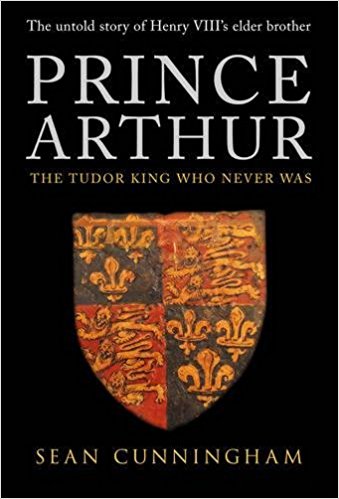
During the early part of the sixteenth century England should have been ruled by King Arthur Tudor, not Henry VIII. Had the first-born son of Henry VII lived into adulthood, his younger brother Henry would never have become King Henry VIII. The subsequent history of England would have been very different; the massive religious, social and political changes of Henry VIII’s reign might not have been necessary at all.
In naming his eldest son Arthur, Henry VII was making an impressive statement about what the Tudors hoped to achieve as rulers within Britain. Since the story of Arthur as a British hero was very well known to all ranks of the Crown’s subjects, the name alone gave the young prince a great deal to live up to. Arthur’s education and exposure to power and responsibility, not to mention his marriage to a Spanish princess in Catherine of Aragon, all indicate that the young prince was being shaped into a paragon of kingship that all of Britain could admire.
This book explores all of these aspects of Prince Arthur’s life, together with his relationship with his brother, and assesses what type of king he would have been.
~~
Henry VIII is far from the only man who took a throne and went mad. Some tend to be hard on him, as if he was the only angry ruler the world saw, making it easy to say ‘what would have happened if Arthur had never died?’
Henry VIII was the king who shouldn’t have been, making Prince Arthur the king who never was. Here is the book to answer all your questions had King Arthur I taken his place in history.
Arthur was born to role. The first child of his parents, Henry VII and Elizabeth of York. Much has been made of little Arthur; some claim him fragile since birth, others draw the opposite conclusion. From a young age, Prince Arthur was given a top education, given a reigning position as Prince of Wales, close to his father the king.
Arthur was treated like a precious jewel, the king who would reign after the bloody battles of the War of the Roses. Arthur was the blood of the house of Lancaster and York combined; his existence alone suggested constant unity and peace. Given an education both in practical subjects, plus religion and humanism, Arthur got involved in local matters as a child, at his father’s side, completely prepared to take over England when the time came. Arthur had siblings, first a sister Margaret, then the spare heir Henry, and little Mary, to be followed by Elizabeth, Edmund and Katherine who all did not survive infancy. Henry and the girls were kept with their mother while Arthur was cradled for brilliance.
Officially married in 1501 after four years of being married by proxy, 15-year-old Arthur was to move to his castle in Ludlow, to rule over Wales, as his title suggested. Princess Katherine of Aragon was at his side, a Spanish princess there to ensure that Arthur’s future children would be recognised as the sole rulers of England, to soothe Henry VII’s constant fears of being usurped. Arthur boasted of bedding his new bride, words that would live for all time.
Only a few months into the marriage, Prince Arthur died at Ludlow Castle, of possible sweating sickness, leaving a widow not pregnant with the future heir. While spoiled little Henry would take the crown seven years later, along with the princess, England never got their perfect king. Queen Elizabeth died only a year after Arthur, and Henry kept his son hidden away, in the fear something might happen to his remaining son. Little Henry should have been given Arthur’s education, yet received nothing.
It is easy to suggest that Arthur’s reign would have been different. Naturally, there would have been differences. Henry broke from Catholicism in order to get rid of his wife of twenty years, on the grounds that Katherine had slept with Arthur, which she denied all her days. It is easy to say the Protestant Reformation would have never occurred in England without Henry’s need for divorce. Reformation would have come to England without Henry’s divorce, but simply would have taken a different route, as it did with other nations. Henry divorced to gain an heir with another woman, the exact same pressure Arthur would have faced if he couldn’t produce a son to inherit. For all his kindness and intelligence, Arthur could have suffered the same infertility problems as his little brother.
Cunningham’s book gives you an insight to the life of King Arthur I. It is impossible to tell for certain, but here is a good best-case scenario, with a fine leader on the throne, and a stable dynasty as a result.
 CAROLINE ANGUS