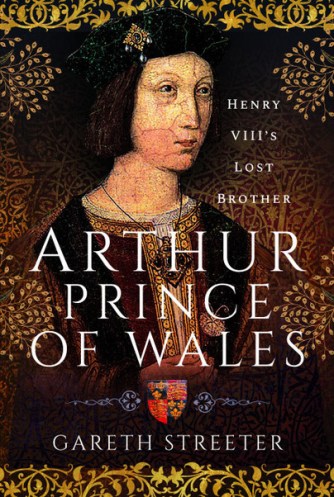
BOOK REVIEW: Arthur, Prince of Wales by Gareth Streeter

For too long, Arthur Tudor has been remembered only for what he never became. The boy who died prematurely and paved the way for the revolutionary reign of his younger brother, Henry VIII.
Yet, during his short life, Arthur was at the centre of one of the most tumultuous periods of England’s history. At the time of his birth, he represented his father’s hopes for a dynasty and England’s greatest chance of peace. As he grew, he witnessed feuds, survived rebellion and became the focal point of an international alliance.
From the threat of pretenders to West Country rebellions, the dramatic twists and turns of early Tudor England preoccupied Arthur’s thoughts. At a young age, he was dispatched to the Welsh border, becoming a figure head for a robust regional government. While never old enough to exercise full power in his dominion, he emerged as a figure of influence, beseeched by petitioners and consulted by courtiers. While the extent of his personal influence can only be guessed at, the sources that survive reveal a determined prince that came tantalisingly close to forging his future.
Finally, after years of negotiation, delay and frustration, the prince finally came face to face with his Spanish bride, Katharine of Aragon. The young couple had shared a destiny since the cradle. Securing the hand of this prestigious pride for his son had been a centre piece of Henry VII’s foreign policy. Yet, despite being 14 years in the making, the couple were to enjoy just five months together before Arthur succumbed to a mysterious illness.
Arthur’s death at the age of 15 was not just a personal tragedy for his parents. It changed the course of the future and deprived England of one of the most educated and cultivated princes in their history. Arthur would never wear the crown of England. But few Princes of Wales had been better prepared to rule.
‘Arthur, Prince of Wales: Henry VIII’s lost brother’ shows that Arthur Tudor was more than a prince who died. He was a boy that really lived.

In Arthur, Prince of Wales Gareth Streeter meticulously reconstructs the life and legacy of one of Tudor England’s questioned royal figures. What sort of king would Arthur have been? It is an interesting question, but the fifteen years Arthur spent alive are often forgotten in the wonders of what could have been. Drawing on historical sources and archival material, this book offers a portrait of Prince Arthur’s life, his childhood, upbringing,  and education, and his lasting impact on English history.

Streeter begins by tracing Arthur’s early years, from his birth in 1486 as the first son of King Henry VII and Elizabeth of York, to his education and training as the heir to the English throne. Through vivid storytelling and insightful analysis, the author explores the challenges and expectations that accompanied Arthur’s position as the future king, painting a picture of the royal court and the political intrigues of the time.

One of the book’s most compelling aspects is its exploration of Arthur’s marriage to Katharine of Aragon, a union intended to forge an alliance between England and Spain. Streeter delves into the complexities of their relationship, from their initial meeting to their wedding and wedding night(s), offering insights into the dynamics of their marriage and the role it played in shaping the course of English history.

Arthur, Prince of Wales provides a detailed account of Arthur’s brief reign as Prince of Wales, a period marked by hope and anticipation for the future of the Tudor dynasty. The author examines Arthur’s efforts to establish himself as a future ruler, as well as the challenges his father faced in asserting his authority in a kingdom still recovering from years of civil war and instability.

Tragically, Arthur’s reign was cut short by his untimely death in 1502, just months after his marriage to Katharine. The author explores the circumstances surrounding Arthur’s demise, including the various theories and rumours which have surrounded his death for centuries, and the realities his death brought to Katharine, his parents, and England.

Arthur, Prince of Wales is a patiently researched biography that offers a different perspective on one of England’s most intriguing royal figures. The narrative style makes this book a must-read for anyone interested in the Tudor era and the individuals who shaped it.

Available from Pen & Sword here

HISTORICAL BOOK REVIEW: ‘Henry VII and the Tudor Pretenders’ by Nathen Amin

On 22 August 1485, Henry Tudor emerged from the Battle of Bosworth victorious, his disparate army vanquishing the forces of Richard III. Yet, all was not well early in the Tudor reign. Despite later attempts to portray Henry VII as single-handedly uniting a war-torn England after three decades of conflict, the kingdom was anything but settled. Nor could it be after a tumultuous two-year period that had witnessed the untimely death of one king, the mysterious disappearance of another, and the brutal slaughter of a third on the battlefield. For the first time in one compelling and comprehensive account, Nathen Amin looks at the myriad of shadowy conspiracies and murky plots which sought to depose the Tudor usurper early in his reign, with particular emphasis on the three pretenders whose causes were fervently advanced by Yorkist dissidents—Lambert Simnel, Perkin Warbeck, and Edward, Earl of Warwick.

Purchase on Amazon here

~~

Henry VII gets grossly overlooked in favour of his son Henry VIII, which is surprising given how dramatic his role and life truly was. Henry’s life and rise to power are largely known through the well-worn stories of the War of the Roses and the tragic reign of poor Richard III, culminating in the Battle of Bosworth. Henry Tudor became king and the wars ended, or so many tales go.

There are a few good biographies of Henry VII out there, but Amin gives a new look and refreshing enthusiasm for a king who desperately deserves the attention. The 1480s and 1490s did not give Henry a moment’s peace, punctuated by the belief he was not a true king, and several other men deserved the crown. Henry should have been able to concentrate on putting England back together – he won the crown legitimately, married the daughter of Edward IV, followed quickly birth of a son born of a dual royal line. England should have been grateful for the level of peace Henry could provide.

Instead, the Battle of Stoke and the rise of Lambert Simnel, posing as either the ‘dead’ Edward V or Edward, Earl of Warwick came in 1487, a murky battle and claim to the throne, which Amin gives in full detail. No sooner than Simnel was subdued came the murmurings of Perkin Warbeck, claiming to be Richard, the ‘dead’ Duke of York. Children and young men posing as Henry’s beloved wife’s dead brothers would have placed significant strain on Henry and Elizabeth, who were doing their best to rule England. Throughout the constant rumours of planned coups, betrayals, even relatives and close confidants changing sides, Henry had to hold his country together, and the author shows him not to be the old miser commonly portrayed, but a man of kindness, loyalty, generosity and wisdom, all while seeing off years of undermining and instability.

The final main pretender is Edward, Earl of Warwick, who had been kept alive, like all pretenders, the sad son of the Duke of Clarence, who through no fault of his own needed to be kept under guard. Henry tried for years to be merciful, but if his Tudor dynasty was ever going to thrive, Henry needed to end the claims to his throne. Even after Henry’s grand coup of bringing Katherine of Aragon to England, the wannabes did not stop, and Henry worked harder than ever to secure England for his second son. The cobwebs of the old tales of Henry being a penny-pincher, a tax-collecting tyrant and generally miserable old man can be blown away by this book, showing the true Henry VII. Without spilling details that will create spoilers, Amin has gone to great lengths to find Henry’s true nature among the endless barrage of difficulties he faced. How Henry’s wife-collecting son gets more attention, I’ve never really understood.

This book is truly wonderful, well-planned and constructed, a real labour of love and determination that is a gift to readers.

no free book or money changed hands in return for this review

HISTORICAL BOOK REVIEW SERIES: ‘The House of Grey’ by Melita Thomas

The Grey family was one of medieval England’s most important dynasties. They were were on intimate terms with the monarchs and interwoven with royalty by marriage. They served the kings of England as sheriffs, barons and military leaders. In Henry IV’s reign the rivalry between Owain Glyndwr and Lord Grey of Rhuthun was behind the Welsh bid to throw off English dominance. His successor Edmund Grey played a decisive role at the Battle of Northampton when he changed allegiance from Lancaster to York. He was rewarded with the disputed lands and the earldom of Kent. By contrast his cousin, Sir John Grey, died at the second battle of St Albans, leaving a widow, Elizabeth née Woodville, and two young sons, Thomas and Richard. Astonishingly, the widowed Elizabeth caught the eye of Edward IV and was catapulted to the throne as his wife. This gave her sons an important role after Edward s death. The Greys were considered rapacious, even by the standards of the time and the competing power grabs of the Greys with Richard, Duke of Gloucester led to Richard Greys summary execution when Gloucester became king. His brother, Thomas, vowed revenge and joined Henry Tudor in exile.

When Thomas Grey’s niece, Elizabeth of York, became queen, the family returned to court, but Henry VII was wary enough of Thomas to imprison him for short time. Thomas married the greatest heiress in England, Cicely Bonville, their numerous children gained positions in the court of their cousin, Henry VIII, and his daughter, Mary. The 2nd Marquis was probably taught by Cardinal Wolsey but was a vigorous supporter of Henry VIII s divorce from Katharine of Aragon. But his son’s reckless involvement in Wyatt s rebellion ended in his own execution and that of his daughter, Lady Jane Grey, the ‘Nine Days Queen’. Weaving the lives of these men and women from a single family, often different allegiances, into a single narrative, provides a vivid picture of the English mediaeval and Tudor court, reflecting how the personal was always political as individual relationships and rivalries for land, power and money drove national events.

cover and text via Amberley Publishing

~~

I jumped with joy when Amberley kindly sent me a copy of this book. Thomas Cromwell was beloved by the Greys, and they are a big theme in my next Cromwell novel out next year. The Grey family has not been given enough of the spotlight, and yet they are always there, close beside the better-known members of the royal court, ready for their time to shine.

While the Grey family began in the late 1100s, it was Lord Reginald Grey of Rhuthun who rose to prominence under Henry IV, and is famous for his battles with the Welsh, and being held hostage due to failed plans. His son, Edmund Grey fought during the Wars of the Roses, splitting from his family, who supported the Lancasterians, and supported the Yorkist cause instead. His son John Grey continued to fight for the Lancastrian cause, but was killed at the Battle of St Albans in 1461, leaving his wife Elizabeth Woodville a young widow with two sons, Thomas and Richard. When she secretly remarried to King Edward IV, the Grey family became full Yorkist supporters. It is these sons Thomas and Richard the world already knows. As with many noble houses of the time period, divided loyalties were a major problem when making the wrong choice could mean death.

Richard, younger of the brothers, did well from his mother’s remarrriage, elevated at the royal court, and half-brother to the heir to the throne. But when Edward IV died in 1483, Richard Grey was executed beside his uncle Anthony Woodville, on Richard of Gloucester’s (Richard III’s) orders, aged only about 26. These killings sparked an already deeply divided power battle between the newly widowed queen and Richard III, her brother-in-law.

Elder brother Thomas Grey was a loyal Yorkist, and the Marquess of Dorset, and watched Richard III be crowned in London as his brother died, and soon after heard of the disappearance of the Princes of the Tower, his two young half-brothers. Thomas joined the Duke of Buckingham’s rebellion against Richard III, but when that rapidly failed, Thomas changed loyalties fled to Brittany to join Henry Tudor, who pledged to marry Thomas’ half sister Elizabeth of York, and rule England. Thomas was ready to invade England alongside Henry Tudor in 1485, only to hear that his mother had come to terms with Richard III, and he tried to desert the Lancastrian cause. Instead, he was captured by the French and held in Paris while the Battle of Bosworth saw Henry Tudor crowned Henry VII and step-uncle Richard III slain. Thomas was only released when Henry was on the throne and the new king could pay his French supporters.

Thomas Grey never recovered his influence in England after flipping between York and Lancaster, and was imprisoned during the Lambert Simnel uprising and the Battle of Stoke Field. Despite being the new queen’s brother, the cloud of treason hung over Thomas, and he enjoyed little favour until his death in 1501, aged only about 48. But Thomas had 14 children, including his heir and namesake, the 2nd Marquess of Dorset.

While his father suffered for his divided loyalties, the young Thomas Grey did well as the ward of Henry VII, only encountering trouble towards the end of the king’s life, when suspicion of treason was rife. But with the accession of Henry VIII, Thomas Grey sat comfortably for another twenty years as one of the few Marquess’ in England, until the King’s Great Matter started to divide the royal court. Grey, along with his brothers and their wives, were loyal to the king, and their Queen Katherine. The Grey family were again forced to take sides and divide their loyalties between Henry and Katherine, to their great disadvantage. But the Grey family, from Dowager Cecily Grey downwards, had the love and friendship of Thomas Cromwell, who gave them money, patronage and preference in the royal court. Thomas Grey died in 1530, leaving behind his  siblings, and also four sons and four daughters, among them Henry and Elizabeth.

While Elizabeth would go on to marry a friend of Cromwell’s, Lord Chancellor Thomas Audley, and live a happy life, Henry Grey was not the smartest man. (His grandmother Cecily asked Thomas Cromwell to watch out for him at court, guide him, possibly godfather his children, etc.) Henry married Frances Brandon, daughter to Charles Brandon and Henry VIII’s sister Mary, Queen of France; quite the coup. (Cromwell continued to favour the Grey family,and the Dudleys due to their connection in marriage to the Greys). Henry and Frances had the famous Grey three daughters – Jane, Katherine and Mary. Henry rose to the title of Duke of Suffolk after the death of his brother-in-law in 1551 (rather than earning a title), but it was Frances Brandon who was the brains of the pair, and their daughters, Jane especially, became the heirs of King Edward VI. Henry Grey saw his daughter Jane become queen for nine days in 1553, only for he and poor Jane to be overthrown, and beheaded a year after their imprisonment. After 150+ years serving high in the royal court, constant divided loyalties saw the Grey family finally slip from favour.

The story of the Grey family at court is one of huge ups and downs from family upheavals all the way up to executions from kings and queens. The Greys were an integral part of the royal court alongside Henry IV, Henry V, Henry VI, Edward IV, Richard III (and the cause of Edward V), Henry VII, Henry VIII, Edward VI, Queen Mary I, and Grey family members still had claims to the throne during the reign of Queen Elizabeth I and succession of King James VI/I.  The story of this family takes place in a tumultuous time, and I greatly enjoyed reading this book.  As someone who prefers the players in the shadows to the stars of the royal court, the tale of the Grey family shows a new side to old tales in history. I truly love having this book in my library.

See also ‘The King’s Pearl’ by Melita Thomas

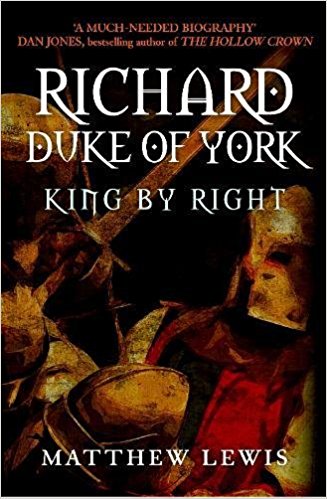
HISTORICAL BOOK REVIEW SERIES: ‘Richard, Duke of York’ by Matthew Lewis

Richard, 3rd Duke of York is frequently used to recall the colours of the rainbow with the mnemonic ‘Richard Of York Gave Battle In Vain’, wrongly believed to be the Grand Old Duke of York who had 10,000 men, or mistaken for his youngest son, Richard III. The son of a traitor, he inherited a dukedom aged four, became the wealthiest man in England at thirteen and later rebelled against his king, and if he is remembered, it is as a man who ignited the Wars of the Roses. Further eclipsed by two of his sons, who would become the mighty warrior Edward IV and the recently rediscovered Richard III, he is an ancestor of the Tudor monarchs and fifteenth great-grandfather to Queen Elizabeth II, yet the man himself is obscured from view. Matthew Lewis pushes aside the veils of myth and legend to challenge the image of Richard as a man whose insatiable ambition dragged a nation into civil war, revealing a complex family man with unparalleled power and responsibilities. The first person ever recorded to use the Plantagenet name, he pushed the political establishment to its limits, dared to fight back and was forced to do the unimaginable.

cover and blurb via amazon

~~

I was looking forward to this book for a number of reasons – firstly, because it’s Matthew Lewis, and also because Richard, Duke of York, really was kinda sorta the right person to be king if you dig through the family tree. This book didn’t disappoint at all.

Henry VI was in power, a man who was king as an infant, and England first had to go through a period ruled by the Lord Protector, the Duke of Gloucester, before Henry VI, a meek boy and then weak man, took over. Henry VI got himself a bride who was smart, strong and up to something with the Duke of Somerset. French lands in English hands were lost before Henry VI had a chance to rule them, and England was going to hell. (No offence, H6, it wasn’t really your fault).

Richard Plantagenet was a descendant of Edward III, like pretty much everyone in the War of the Roses. Through his mother, Richard was related to Edward II’s son Lionel Duke of Clarence, and through his father, Richard was related to Edward III’s son Edmund Duke of York. Edward III had five sons and three daughters who survived to adulthood (eight sons, five daughters in total, yikes!), and Richard Plantagenet was a descendant of surviving sons number two and four. As King Richard II, son of Edward The Black Prince, eldest son of Edward III, died without children, Lionel’s descendants were supposed to inherit (Richard’s mother’s family line, the Mortimers).

But the Lancaster branch took over. Edward III’s third son, John of Gaunt – the Lancaster line, usurped the throne from Richard II, led by Gaunt’s son Henry IV, leading to Henry V and Henry VI. But the Mortimer/York branches, now joined in marriage, thought they deserved the crown. And by right they did.

Richard Plantagenet sought to claim his right, resulting in the War of the Roses, killing off all the direct male descendants of Edward III, more or less. It was bloody, it was awful and needless and could be confusing if not for great books like this one. Richard had a solid claim to the throne, but Henry VI also had a claim, and was an anointed king. Richard Plantagenet is portrayed as a greedy, bloodthirsty man who tried to steal the throne, when it was essentially stolen from him by his own relatives years ago. Richard’s own father was beheaded for trying to assert the same right. Richard’s head too ended up on a spike, and his son Edmund was killed with him.

But two of Richards’ three remaining sons went on to be kings – Edward IV and Richard III (they killed their other brother, long story). Richard may have been killed in 1460, but his seven surviving children all continued to fight as Yorks against the Lancasters for the right to the throne, ending with Richard’s granddaughter Elizabeth, who married Lancastrian Henry VII and became queen, ending the wars for good.

A huge thanks to Matthew Lewis for this book, giving Richard Plantagenet a book of his own to show him as more than a usurper who got what he deserved. The Yorks had every right, just as Richard believed.

HISTORICAL BOOK REVIEW SERIES: ‘Owen Tudor’ by Terry Breverton

For generations, the ancestors of Welshmen Owen Tudor had fought Romans, Irish Picts, Vikings, Saxons, Mercians and Normans. His uncles had been executed in the Glyndwr Welsh War of Independence, his father pardoned, but his estates stripped from him. Owen’s now landless father took him to London to try and find employment, and Owen fought for Henry V in France. He entered the service of Henry’s queen, Catherine of Valois, and soon after the king’s death he secretly married her, the mother of the eight-month-old Henry VI. Owen and Catherine would have two boys together, hidden from the world and the boy-king Henry VI by the Bishops of London and Ely. Henry VI would go on to ennoble them as Edmund Earl of Richmond, and Jasper Earl of Pembroke, but upon Catherine’s death Owen was imprisoned. Escaping twice, Owen was thrown into the beginnings of the Wars of the Roses with his two sons. Edmund died in Wales, and Jasper became the only lord who fought throughout the civil wars until his nephew, Edmund’s son Henry Tudor, was established on the English throne as Henry VII. When Jasper led the Lancastrian forces at Mortimer’s Cross in 1461, the aging Owen led a wing of the defeated army, was captured and executed. Without the secret marriage for love, there would have been no Tudor dynasty.

cover and blurb via amazon

~~

I have to admit I had only read fiction about Owen Tudor until I picked up this book. The author has written a bountiful amount of Tudor works, so before reading the books on Jasper Tudor and Henry VII, I decided to start with Owen Tudor.

Tudor was, of course, a Welshman, from a family fraught after the Welsh Independence wars. Tudor, born Owain ap Maredudd ap Tudur, left for England for a new start. Tudor got a job, working for Queen Katherine de Valois, the bride Henry V took from France in return for peace. While Shakespeare wrote of Henry’s love for Katherine, all he did was basically purchase her, get her pregnant and then die. Katherine was left in England with a tiny baby who was king at nine months old, and all alone.

But all was not lost. Katherine had fallen in love with Owen Tudor, who had been working in her household on behalf of the king’s steward. Katherine and Tudor secretly married, and had up to six children – two sons who survived, Edmund and Jasper, plus Edward and Margaret ( who may or may not have entered the church and died young), and possibly two more, unknown, who did not survive (it’s a murky situation. For an author researching, a bit of  nightmare really). Sadly, Katherine passed away in 1437, aged only 35, leaving her kingly son in the Lord Protector’s hands and Tudor with the boys. Tudor was lucky not to be imprisoned or worse for secretly marrying a queen, as a law was in place that she could not marry without the king’s permission. There was no proof Katherine and Tudor ever legally married, and could have been nullified anyway. Tudor had all his possessions and lands seized but did keep his head and children.

Once Henry VI grew up a little, he treated his half-brothers well and kept Tudor on a good salary. Poor Tudor however was captured in Hereford during the Battle of Mortimer’s Cross in 1461 when his son Jasper’s army was defeated. Tudor was beheaded, his last words about Katherine. The bastard son he had fathered two years earlier had a headstone placed on his father’s grave years later.

Owen Tudor must be a hard man to write about, as he was not born royal and has a murky history, along with his family, given the lack of evidence about his life. What we do know is that Edmund died, leaving a pregnant Margaret Beaufort behind, who had Henry VII, and of course, had his bloodline through the royals ever since. I am definitely going to read the other books written by Terry Breverton.