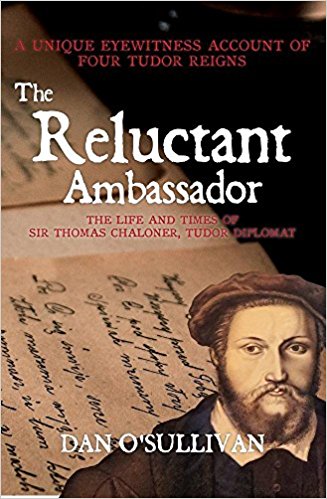
HISTORICAL BOOK REVIEW SERIES: ‘ The Reluctant Ambassador’ by Dan O’Sullivan

Sir Thomas Chaloner achieved much during his short life. As someone at the heart of four Tudor courts, his experience is fascinating.

Serving in the household of Thomas Cromwell after university, he later was entrusted with delicate diplomatic missions in France, Scotland, Flanders and finally Spain, where he was resident ambassador at the court of Philip II. His career was helped by his close friendship with William Cecil, whom he got to know at Oxford. He managed to stay employed during the religious and political upheavals of four reigns, while many close to him lost their positions and even their lives.

Chaloner was an intellectual and a humanist. He had a close circle of literary friends with whom he collaborated in the staging of court masques and other productions. He produced reams of verse and also translated several works from Latin, among them The Praise of Folly by Erasmus.

In Spain, Chaloner devoted much energy toward trying to save dozens of English sailors who had found themselves imprisoned as a result of bitter trade disputes between England and Spain. The stresses of his job weakened him physically, and he died soon after his recall, leaving a wife and young son.

Dan O’Sullivan explores the life of Chaloner and delves into the intricacies of European court life during the time of the Tudors. Chaloner, a reluctant ambassador who longed for his home in England, is a fascinating but little-known character who is here brought to life in vivid detail.

cover and blurb via amazon

~~

In 1541, Holy Roman Emperor Charles, who ruled much of Europe, went to war against the Turks and the Barbary pirates. He planned to besiege Algiers to free Christians from pirates, but could not attack Constantinople, as he did not have the numbers. One of these men onboard was Thomas Chaloner, on his first trip abroad from England. The fleet was caught in a storm, resulting in the loss of 8,000 lives as ships sank.

Chaloner was lucky; he could swim, unlike most. In fact, he had much luck in his early life. With a wealthy merchant father, Chaloner went to Cambridge and was given a job in Thomas Cromwell’s house. Still in his teen years, Chaloner could ready himself for life at court, learn politics and Latin, Italian and French. At St Johns College, he made a friend named William Cecil, which would help Chaloner again later in life.

Chaloner had sailed abroad as a diplomat, there to represent England while Charles V took on the Turks, and was one of the few who survived the Mediterranean storms. He went home to a new England – wife number five of Henry, Katherine Howard, was about to die. But change helped, as Chaloner gained a place on the privy council as a clerk, and as Henry failed to rule his country properly, or had Thomas Cromwell to fall back on, Chaloner was there with the men who ran England, while still in his early twenties.

.

Chaloner had languages, and this made him key as a diplomat, both with overseas missions as England forged wars, and at home. By 1547, Chaloner was negotiating with the Scots to stop fighting and help gain a royal marriage for his young new king. Chaloner felt high in esteem at court, already wealthy with his inheritance and marriage to a wealthy widow. He was a humanist, enjoying the Protestant reformation.

Edward IV died in 1553 and while Chaloner’s school friend, William Cecil, and countless more fled to Europe, Chaloner decided to try to stay working for the government through the Catholic changes brought by Queen Mary. Chaloner wrote poems for Jane Grey, beheaded after her nine days as queen, but quietly managed to stay alive and work for Mary.

By by 1558, Mary was dead, and many flocked home to their Protestant princess as she was crowned Elizabeth I. Constant Chaloner was sent to meet the Holy Roman Emperor  to discuss marriage for Elizabeth, her most difficult issue throughout her reign. Chaloner then travelled to the Netherlands on Her Majesty’s behalf, only to learn his school friend, William Cecil, now Elizabeth’s right-hand man, had selected him to be ambassador to Spain.
.
Chaloner hated Spain, with its Catholic soul and its intense heat. He hated Madrid with a passion; it cost too much, he never got much time with the king, and the Spanish didn’t let him be part of their secret conversations. Chaloner seemed to worry about everything, especially about being robbed of his wage as ambassador. Trouble came when Chaloner told the Spanish court that England would not support the Huguenots in France during civil war, only to find out the English had headed to battle.
.
One thing fell into place for Chaloner; he couldn’t sleep in Spain and the food made him ill. Because of this, he had many nights awake, when he got write Latin poems. The poems told much of Chaloner’s time in Spain; after four years, he was convinced he would die and worried about everything.
.
It was a bad time to be at the Spanish court. England was not popular with Spain, ships constantly were embattled, bureaucracy was, well, Spanish, the inquisitions were in full swing. Chaloner ended up with kidney stones from Spanish wine mixed with lime and chalk. His only bright spot was a woman named Audrey Frodsham, who travelled to Spain from England with a view to marry Chaloner once his first wife died. The trip must have gone well, because Audrey went home pregnant.
.
After arguing with the Spanish government over English sailors in Spanish prisons for several years, Chaloner was finally allowed to return home to England. In 1565, he landed in England to find Audrey in his house, with a young baby in tow, named Thomas jnr. Chaloner married Audrey and then died a month later of illness.
.
 Chaloner was a man able to serve in four royal households in a time when many lost their head. As much as he liked to complain, Chaloner must have been doing something right, even if it did make him into a hypochondriac. I had never even heard of Chaloner until I read this book, and a big thanks to the author for a vivid book about a lesser-known Tudor figure.

HISTORICAL BOOK REVIEW SERIES: ‘ The Nevills of Middleham’ by K.L Clark

At a time when family name was everything, the Nevills were the most influential people in England. They saw the Wars of the Roses from both sides—Yorkist and Lancastrian—but mainly from their own. Their men lived and died violently, and the Nevill women married leading players on both sides. Their bitter and violent rivalry with the Percy family tumbled into the wider political unrest that resulted in the Wars of the Roses, the ongoing feud between York and Lancaster that deposed two kings. This is the first definitive history of a fascinating family, and is essential reading for anyone with an interest in the Wars of the Roses.

~~

Richard Neville was one of the famous descendants of the Beaufort dynasty, and by 1465, he was one of the most powerful men in England. He was the 16th Earl of Warwick and nicknamed the Kingmaker, with good cause. Married to the wealthy Anne Beauchamp, Neville was constantly at King Edward IV’s side. He was not the only powerful Neville – brother George Neville was Archbishop of York and John Neville, Marquess of Montagu, was a famed soldier. Sister Katherine had married into the powerful Hastings family, and Cecily was a duchess, Alice a Countess, just a sample of the all-powerful Neville empire.

While Richard Neville stood at the side of a York king, the Neville name harks back to Lancastrian kings, due to being linked by blood to Joan Beaufort in the late 1300’s. The Nevilles moved toward the York arm of the royal names before spending time in exile and rebellion, before Anne Neville took the throne at Richard III’s side. The Neville name then started to fade from the annuls of history.

This book takes on a complex family and helpfully provides a way through the many branches of the family tree. While the Kingmaker is the most studied Neville, there are many more to learn about and the author has encompassed them all.

Warwick the Kingmaker was a man like any other when in power; he was a selfish . He saw fit to execute many enemies, his own brother dispatched to take part on many killings. He was revered by the men he kept on his side and a villain to anyone be opposed. Like most in the War of the Roses, Richard Neville was neither hero or villain, he was both. I found this to be the most comprehensive book on this family.

HISTORICAL BOOK REVIEW SERIES: ‘Jane the Quene’ by Janet Wertman

All Jane Seymour wants is a husband; but when she catches the eye of a volatile king, she is pulled deep into the Tudor court’s realm of plot and intrigue….

England. 1535. Jane Seymour is 27 years old and increasingly desperate for the marriage that will provide her a real place in the world. She gets the perfect opportunity to shine when the court visits Wolf Hall, the Seymour ancestral manor. With new poise born from this event, it seems certain that her efficiency and diligence will shine through and finally attract a suitor.

Meanwhile, King Henry VIII is 45 and increasingly desperate for a son to secure his legacy. He left his first wife, a princess of Spain, changing his country’s religion in the process, to marry Anne Boleyn — but she too has failed to deliver the promised heir. As Henry begins to fear he is cursed, Jane Seymour’s honesty and innocence conjure redemption. Thomas Cromwell, an ambitious clerk who has built a career on strategically satisfying the King’s desires, sees in Jane the perfect vehicle to calm the political unrest that threatens the country: he engineers the plot that ends with Jane becoming the King’s third wife.Jane believes herself virtuous and her actions justified, but early miscarriages shake her confidence and hopes.

How can a woman who has done nothing wrong herself deal with the guilt of how she unseated her predecessor?

~~

Jane’s story begins in 1525, where at age 18 is still unmarried and becomes a maid of honour for mighty Katherine of Aragon. Jane is a quiet girl, keen to be part of the court instead of being a lowly spinster at home. But Jane’s tuition at court is placed in the hands of two other maids to the queen – Anne and Mary Boleyn. They are distant cousins to Jane, but quiet Jane finds the pair to be disingenuous – Mary is already the king’s mistress, and rumours swirl of Anne’s virtue also. Jane, who sees herself as fair and perfect, considers her cousins to be intimidating and foolish, and they care not for the company of boring Jane. Years pass and Jane works in the court, slowly rising in favour until poor Katherine is ousted.
 .
 But then Jane’s cousin Anne Boleyn is finally elevated from mistress to Henry’s side as queen. Jane is still unwed, a seemingly boring woman in the company of Queen Anne, who sees nothing in her lady. But trouble soon comes when Anne gives birth to a daughter for Henry.
 .
Jane isn’t the only Seymour at court; her young sister Elizabeth found a husband quickly and the Seymours decide to swap out Jane for another sister, Dorothy. Quiet Jane needs a plan; she goes home to Wolf Hall, where the king plans to stay on summer progress, to host the royal party, and in return her brother will find her a decent husband.
 But while everyone thinks they know Jane Seymour, quiet Jane is a totally new woman. Only she can interest Henry; not brash like Anne Boleyn, but no weakling as her family assumes. Jane has a plan all of her own. Jane goes into training; she will be no whore, and she will be no Anne Boleyn either. Jane wants better for herself and she is no pawn any longer. Jane is ready to stand up, and play her part at court, all to claim what she wants – the crown itself.
 .
Jane is always written as the boring queen and I enjoyed reading a book where she was anything but. Jane plays the games at court well, ready to scheme her way onto the throne, rather than being shoved on by her brother. Her brother Edward is a likable man, a product of his time, and young brother Thomas is a cad, as history suggests. Everyone knows of Edward’s second wife Anne, the bitchy sidekick of her husband. This time, Anne is a kinder woman, while my book-husband Thomas Cromwell is a man who can work with anyone, always ready to come out on top. Cromwell’s POV is used a little too, which was a bonus for me.
 .
 It was fun to read Jane’s perspective, who is sometimes seen as appearing from nowhere to take a king, when she was instead in the background, understanding court politics. And this book is the first in a series, so make room on your shelf!

HISTORICAL BOOK REVIEW SERIES: ‘Young and Damned and Fair: The Life of Catherine Howard, Fifth Wife of King Henry VIII’ by Gareth Russell

Written with an exciting combination of narrative flair and historical authority, this interpretation of the tragic life of Catherine Howard, fifth wife of Henry VIII, breaks new ground in our understanding of the very young woman who became queen at a time of unprecedented social and political tension and whose terrible errors in judgment quickly led her to the executioner’s block.

On the morning of July 28, 1540, as King Henry’s VIII’s former confidante Thomas Cromwell was being led to his execution, a teenager named Catherine Howard began her reign as queen of a country simmering with rebellion and terrifying uncertainty. Sixteen months later, the king’s fifth wife would follow her cousin Anne Boleyn to the scaffold, having been convicted of adultery and high treason.

The broad outlines of Catherine’s career might be familiar, but her story up until now has been incomplete. Unlike previous accounts of her life, which portray her as a naïve victim of an ambitious family, this compelling and authoritative biography will shed new light on Catherine Howard’s rise and downfall by reexamining her motives and showing her in her context, a milieu that goes beyond her family and the influential men of the court to include the aristocrats and, most critically, the servants who surrounded her and who, in the end, conspired against her. By illuminating Catherine’s entwined upstairs/downstairs worlds as well as societal tensions beyond the palace walls, the author offers a fascinating portrayal of court life in the sixteenth century and a fresh analysis of the forces beyond Catherine’s control that led to her execution—from diplomatic pressure and international politics to the long-festering resentments against the queen’s household at court.

Including a forgotten text of Catherine’s confession in her own words, color illustrations, family tree, map, and extensive notes, Young and Damned and Fair changes our understanding of one of history’s most famous women while telling the compelling and very human story of complex individuals attempting to survive in a dangerous age.

cover and blurb via amazon

~~

I have to admit that I am no fan of Catherine Howard. By the time that Henry married Catherine, he was fat, demented and most importantly (to me), had turned against my book-husband Thomas Cromwell. So I read little about wife number five. The whole Catherine Howard incident is just one big hot mess, and one of the main indicators of how far Henry had already fallen.

King Henry had spent twenty years on the throne as a golden king, praised by all in word and art, so to cement a legacy, but Henry’s third decade showed signs of decay. By the time that Henry had denied Anne of Cleves because of his erectile issues, it was little Catherine Howard who had accidentally wandered into view, as a teenage attendant to Anne. Anne of Cleves was an educated, travelled woman and Henry was more in need of a child who had no thoughts or opinions and could be manipulated by a man who would make a better grandfather than lover.

The English court expected women to be virgins, perfect and untouched in every way. Yet men roamed freely, unguarded in their desires, as if their meddling had no effect on virginity. Catherine Howard was a simple girl, raised away from family and without anyone really caring for her. Catherine makes the perfect victim to be targeted by an old weirdo.

Russell’s book tells the story about how court life would have been in Catherine’s time; the late 1530’s were an awful time all round, with Henry’s leg increasingly pressing upon his sanity, the country in revolt, and Anne of Cleves getting the blame for Henry’s lack of male…. well… just, ew.

Catherine was a victim of her own lifestyle, one she never chose. Without a decent education or people to confide in, she fell for charms of young men liked a pretty face. A sweet girl told whispers of love is easy prey for older men. By the time Catherine was sent to court to wait on the new Queen Anne, she had already become a victim of her own existence.

Henry, a fat, old man with a desire to feel special and young again, laid eyes on a girl, not a seductress or whore as claimed, but an innocent girl who was whisked away in the glamour of being courted by the most powerful man in the land. Henry had been married to Catherine’s cousin, Anne Boleyn, and yet Catherine had not been shown a caution around the king, and soon was caught up with a man who never loved her, rather loved the idea of her instead.

Catherine, covered in gowns and jewels, played the role of token on the king’s arm, only to fall in love – with someone else. A man who worked in Henry’s chamber, a man known to be a disgusting human being in his own right, was happy to let Catherine’s feelings run away with her, thinking she could have romance in her life while playing concubine to an ailing fat man.

Catherine’s life ended far too soon, scared, alone and never believed in her words and deeds. A young girl who wanted, needed, to be loved, was instead used and abused by everyone, a minor detail in a long story of depravity that was the end of Henry’s reign. It is nice to read about the life and facts of Catherine, instead of whore narratives.


HISTORICAL BOOK REVIEW SERIES: ‘The Temptation of Elizabeth Tudor: Elizabeth I, Thomas Seymour, and the Making of a Virgin Queen’ by Elizabeth Norton

A power-hungry and charming courtier. An impressionable and trusting princess. The Tudor court in the wake of Henry VIII’s death had never been more perilous for the young Elizabeth, where rumors had the power to determine her fate

England, late 1547. King Henry VIII Is dead. His fourteen-year-old daughter Elizabeth is living with the king’s widow, Catherine Parr, and her new husband, Thomas Seymour. Seymour is the brother of Henry VIII’s third wife, the late Jane Seymour, who was the mother to the now-ailing boy King.

Ambitious and dangerous, Seymour begins and overt flirtation with Elizabeth that ends with Catherine sending her away. When Catherine dies a year later and Seymour is arrested for treason soon after, a scandal explodes. Alone and in dreadful danger, Elizabeth is threatened by supporters of her half-sister, Mary, who wishes to see England return to Catholicism. She is also closely questioned by the king’s regency council due to her place in the line of succession. Was she still a virgin? Was there a child? Had she promised to marry Seymour?

Under pressure, Elizabeth shows the shrewdness and spirit she would later be famous for. She survives the scandal, but Thomas Seymour is not so lucky. The “Seymour Scandal” led Elizabeth and her advisers to create of the persona of the Virgin Queen.

On hearing of Seymour’s beheading, Elizabeth observed, “This day died a man of much wit, and very little judgment.” His fate remained with her. She would never allow her heart to rule her head again.

cover and blurb via amazon

~~

While Edward Seymour, the eldest brother of Jane, Queen of England, was well-connected, respected, and Lord Protector of King Edward VI, there was the just as well-known brother, Thomas. Thomas Seymour had his own interesting, but definitely not as prestigious, history. Seymour was the brother of one of the Henry’s queens, and uncle to the young King Edward. Because of this happy accident, Seymour had a high sense of importance, and felt he was owed a place close to the young king and parliament.

Seymour wandered his way through the latter part of Henry’s reign (after the death of Jane) and was madly in love with Catherine Parr. When her second husband died, Seymour and Parr were keen to marry; but King Henry decided he needed a sixth wife and took Catherine for himself.

Seymour had previously tried to get himself a bride in the form of Henry’s daughter, Princess Mary, without success. When Henry dropped dead, Thomas’ paramour was no longer a queen, and Seymour married Parr just four months after Henry was buried. With Edward Seymour the child king’s Protector, Seymour was now married to the king’s stepmother, and got himself the title of Lord High Admiral.

That was when the self-entitled younger brother started to show off his creepy in a more obvious way. Before the hurried marriage to Catherine, Seymour had asked to marry 13-year-old Elizabeth, without success. Now, married to the dowager queen, Seymour had access to little Elizabeth every single day.

June 1547 was only months after her father’s death, and Elizabeth started receiving early morning visits from Seymour, coming into her room half-dressed while she was in her nightgown, even once climbed into her bed, and was known to smack her butt when given the chance. She was only 13, he was married and beneath her, and for a man to do such things in a girl’s rooms was considered shameful. Poor Elizabeth had no say, and Catherine soon started to be suspicious. With Catherine pregnant, Seymour would have had a wandering eye – and it seems all he ever wanted was little Elizabeth, and more importantly, the power she held.

By mid 1548, things were out of hand and Catherine found her husband with Elizabeth in his arms, and Elizabeth was banished. Sent away, Elizabeth spent months sick after the acts – some whispered pregnancy, though more likely shock of the abuse and then banishment.

Poor Catherine Parr died a week after giving birth to a daughter, in September 1548. Seymour sent a nephew to Elizabeth’s new household to spy on her, and asked whether or not her butt had grown any since he had last grabbed it. Talk about a pervert.

Luckily for Elizabeth, she did not have to suffer Seymour’s abuse again, and in January 1549, Seymour got arrested for conspiring to marry Elizabeth, kidnap Elizabeth’s brother, the King Edward, and rule England himself. Elizabeth testified against Seymour, as did two servants to Elizabeth, and Seymour was beheaded in March 1549.

Given the lack of evidence, the abuse suffered by Elizabeth is questioned, sometimes written off as play or harmless games. This book is a great read for anyone who wants to know more about these years of Elizabeth’s early life. To me, Seymour comes across as a classic abuser; makes a girl feel shamed and claims all is in jest, which mocks the victim further. Catherine Parr knew something was happening, and didn’t scorn her stepdaughter, but never lived long enough to speak out.

I enjoyed reading this book, and the author did not try to lean the reader in either direction in terms of outcome, but I certainly got my own conclusion on the ugly subject. It could be easy to call this gossip or scandal, when it seems more like an ugly situation many girls and women find themselves in, with few who believe them.