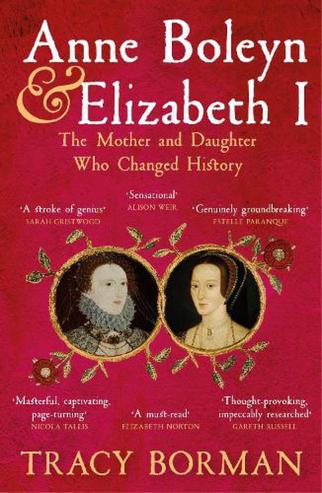
BOOK REVIEW: Anne Boleyn & Elizabeth I – The Mother and Daughter Who Changed History by Tracy Borman

Anne Boleyn may be best known for losing her head, but as Tudor expert Tracy Borman reveals in a book that recasts British history, her greatest legacy lies in the path-breaking reign of her daughter, ElizabethMuch of the fascination with Britain’s legendary Tudors centers around the dramas surrounding Henry VIII and his six wives and Elizabeth I’s rumored liaisons. Yet the most fascinating relationship in that historic era may well be that between the mother and daughter who, individually and collectively, changed the course of British history.

The future Queen Elizabeth was not yet three when her mother, Anne Boleyn, was beheaded on May 19, 1536, on Henry’s order, incensed that she had not given him a son and tired of her contentious nature. Elizabeth had been raised away from court, rarely even seeing Anne; and after her death, Henry tried in every way to erase Anne’s presence and memory. At that moment in history, few could have predicted that mother and daughter would each leave enduring, and interlocked, legacies. Yet as Tracy Borman reveals in this first-ever joint portrait, both women broke the mold for British queens and for women in general at the time. Anne was instrumental in reforming and reshaping forever Britain’s religious traditions, and her years of wielding power over a male-dominated court provided an inspiring role model for Elizabeth’s glittering, groundbreaking 45-year reign. Indeed, Borman shows how much Elizabeth–most visibly by refusing to ever marry, but in many other more subtle ways that defined her court–was influenced by her mother’s legacy.

In its originality, Anne Boleyn & Elizabeth I sheds new light on two of history’s most famous women–the private desires, hopes, and fears that lay behind their dazzling public personas, and the surprising influence each had on the other during and after their lifetimes. In the process, Tracy Borman reframes our understanding of the entire Tudor era.

In Anne Boleyn and Queen Elizabeth I: The Mother and Daughter Who Changed History, Tracy Borman offers a captivating exploration of the complex and enduring long-distance relationship between two of the most iconic figures in English history. This  work delves into the intertwined lives of Anne Boleyn, the ill-fated second wife of Henry VIII, and their daughter Queen Elizabeth I, one of England’s most celebrated monarchs.

Borman begins by providing an essential background on Anne Boleyn in her classic style of bringing out details others tend to miss, tracing Anne’s rise from a young courtier to Henry VIII’s queen consort. With meticulous attention to detail, the author paints a vivid portrait of Anne’s intelligence, charm, and ambition, as well as the political and religious forces that shaped her life. By exploring Anne’s influence on Henry and her role in the English Reformation, the author sets the stage for understanding her impact on her daughter, Elizabeth.

The heart of the book lies in the examination of the relationship between Anne Boleyn and Queen Elizabeth I, given they knew one another for less than three years. Borman delves into how Anne’s brief but tumultuous reign left a lasting imprint on her daughter, shaping her personality, her politics, and her approach to governance. Through meticulous analysis of historical records and contemporary accounts, the author uncovers how Elizabeth both emulated and distanced herself from her mother’s legacy.

One of the most fascinating aspects of the book is its exploration of Elizabeth’s upbringing and education. The author discusses how Elizabeth’s early years were marked by uncertainty and danger, as she navigated the treacherous political landscape of Tudor England. By examining the influence of Anne’s teachings and example on her daughter, the author offers valuable insights into Elizabeth’s development as a ruler and a woman.

Anne Boleyn and Queen Elizabeth I sheds light on the ways in which Elizabeth’s reign was shaped by her mother’s memory. Borman explores how Elizabeth used Anne’s legacy to her advantage, presenting herself as the rightful heir to the Tudor dynasty and emphasizing her connection to her mother’s royal lineage. Through careful analysis of Elizabeth’s speeches, portraits, and public persona, the author reveals how Anne’s ghost haunted and helped the Elizabethan court.

Anne Boleyn and Queen Elizabeth I is a captivating exploration of the enduring influence of Anne Boleyn on her daughter, Queen Elizabeth I. Borman’s engaging prose makes this book a must-read for anyone interested in Tudor history, the lives of remarkable women, or the dynamics of power and politics in early modern Europe. It is a pleasure to read about such powerful women, written by a masterful female author.
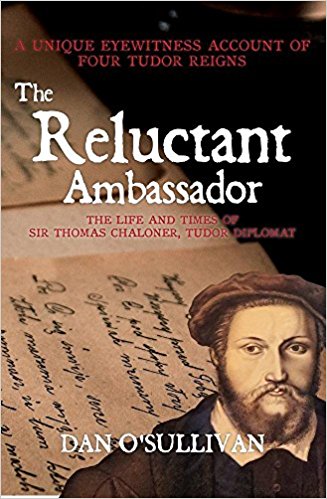
HISTORICAL BOOK REVIEW SERIES: ‘ The Reluctant Ambassador’ by Dan O’Sullivan

Sir Thomas Chaloner achieved much during his short life. As someone at the heart of four Tudor courts, his experience is fascinating.

Serving in the household of Thomas Cromwell after university, he later was entrusted with delicate diplomatic missions in France, Scotland, Flanders and finally Spain, where he was resident ambassador at the court of Philip II. His career was helped by his close friendship with William Cecil, whom he got to know at Oxford. He managed to stay employed during the religious and political upheavals of four reigns, while many close to him lost their positions and even their lives.

Chaloner was an intellectual and a humanist. He had a close circle of literary friends with whom he collaborated in the staging of court masques and other productions. He produced reams of verse and also translated several works from Latin, among them The Praise of Folly by Erasmus.

In Spain, Chaloner devoted much energy toward trying to save dozens of English sailors who had found themselves imprisoned as a result of bitter trade disputes between England and Spain. The stresses of his job weakened him physically, and he died soon after his recall, leaving a wife and young son.

Dan O’Sullivan explores the life of Chaloner and delves into the intricacies of European court life during the time of the Tudors. Chaloner, a reluctant ambassador who longed for his home in England, is a fascinating but little-known character who is here brought to life in vivid detail.

cover and blurb via amazon

~~

In 1541, Holy Roman Emperor Charles, who ruled much of Europe, went to war against the Turks and the Barbary pirates. He planned to besiege Algiers to free Christians from pirates, but could not attack Constantinople, as he did not have the numbers. One of these men onboard was Thomas Chaloner, on his first trip abroad from England. The fleet was caught in a storm, resulting in the loss of 8,000 lives as ships sank.

Chaloner was lucky; he could swim, unlike most. In fact, he had much luck in his early life. With a wealthy merchant father, Chaloner went to Cambridge and was given a job in Thomas Cromwell’s house. Still in his teen years, Chaloner could ready himself for life at court, learn politics and Latin, Italian and French. At St Johns College, he made a friend named William Cecil, which would help Chaloner again later in life.

Chaloner had sailed abroad as a diplomat, there to represent England while Charles V took on the Turks, and was one of the few who survived the Mediterranean storms. He went home to a new England – wife number five of Henry, Katherine Howard, was about to die. But change helped, as Chaloner gained a place on the privy council as a clerk, and as Henry failed to rule his country properly, or had Thomas Cromwell to fall back on, Chaloner was there with the men who ran England, while still in his early twenties.

.

Chaloner had languages, and this made him key as a diplomat, both with overseas missions as England forged wars, and at home. By 1547, Chaloner was negotiating with the Scots to stop fighting and help gain a royal marriage for his young new king. Chaloner felt high in esteem at court, already wealthy with his inheritance and marriage to a wealthy widow. He was a humanist, enjoying the Protestant reformation.

Edward IV died in 1553 and while Chaloner’s school friend, William Cecil, and countless more fled to Europe, Chaloner decided to try to stay working for the government through the Catholic changes brought by Queen Mary. Chaloner wrote poems for Jane Grey, beheaded after her nine days as queen, but quietly managed to stay alive and work for Mary.

By by 1558, Mary was dead, and many flocked home to their Protestant princess as she was crowned Elizabeth I. Constant Chaloner was sent to meet the Holy Roman Emperor  to discuss marriage for Elizabeth, her most difficult issue throughout her reign. Chaloner then travelled to the Netherlands on Her Majesty’s behalf, only to learn his school friend, William Cecil, now Elizabeth’s right-hand man, had selected him to be ambassador to Spain.
.
Chaloner hated Spain, with its Catholic soul and its intense heat. He hated Madrid with a passion; it cost too much, he never got much time with the king, and the Spanish didn’t let him be part of their secret conversations. Chaloner seemed to worry about everything, especially about being robbed of his wage as ambassador. Trouble came when Chaloner told the Spanish court that England would not support the Huguenots in France during civil war, only to find out the English had headed to battle.
.
One thing fell into place for Chaloner; he couldn’t sleep in Spain and the food made him ill. Because of this, he had many nights awake, when he got write Latin poems. The poems told much of Chaloner’s time in Spain; after four years, he was convinced he would die and worried about everything.
.
It was a bad time to be at the Spanish court. England was not popular with Spain, ships constantly were embattled, bureaucracy was, well, Spanish, the inquisitions were in full swing. Chaloner ended up with kidney stones from Spanish wine mixed with lime and chalk. His only bright spot was a woman named Audrey Frodsham, who travelled to Spain from England with a view to marry Chaloner once his first wife died. The trip must have gone well, because Audrey went home pregnant.
.
After arguing with the Spanish government over English sailors in Spanish prisons for several years, Chaloner was finally allowed to return home to England. In 1565, he landed in England to find Audrey in his house, with a young baby in tow, named Thomas jnr. Chaloner married Audrey and then died a month later of illness.
.
 Chaloner was a man able to serve in four royal households in a time when many lost their head. As much as he liked to complain, Chaloner must have been doing something right, even if it did make him into a hypochondriac. I had never even heard of Chaloner until I read this book, and a big thanks to the author for a vivid book about a lesser-known Tudor figure.

HISTORICAL BOOK REVIEW SERIES: ‘The King’s Pearl’ by Melita Thomas

Mary Tudor has always been known as ‘Bloody Mary’, the name given to her by later Protestant chroniclers who vilified her for attempting to re-impose Roman Catholicism in England. Although a more nuanced picture of the first queen regnant has since emerged, she is still stereotyped, depicted as a tragic and lonely figure, personally and politically isolated after the annulment of her parents’ marriage and rescued from obscurity only through the good offices of Katherine Parr.

Although Henry doted on Mary as a child and called her his ‘pearl of the world’, her determination to side with her mother over the annulment both hurt him as a father and damaged perceptions of him as a monarch commanding unhesitating obedience. However, once Mary had finally been pressured into compliance, Henry reverted to being a loving father and Mary played an important role in court life.

As Melita Thomas points out, Mary was a gambler – and not just with cards. Later, she would risk all, including her life, to gain the throne. As a young girl of just seventeen she made the first throw of the dice, defiantly maintaining her claim to be Henry’s legitimate daughter against the determined attempts of Anne Boleyn and the king to break her spirit.

Following the 500th anniversary of Mary’s birth, The King’s Pearl re-examines Mary’s life during the reign of Henry VIII and her complex, dramatic relationship with her father.

cover and blurb via amazon

~~

Called Bloody Mary through the centuries, Queen Mary has never attracted the same level of interest as her little sister Elizabeth I. This book has set out to change the stereotype of Mary, heir to the throne of Henry VIII and her powerful mother, the Queen Katherine. Mary has been seen as a Catholic fanatic, unable to navigate politics with poise or experience, a cruel woman happy to kill Protestants without thought. Mary is seen as married to a Spaniard, which somehow made her an instant tyrant.

In recent times, some authors have tried to make Mary into a more gentle figure; an innocent woman, forced away from her religious mother, determined to turn back time in England, unable to satisfy a husband or make an heir. The King’s Pearl is different again, which makes the book such a nice surprise. Instead, this book looks at Mary from an earlier angle, how her father’s reign impacted on Mary.

Mary’s early life is chronicled in serious detail, before the reality of Henry’s ‘Great Matter’ starts affecting Mary and her life. Mary was a stylish and educated young woman, witty, musical and a skilled horse rider. Mary was not weak or timid, as often portrayed; not constantly alone or at prayer, Mary could hunt or dance, host parties or play games as well as any young woman. She was beautiful and always immaculately dressed. Gone are the dull descriptions that often plagued her mother also, more likely propaganda to portray Elizabeth as superior later in life.

The list of betrothals Mary suffered though makes for bleak reading. Henry never seemed serious in finding a groom for his daughter. Mary was an unchallenged heir for much of her young life, and Henry seemed wary to ever marry her off and make her position as heir more powerful. Mary could defy her father at any time, on any level, and while others were forsaken, Mary was forgiven by Henry, dispelling the notion Henry hated his eldest daughter.

Mary may have had more in common with Elizabeth than either of them would have liked to admit; bright, intelligent girls, separated by their birth and their religion. I feel as if Mary’s reputation suffers due to her sex more than ever – Mary killed less than 300 heretics, her father killed 72,000, yet she is the bloody one? No man would have had a harmed reputation for the killing of 300. Mary rode out and took the throne from Jane Grey, the throne that was rightfully hers, and did her best, in a role she was prepared for, and Mary had her own terms. Only history hasn’t remembered her as well as it should.

This book is a worthy read indeed. Loved it. The author has created an excellent perspective on Queen Mary through facts instead of myth.