SPAIN BOOK REVIEW SERIES – MAY: ‘Spanish Crossings’ by John Simmons

Spanish Crossings is an epic tale of love, politics and conflict, with the yearning but elusive possibility of redemption. A woman’s life has been cast in shadow by her connection to the Spanish Civil War. We meet Lorna in Spain, 1937 as she falls in love with Harry, a member of the International Brigade who had been at Guernica when it was bombed. Harry is then killed in the fighting and Lorna fears she might have lost her best chance of happiness. Can she fill the void created by Harry’s death by helping the child refugees of the conflict? She finds a particular connection to one boy, Pepe, and as he grows up below the radar of the authorities in England their lives become increasingly intertwined. But can Lorna rely on Pepe as he remains deeply pulled towards the homeland and family that have been placed beyond his reach? Coming through the war, then the post-war rebuilding, Lorna and Pepe’s relationship will be tested by their tragic and emotive history.

cover and blurb via amazon 

~~

Having written a string of Spanish Civil War novels, and read countless more, my enthusiasm is beginning to wane at times (having said that, I plan to write plenty more). To hold my interest, an author needs to come up with a new angle, especially when it comes to the International Brigades, who get far more books written about them than the forgotten local heroes of the war. So thank you to John Simmons, who has tried something outside the usual storyline and predictable ending.

Lorna is fairly typical young woman of her time who works in London. Lorna has a lover, Harry, who volunteers to fight in Spain while his country stands idly by. Only Harry goes and gets killed at Guernica. The pain is real for Lorna, who loses someone in the worst way, killed and largely forgotten in a war his country won’t recognise. Of course, Lorna’s experience isn’t a rare one during the Spanish Civil War, but how she learns to cope is unique. Lorna works at a law firm, which is working with Spanish refugee children.

Pepe has been shipped to England, as were thousands of Basque children during the war, in an attempt to keep them safe as the fascists invaded and destroyed their own country. Lorna ‘adopts’ Pepe, and how Lorna learns to live with Harry’s loss is entwined with how Pepe copes with being sent from the Basque Country and his family left to their fate.

Lorna has been torn from a loved one killed in hell, and Pepe longs for his homeland, the hell which killed Harry. But Pepe is an innocent bystander in this mess, and Lorna’s friendship might just be the only way to save them both. The children of the Basque country became foreigners a country that doesn’t fully understand the complexity or the horror that is happening in Spain, and life in London in the late 1930’s is described beautifully without the usual clichés.

This book allows people to feel what it would have been like for all the Lorna’s and Pepe’s of the age, and the realities of having to cope in a world sinking into fascism. There are plenty of lessons to learn that could be just as meaningful for 2018 as the 1930’s.

From the ship which took 4,000 people to England (when it should have taken about 800), to pre-war London, the bombings of WWII, and beyond is shared by Lorna, the book capped by moments told by Lorna’s son at either end.  Happiness is not simple or attainable for everyone, and what it means to heal and be happy again is different for every person. Lorna and Pepe are a shining glimpse to a time when life and death, reality and art, truth, lies and propaganda, love, friendship and home all meant different things.  Thank you to John Simmons, for a refreshing take on a classic story.


SPAIN BOOK REVIEW – APRIL: ‘Albi’ by Hilary Shepherd

A poignant, compassionate glimpse into the life of a child caught in a country at war with itself

Albi is nine years old when Franco’s soldiers arrive in the village and his life begins to change in confusing ways. It’s not clear quite who should be trusted and who should not. Some neighbours disappear not to be seen again, others are hidden from view in cellars and stables – like his brother, Manolo, who left long ago to join the resistance. Albi is charged with shepherding not just his own sheep, but also those of El Ciego who sends him on errands requiring a good memory and the ability to keep his mouth shut at all times.

Alberto, at 88, is haunted by what he did and what he may or may not have said. And then the daughter of his old friend Carlos turns up wanting stories of old times. Albi’s day of reckoning may be at hand…

cover and blurb via Honno Press

~~

Here we are – yet another Spanish Civil War book, which alternates between present day and the 1930’s. All I can say is – yay! I’ve written three of these myself, so I’m always pleased to find another one, but this one is different to many I have stumbled across.

The book starts in present time, where Alberto has just been to a funeral, of his friend, Carlos, who grew up with Alberto in rural Aragon. The remembrance of his childhood friend takes Alberto back to the time where he was known as Albi, only aged nine, and the memories he still hasn’t managed to shake.

It’s September 1938, and Republican Aragon is being eaten up by Nationalist rule. Not a story about the frontline, but rather this book takes us into the lives of those who lived during the war under their new fascist rulers, and the reality that they faced in the uproar of the civil war. Poor Albi is only a boy, and his parents, three sisters and his senile grandmother are forced to live under the Guardia soldiers who have occupied their town. Albi’s bother Manolo was gone off with the Republican army and is already a ghost in Albi’s life. Things start hard and frightening for Alibi, adjusting to soldiers everywhere, curfews in place, and odd screaming echoing, but the adults in Albi’s life won’t share anything with him. Albi herds sheep for his disabled father, but whisperings in his house start leading to a slow demise for Albi as his family falls apart with illnesses, hushed up mysteries, secret weddings, and daring daybreak escapes.

Albi and Carlos are kids caught in a real disaster destroying their country. But Albi’s life takes a dangerous turn when he starts passing messages and spending time with Mena, a woman from Valencia who stands out, and  Mena is not one to sit back as war changes their country. The marquis are in the Aragonese hillside, rebel fighters prepared to take on Francoist soldiers, regardless of the cost.

Albi’s trips to see Mena lead him to a moment in the war he cannot forget, not even in 2017 when Alberto’s story has caught the attention of people making a show about the war. While Carlos’ granddaughter is telling the stories she was told, Albi is the one with the real truth, the truth Carlos didn’t know or share. Death came to Albi’s village and he is the only witness who knows the truth, which haunts his dreams nearly 80 years on. But is 80 years enough for Alberto to be ready to tell the whole truth?

Many thanks should be given to the author, as Shepherd has written a book about those who tend to get forgotten. While I write the weekly updates about the war and major battles, it is people in the cities and villages already ‘conquered’ who get forgotten about, who had to live under the cruel rule of their new leaders. Shepherd has told that story through the eyes of a child, who doesn’t take sides, as his innocence will be destroyed either way. The doesn’t dwell on detail and accurately gives the point of view of a child, a messy and confused state in a world which wouldn’t make sense to anyone.

Albi is available April 19.


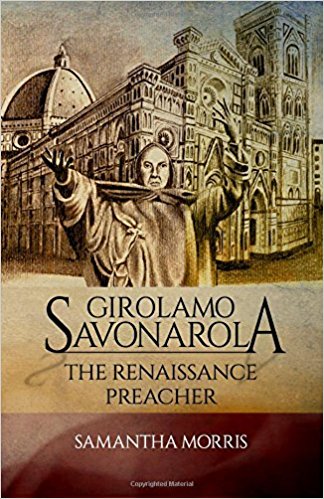
HISTORICAL BOOK REVIEW SERIES: ‘Girolamo Savonarola: The Renaissance Preacher’ by Samantha Morris

Born on 21 September 1452, the very same year that Leonardo Da Vinci was born, Girolamo Savonarola: The Renaissance Preacher tells the story of a man who believed so wholeheartedly in God and the message that He was giving, that he gave his life for it.

The book is an introduction to the life and times of this infamous preacher, a man who was witness to the dramatic downfall of the Medici dynasty in fifteenth-century Florence, who instigated some of the most dramatic events in Florentine history and whose death is still commemorated today.

cover and blurb via amazon

~~

If you are new to Savonarola, here is a great place to begin. Savonarola was a Dominican friar and preacher up until 1498 when he was excommunicated and executed for throwing out prophesies and for calling for the end of corruption, the type of thing that gets you killed in Italy during this period. Yet he is constantly made out to be a crazy man, who preached as a friar, who was mad as a hatter, pretended to see the future and callously destroyed priceless art in the process. This time, Morris has created a different man, a portrayal given time and clarity.

Savonarola began life in 1452, and entered life as a friar in 1475. After studying and praying, he gained momentum in 1494, when he set off to preach in Florence, and bumped heads with the most powerful men around at that time. In four years, he would be burned in public for his work. How? By hitching his wagon to the current anti-Medici feelings in Florence at the time. Florence, a Republic then, was in the Medici grip, but only for the last 16 years, so they still had plenty of enemies to go around. Combined with the fact that the French king wanted to storm through Italy and there was the great Borgia Pope on the papal throne, Florence was a jittery mess and Savonarola was right in the middle.

Savonarola believed he could see the future, and began preaching that he was destined to save Florence and its people from sin. He also thought the French king Charles was placed on Earth by God to restore Italy to the ways of 2000 years earlier. Charles himself wanted the Kingdom of Naples, though places such as Florence and Rome stood in his way. But while Savonarola was crushing on the French, he was also busy hating the powerful Medicis, masters of Florence, the Borgia Pope and the strong Sforza family of Milan.

Foretelling the future and also preaching chastity, poverty, piety and repentance, Savonarola hit out against the friars of Florence who lived luxurious lives. He hated the art and beauty of Florence, the greatest to be found in Europe. He was a huge homophobe, so much so that maybe he was possibly over-compensating? (That’s my theory). Savonarola was desperate to make sodomy a crime. He also hated the Church in general for its lavish lifestyle, massive wealth and for its corruption, crimes, whores, nepotism, you name it. Savonarola seemed to think himself the great saviour of everyone.

Along with two others, Savonarola was arrested and tortured, and he caved very quickly, unlike nutters or those desperate to cling to martyrdom. He confessed to everything he had said and done against the Church and Pope. The sad thing is, Savonarola wasn’t some bigot crying in the streets while living it up in private; he seemed to believe what he said completely. It gives the man a little sympathy, as he was not looking for personal gain, just had a desire to change the world order, but it was all in his head.

Poor Savonarola was taken out as a defeated crazy man and set alight, his ashes scattered in the Arne river so they wouldn’t be relics. Savonarola was a victim of his own delusions, of his own pride and vanity, and he burned just like the books and artwork, clothes and wigs he had his faithful followers destroy.

I love Morris’ enthusiasm for Savonarola, a man largely overlooked, always written the same way. Anyone who loves the Medici like Morris is bound to be an authority on all the big players of Florence.


HISTORICAL BOOK REVIEW SERIES: ‘Pustules, Pestilence and Pain: Tudor Treatments and Ailments of Henry VIII’ by Seamus O’Caellaigh

Henry VIII lived for 55 years and had many health issues, particularly towards the end of his reign.

In Pustules, Pestilence, and Pain, historian Seamus O’Caellaigh has delved deep into the documents of Henry’s reign to select some authentic treatments that Henry’s physicians compounded and prescribed to one suffering from those ailments.

Packed with glorious full-colour photos of the illnesses and treatments Henry VIII used, alongside primary source documents, this book is a treat for the eyes and is full of information for those with a love of all things Tudor. Each illness and accident has been given its own section in chronological order, including first-hand accounts, descriptions of the treatments and photographic recreations of the treatment and ingredients.

cover and blurb via amazon

~~

The title doesn’t exactly make someone dash to the store for this book, but to miss out would be a real shame. O’Caellaigh has dived into a complex subject and combined it with a visually stunning piece of work to create a detailed life story of Henry and his illnesses, a book which came in very handy for me personally, as well as a great read.

Much is known of Henry’s health, combined with letters written by his doctors and those who were close to the king. Henry’s health changed dramatically throughout his life and had a stark impact on the relationship he had with his wives. Because of this behaviour with these queens, the Tudors have become infamous.

Anyone who has looked for info on Henry’s health will know there is much out there, and not all of it accurate. The author has tried to use primary sources, a great challenge for the time period, as doctors did not keep records as they now do. But through sheer determination it seems, O’Caellaigh has tracked down Henry’s prescription book as well as handwritten records from the Royal British Library. This is combined with letters in the court at the time, and the author has had to push through the accounts to separate truth from rumour.

One original and lucky bonus in this book is the photographs. As Henry was a handsome man, then a huge man, physical appearance would have been important in Tudor times. So this book has been dressed accordingly, with lavish photos of Tudor medicine and history. The photos are a welcome addition to the book.

While there are numerous books that look at Henry’s wives and the destruction of the church, this book looks at Henry from a unique angle, and also catalogues the changes and advancements made during Henry’s life. As Henry’s health and recovery from injuries made such a  difference to his reign, to makes sense to write a book on the details of how people survived during this period. I got a copy of this book not expecting a long read, and yet, to my delight, found it to be fascinating and well-researched. I am extremely pleased to have this book in my digital library and will definitely go back to it time and again.


HISTORICAL BOOK REVIEW SERIES: ‘The Raven’s Widow: A Novel of Jane Boleyn’ by Adrienne Dillard

The river was as calm as I had ever seen it. Ordinarily, the tide would have been wild by this time of year, and woe unto any man unfortunate enough to fall into the fierce currents of the Thames. Tonight the tides were still, and the surface of the water appeared glassy. When I peered down into the dark depths, I saw my tired, drawn face wavering in the reflection. I quickly turned away as I fought back a wave of nausea, frightened by the anguish I saw etched there.

“Only a few moments more my lady, the Tower is just ahead.”


Jane Parker never dreamed that her marriage into the Boleyn family would raise her star to such dizzying heights. Before long, she finds herself as trusted servant and confidante to her sister-in-law, Anne Boleyn; King Henry VIII’s second queen. On a gorgeous spring day, that golden era is cut short by the swing of a sword. Jane is unmoored by the tragic death of her husband, George, and her loss sets her on a reckless path that leads to her own imprisonment in the Tower of London. Surrounded by the remnants of her former life, Jane must come to terms with her actions. In the Tower, she will face up to who she really is and how everything went so wrong.

cover and blurb via amazon

~~

No one with the name Boleyn has fared well through history or fiction, and Jane Boleyn is definitely no exception. In recent times, Jane has been pained as a snitch, a mean, meddling and jealous woman, one who helped get her husband beheaded. Here, Dillard sets out to paint a very different woman.

Jane Parker was born in around 1505 to Henry Parker, Baron Morley and Alice St John (so through her mother’s family, a distant relative of King Henry). By 1520 Jane was in service to Queen Katherine, and considered an attractive woman for her time. By 1525, marriage had been arranged to George Boleyn, brother of two women, Anne and Mary Boleyn, whom also served Queen Katherine. As the Boleyn family were of little consequence at the time, little is recorded about the marriage, or Jane herself. It seems they had a loving marriage, though no children were ever born to the pair. Here, possible miscarriages and losses are added to the book to gain a different insight with artistic licence.

After Mary Boleyn’s time as the king mistress ended, it was Anne’s turn to fall prey to Henry, whom loved her deeply right through the 1520’s, and it was then that the Boleyns rose in the court and public eye. By 1533, Anne was queen of England, and Jane was in her service, now Viscountess Rochford. No part of Jane’s life could have prepared her for such circumstances. Jane is written as caring, emotional, irrational but interesting through the trials of being the queen’s sister-in-law, through the eyes of a courtier not often chosen as a main protagonist.

History remembers Jane as the one who told Cromwell that Anne and George were committing incest to gain a child to claim as King Henry’s. But Jane n reality was a woman married to a man who was a womaniser (though is portrayed as kinder and more chaste in this book), and, when George lost his head, she had to plead and bow to regain favour.

In this book, as in life, Jane is a character who manages to survive, to serve Anne of Cleves and then Katherine Howard as queens, before Jane too loses her head for helping Queen Katherine set up dates with her secret lover in 1542. The twist in this book is how Jane is not written as the scheming bitch who happily served her husband and sister-in-law to the axe so she could continue to survive. Also, Jane’s breakdown right before death is also given a fresh look. A book for those who are on the look out for something new.