HISTORICAL BOOK REVIEW: ‘The Tudors in Love: The Courtly Code Behind the Last Medieval Dynasty’ by Sarah Gristwood

Why did Henry VIII marry six times? Why did Anne Boleyn have to die? Why did Elizabeth I’s courtiers hail her as a goddess come to earth?

The dramas of courtly love have captivated centuries of readers and dreamers. Yet too often they’re dismissed as something existing only in books and song – those old legends of King Arthur and chivalric fantasy.

Not so. In this ground-breaking history, Sarah Gristwood reveals the way courtly love made and marred the Tudor dynasty. From Henry VIII declaring himself as the ‘loyal and most assured servant’ of Anne Boleyn to the poems lavished on Elizabeth I by her suitors, the Tudors re-enacted the roles of the devoted lovers and capricious mistresses first laid out in the romances of medieval literature. The Tudors in Love dissects the codes of love, desire and power, unveiling romantic obsessions that have shaped the history of this nation.

Purchase on Amazon here

~~

When I saw this book advertised, I thought three things – 1. ooh, a new book from Sarah! 2. It’s so pretty! 3. Can any book really live up to the hyped early reviews they receive? I had to roll up my grumpy covid-outbreak words and bake them into a humble pie, because, yes, The Tudors in Love really is a wonderful book.

Love is not a subject of which I am especially fond or enjoy reading, and while I understand the concept of courtly love in the time of the Tudors, I have always found it to be, well, a bit dumb. I mean, look what happened to Anne Boleyn as an example. But here is a book that can make even a cynical asexual like myself appreciate its place at court.

I have always found the concept of courtly love misogynistic; a man wants to woo his object of desire, and if she gave in to his affections, she was a whore. If she did not, she was frigid and cruel. Gristwood writes about this particular issue in medieval literature and points out even they could see the flaws in the imagined game of romance. The games of love and romance then leaked into a concept that one should love the person they marry. Edward IV’s foolish marriage to Elizabeth Woodville is a classic example of how quickly romantic love can cause disaster, while their daughter Elizabeth married Henry Tudor and had an honest, loving relationship born out of more than foolish love/lust at first sight. Henry VII and Queen Elizabeth may have had something of a perfect marriage with dynastic ties and genuine affection but would prove a hard, nigh impossible, act to follow.

Perhaps Henry and Elizabeth wished the same for their children, Margaret was given in marriage to gain an alliance, only to then be free to make love matches later, Margaret a classic example of seeing love burned to ashes by the realities of marriage. Mary fared better; she was sold in a disgusting political marriage, only to have her old husband drop dead and the man of her dreams come to her rescue immediately after. Mary’s stolen chance to marry for romance and having things work out was a rare case indeed.

Their brother Henry VIII cannot for a moment take a back seat in the tales of courtly love in the 16th century. He loved his wife, Katherine, nicknaming himself Sir loyal Heart and waxing lyrical of his admiration for his wife. It should have been perfect; Henry and Katherine were an excellent political match and could have been as in love and happy on the throne as his parents before them, had the constant loss of their children not hardened Henry’s heart and broken Katherine’s.

While Katherine was openly loved, Anne Boleyn suffered from the pain of courtly love from Henry. Free of the burden of politics and marriage, Henry could chase Anne, declare love, write love letters, he Anne’s servant and she Henry’s sovereign. Henry could not tell the difference between courtly and marital love and married Anne, sucking the fun and thrill of the chase from the game. Anne, now a married birthing machine, still had to play the foolish games of courtly love with other admirers, only to have her words twisted against her when Henry confused his game of courtly love with Jane Seymour for a desire for marriage yet again.

While Henry’s three final marriages were a mixture of manchild tantrums, impulsive mistakes and wavering affections, and his son Edward too young to ever play the game  before his demise, Queen Mary came next. The game of courtly love was not one really played by Mary, with her marriage a political choice with no winners. Perhaps if Mary and Philip had indulged in some courtly love, at least some mild affection could have blossomed.

But it was Queen Elizabeth who had watched the games of court long enough by the time she took the throne. No one could play the game like Elizabeth. Fluttering lashes, poetry, majestic parties, smouldering glances, all the detailed images of courtly love were prepared for the beautiful queen, who had her hands full with constant favourites and men trapped in a web of their own making. Elizabeth’s ability to play men off one another and string them along without making the mistake of marriage made for many interesting scenarios, only for the misogyny of the whole concept to again rear its ugly head when Elizabeth became too old to beguile anyone. But even as Elizabeth’s games of courtly love started to lose their appeal, even to her favourites, she had already solidified her real power enough that the games no longer mattered, and she could defeat any man who dared threaten her crown. Only Elizabeth, the one to understand courtly love and the strings which made men her puppets, and who never confused the game with marriage and duty, could ever call herself the winner.

The Tudors in Love is an excellent book because it does what many fail to do; find a new angle on the subject of the Tudors, and carve out a new story without wandering off-topic. The concept of courtly love, its origins, its meanings and the implications, are all clearly laid out and explained in context. It is so easy to get lost in the webs of Tudor history and sources, and yet Gristwood has kept the theme throughout the book, leaving anything unnecessary on the editing room floor. If only all authors could be as singular minded when delivering a unique narrative.

no free book or money changed hands in return for this review

HISTORICAL BOOK REVIEW: ‘Woodsmoke and Sage: The Five Senses 1485-1603: How the Tudors Experienced the World’ by Amy Licence

Traditionally history is cerebral: what did they believe, what did they think, what did they know?

Woodsmoke and Sage is not a traditional book.

Using the five senses, historian Amy Licence presents a new perspective on the material culture of the past, exploring the Tudors’ relationship with the fabric of their existence, from the clothes on their backs, the roofs over their heads and the food on their tables, to the wider questions of how they interpreted and presented themselves, and what they believed about life, death and beyond. Take a journey back 500 years and experience the sixteenth century the way it was lived, through sight, sound, smell, taste and touch.

Purchase on Amazon here

~~

It can be easy to feel a bit jaded when it comes to books on the Tudor period. They are abundant, and those of us who write for the newer generation are constantly having to come up with new ways to present the subject and find new information and sources to change old narratives. While some authors succeed and some do not, Amy Licence has yet again produced a masterstroke of Tudor writing.

Woodsmoke and Sage is an entirely new concept in the world of Tudor books, a book broken down into five parts, covering the five senses and how they were experienced in Tudor England.  This new book shows what we have in common with the (predominately) 16th century, and what has changed remarkably.

Naturally, sight is first, covering the enormous variations of daily life, from the way cloth and clothing were enjoyed and used to convey status, to the way people wrote and painted portraits of one another. Buildings and possessions are well covered, along with the way people presented themselves in public. The second section, the section I was most interested in, covers smell, something often lost when reading or watching something about Tudor England, covering from the smells of perfumes to the opposite end of pleasantries.

Sound was a sense I confess I didn’t think too much of, but apart from music and the sound of daily life, there are new things to consider such as the way news was shared. Taste is a natural feast, covering food and drink, and a handy section of which foods were considered dangerous at the time. Finally, touch covers a great deal, covering healthcare, disease, and childbirth. Another incredibly important issue was agricultural life and the weather, and the section also covers sports in the period and the realities of poverty and violence. I don’t want to share any tidbits of Licence’s research, that’s for you to enjoy for yourselves.

Woodsmoke and Sage is a bible of helpful instructions for a reader or writer. It can be read as a story, or used as a reference guide for particular subjects when needed. You can hop between sections without losing any of the book’s momentum, whether you are looking for the feel of the king’s coat, the noises wives would hear while they worked, or what salad may poison you. I personally found lots of little details new to me, despite years of research. Thomas Cromwell had plenty of perfume bottles and had plenty of handwashing facilities available, but what he was using in the bottles and basins can only be speculated, and this book offers me likely suggestions for future use (thanks!).

Woodsmoke and Sage (or Living Like a Tudor: Woodsmoke and Sage: A Sensory Journey Through Tudor England in the USA) is both interesting and engaging regardless of a reader’s knowledge of the period. I can say without a doubt that this book is going to be extremely precious to me in years to come. 

no free book or money changed hands in return for this review
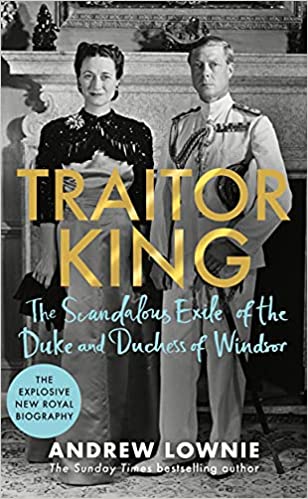
HISTORICAL BOOK REVIEW: ‘Traitor King: The Scandalous Exile of the Duke and Duchess of Windsor’ by Andrew Lownie

Traitor King, by Sunday Times bestselling author Andrew Lownie, looks at the years following the abdication of Edward VIII when the former king was kept in exile, feuding with his family over status for his wife, Wallis Simpson, and denied any real job.

Drawing on extensive research into hitherto unused archives and Freedom of Information requests, it makes the case that the Duke and Duchess of Windsor were not the naïve dupes of the Germans but actively intrigued against Britain in both war and peace.

It reveals:
– the story behind the German attempts to recruit the Duke as a British Pétain in the summer of 1940.
– the efforts, by Churchill in particular, to prevent post-war publication of the captured German documents which detailed the Duke’s Nazi intrigues.
– the reasons why the Duke, as Governor of the Bahamas, tried to shut down the investigation into the 1943 murder of his close friend Harry Oakes.
– the full extent of the feud with the British Royal Family, based on his betrayals going back to his dishonesty about his true financial position at the time of the abdication.
– that far from a love story, Wallis felt trapped in a marriage she had never wanted with a pathetic and suffocating husband, one of the reasons she took several lovers, including the gay playboy Jimmy Donahue.

Traitor King tells the story of a royal exiled with his wife, turning his back on duty, his family and using his position for financial gain.

Purchase on Amazon here

~~

The moment this book arrived, my 18yo son saw it and said ‘ooh, like The Crown!’ and stole it, meaning I had to wait. I can safely say it is one of the best books I have read this year. I am no fan of Edward VIII and have no sympathy for him whatsoever. But even I had extra room to loathe him.

Lownie wastes no time with the story; within the first chapter, the weak king is out of his role and his family. By chapter two, you wish he would slip off a pier or something. Everything he says or does shows just what a truly pathetic man he was. Wallis Simpson instantly comes across as the best-suited partner for Edward – as pitiless, spiteful, thoughtless and nasty as the man she didn’t even want to marry. The book dives straight into Edward and Wallis’ Nazi connections, showing the level of detail of their disgusting associations while stomping on their loyal British friends and leaving everyone around them with bills and a bitter taste in their mouths. Yet the book doesn’t read as one written by an author with a personal hatred for the subjects, rather these people are just so awful that there is no way to flatter the image.

As soon as the royal family managed to get Edward and Wallis out of Europe during the war and their blatant dreams of reclaiming the throne through Nazi intervention, the pair started causing trouble in the Bahamas, where Edward was placed as Governor, a purposeless role to get him out of the way. Excessive spending, wild parties, embarrassing trips to the US, and copious people left used and ripped off culminated in Edward stepping in to cover up the high-profile murder of his friend Harry Oakes. Without giving spoilers, it shows just how low Edward had sunk, and by choice, seemingly having no shame in associating with criminals.

While Edward moaned and lied incessantly about having no money (and simultaneously spending insane amounts), Wallis was doing the same, while trapped with a man-child for a husband she appeared to never like, let alone love. Affairs, lies, cruelty and insufferable complaints abounded through the years. They really were the worst of the upper class; indiscreet with their words and bedroom habits, co-dependent, weak-filled, flighty and never satisfied. Edward seemed to have never developed beyond adolescence and hid the fact he was gay or bisexual, while Wallis made no secret of her infidelity and disdain for the man who gave up the crown. The book is a tale of two truly sad people, and how lucky Britain was to avoid them. Even those who have no love for the monarchy could sympathise with George who took over the throne, having such wastrels in the family.

Despite knowing the life of Edward and Wallis, I was still keen to get to the end of this book and read it in just a few days. The tale leaves you grateful for Queen Elizabeth, that Charles was born before Andrew, and that William was born before Harry. The last thing the monarchy needs is a repeat.

no free book or money changed hands in return for this review

HISTORICAL BOOK REVIEW: ‘The Man in the Iron Mask’ by Josephine Wilkinson

A vivid, dramatic, and eye-opening historical narrative, The Man in the Iron Mask reveals the story behind the most enduring mystery of Louis XIV’s reign.

The Man in the Iron Mask has all the hallmarks of a thrilling adventure story: a glamorous and all-powerful king, ambitious ministers, a cruel and despotic jailor, dark and sinister dungeons— and a secret prisoner. It is easy for forget that this story, made famous by Alexandre Dumas, is that of a real person, Eustache Dauger, who spent more than thirty years in the prison system of Louis XIV’s France—never to be freed.

This narrative brings to life the true story of this mysterious man and follows his journey through four prisons and across decades of time. It introduces the reader to those with whom he shared his imprisonment, those who had charge of him, and those who decided his tragic fate.

The Man in the Iron Mask reveals one of the most enduring mysteries of Louis XIV’s reign; but it is, above all, a human story. Using contemporary documents, this book shows what life was really like for state prisoners in seventeenth-century France—and offers tantalising insight into why this mysterious man was arrested and why, several years later, his story would become one of France’s most intriguing legends that still sparks debate and controversy today.

Purchase through Amazon here

~~

I had been waiting for this book to be released for what felt like a year, and when it came, so did Delta to New Zealand, zapping my ‘essential worker’ energy and enthusiasm for anything. I love a good mystery, conspiracy theory, story moulded by time rather than fact, and yet I struggled to get into this book. My 18yo son saw me trying to read, and started a quick google search on the various character names I read aloud, and the book became a delightful rabbit hole for us both. I ended up reading much of the book aloud as we enjoyed the twists and turns together, given how much these individuals went through, and we ended up talking about them on a first-name basis like they were people we knew. You could definitely make this book in a multiple season show with the twists, turns and strange goings-on in a French prison.

Wilkinson immediately introduces Eustache Dauger (what a name), the so-called Man in the Iron Mask. But there are other people ‘enjoying’ the prison facilities, such as Count Nicolas Foucquet and Comte de Lauzun, who had interesting sentences, such as Lauzan being imprisoned for meddling in his cousin’s affair (the king). While they lived a strange, quasi-high life in prison, Dauger could not speak, see anyone, essentially no longer existed at all.  His was a thirty-year imprisonment starting Pignerol under a man named Saint-Mars, who moved him between Chateau d’Exilles Ile Sainte-Marguerite, and eventually at the Bastille. Dauger seemingly became Saint-Mars life’s work.

Time passed, as these prisoners got up to various behaviours between the prisons they were housed in, and yet Dauger’s true name and identity remained a secret (spoiler, there was no iron mask, just a face cloth, or sheet over him while on the road, in case you didn’t know that).  The theories of who Dauger really was has taken many turns over the centuries, and Wilkinson goes through them, showing the proof (or lack thereof) of each scenario, before giving the most likely and most believable tale of Dauger’ name and crime. I must admit I was a tad sad how it all ended, not from the quality of the book, but from Dauger’s eventual fate. It seems being forgotten to die is the cruellest punishment of all.

Five-stars, a convincing and believable book with a cast of French characters worthy of such a timeless tale. Bonus points for the fun tale of dinner plates with written messages being flung out of prison windows into the sea for passing boats.

no free book or money changed hands in return for this review

HISTORICAL BOOK REVIEW: The Beauty and the Terror by Catherine Fletcher

The period between 1492–resonant for a number of reasons–and 1571, when the Ottoman navy was defeated in the Battle of Lepanto, embraces what we know as the Renaissance, one of the most dynamic and creatively explosive epochs in world history. Here is the period that gave rise to so many great artists and figures, and which by its connection to its classical heritage enabled a redefinition, even reinvention, of human potential. It was a moment both of violent struggle and great achievement, of Michelangelo and da Vinci as well as the Borgias and Machiavelli. At the hub of this cultural and intellectual ferment was Italy.

The Beauty and the Terror offers a vibrant history of Renaissance Italy and its crucial role in the emergence of the Western world. Drawing on a rich range of sources–letters, interrogation records, maps, artworks, and inventories–Catherine Fletcher explores both the explosion of artistic expression and years of bloody conflict between Spain and France, between Catholic and Protestant, between Christian and Muslim; in doing so, she presents a new way of witnessing the birth of the West.

Click here to purchase

¬¬¬

I absolutely jumped with glee when Fletcher released The Beauty and the Terror. One of my most favourite authors, producing books some of my favourite subjects, Alessandro de’ Medici and Gregorio Casali, and now an entire book on one of my favourite time periods, from the 1490s through the 16th century, the dramatic new world seen through the eyes of art.

This is a time period filled with people like Machiavelli, Savonarola, Borgia, Vespucci, Luther, the Medici, da Vinci, Columbus, the massive wars and invasions of Italy, Spain, the Ottoman Empire, the massive betrayals and battles for Florence, the League of Cambrai, not to mention the Reformation and Counter-Reformation and the huge oppression and destruction of women.

Everyone knows the traditional story of the early Renaissance; art, thought, regeneration and invention ending the mediaeval period. But everyone knows that cannot possibly be the reality; the world wasn’t filled with visionary artists painting golden-haired girls in pretty dresses. War, poverty, intrigue, desperation, misery, disease – the reality was a bitter pill. This book suggests that the reality hasn’t been headlined as much as the idealised version of events, and to an extent, that’s true, particularly when it comes to the finer details of the horrid activities going on at the time. Why get into the politics of the Council of Trent when you can be beguiled by a Michelangelo painting?

The book also goes into how we know the famous portraits, sculptures, poems and books, but not the backstories – like how Mona Lisa is known for her smile but not that her husband used to purchase Moorish or African children each year to use as servants and God knows what else (I saw one review argue that didn’t make the man complicit in the slave trade, but that comment says more about the reviewer than the book). Another portrait mentioned is Titian’s Venus of Urbino of 1534 featuring Angela del Moro; a gorgeous piece of art, using the sitter’s previous real-life gang rape as an inspiration for a piece of beauty to behold. We love reading Machiavelli’s words but don’t pay much attention to the hideous rise of handguns; poets are celebrated for the creation of the prose we know today but they sit alongside the rise of pornography. Leonardo da Vinci could create things like a mechanical lion for King Francis, but the same calculations and designs were used in developing weapons responsible for widespread misery.

The Beauty and the Terror is remarkable in both its level of detail and its readability; it gives the names you know with all the details you might have missed. It also offers a wonderful thing – a woman’s voice to the subject, in a time where women were nothing but sexual objects and pawns, drawn to suffer or titillate and little in between. It lets their unknown voices peek out beyond the usual stone-cold portraits or nipple-laden fantasies of men.

Catherine Fletcher is a truly remarkable scholar and every book she produces is a work of art on its own. You don’t know the Renaissance until you’ve read The Beauty and the Terror.