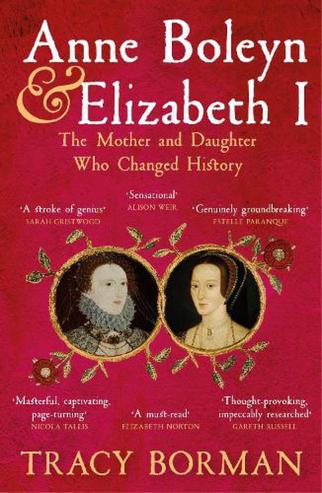
BOOK REVIEW: Anne Boleyn & Elizabeth I – The Mother and Daughter Who Changed History by Tracy Borman

Anne Boleyn may be best known for losing her head, but as Tudor expert Tracy Borman reveals in a book that recasts British history, her greatest legacy lies in the path-breaking reign of her daughter, ElizabethMuch of the fascination with Britain’s legendary Tudors centers around the dramas surrounding Henry VIII and his six wives and Elizabeth I’s rumored liaisons. Yet the most fascinating relationship in that historic era may well be that between the mother and daughter who, individually and collectively, changed the course of British history.

The future Queen Elizabeth was not yet three when her mother, Anne Boleyn, was beheaded on May 19, 1536, on Henry’s order, incensed that she had not given him a son and tired of her contentious nature. Elizabeth had been raised away from court, rarely even seeing Anne; and after her death, Henry tried in every way to erase Anne’s presence and memory. At that moment in history, few could have predicted that mother and daughter would each leave enduring, and interlocked, legacies. Yet as Tracy Borman reveals in this first-ever joint portrait, both women broke the mold for British queens and for women in general at the time. Anne was instrumental in reforming and reshaping forever Britain’s religious traditions, and her years of wielding power over a male-dominated court provided an inspiring role model for Elizabeth’s glittering, groundbreaking 45-year reign. Indeed, Borman shows how much Elizabeth–most visibly by refusing to ever marry, but in many other more subtle ways that defined her court–was influenced by her mother’s legacy.

In its originality, Anne Boleyn & Elizabeth I sheds new light on two of history’s most famous women–the private desires, hopes, and fears that lay behind their dazzling public personas, and the surprising influence each had on the other during and after their lifetimes. In the process, Tracy Borman reframes our understanding of the entire Tudor era.

In Anne Boleyn and Queen Elizabeth I: The Mother and Daughter Who Changed History, Tracy Borman offers a captivating exploration of the complex and enduring long-distance relationship between two of the most iconic figures in English history. This  work delves into the intertwined lives of Anne Boleyn, the ill-fated second wife of Henry VIII, and their daughter Queen Elizabeth I, one of England’s most celebrated monarchs.

Borman begins by providing an essential background on Anne Boleyn in her classic style of bringing out details others tend to miss, tracing Anne’s rise from a young courtier to Henry VIII’s queen consort. With meticulous attention to detail, the author paints a vivid portrait of Anne’s intelligence, charm, and ambition, as well as the political and religious forces that shaped her life. By exploring Anne’s influence on Henry and her role in the English Reformation, the author sets the stage for understanding her impact on her daughter, Elizabeth.

The heart of the book lies in the examination of the relationship between Anne Boleyn and Queen Elizabeth I, given they knew one another for less than three years. Borman delves into how Anne’s brief but tumultuous reign left a lasting imprint on her daughter, shaping her personality, her politics, and her approach to governance. Through meticulous analysis of historical records and contemporary accounts, the author uncovers how Elizabeth both emulated and distanced herself from her mother’s legacy.

One of the most fascinating aspects of the book is its exploration of Elizabeth’s upbringing and education. The author discusses how Elizabeth’s early years were marked by uncertainty and danger, as she navigated the treacherous political landscape of Tudor England. By examining the influence of Anne’s teachings and example on her daughter, the author offers valuable insights into Elizabeth’s development as a ruler and a woman.

Anne Boleyn and Queen Elizabeth I sheds light on the ways in which Elizabeth’s reign was shaped by her mother’s memory. Borman explores how Elizabeth used Anne’s legacy to her advantage, presenting herself as the rightful heir to the Tudor dynasty and emphasizing her connection to her mother’s royal lineage. Through careful analysis of Elizabeth’s speeches, portraits, and public persona, the author reveals how Anne’s ghost haunted and helped the Elizabethan court.

Anne Boleyn and Queen Elizabeth I is a captivating exploration of the enduring influence of Anne Boleyn on her daughter, Queen Elizabeth I. Borman’s engaging prose makes this book a must-read for anyone interested in Tudor history, the lives of remarkable women, or the dynamics of power and politics in early modern Europe. It is a pleasure to read about such powerful women, written by a masterful female author.

HISTORICAL BOOK REVIEW SERIES: ‘The Raven’s Widow: A Novel of Jane Boleyn’ by Adrienne Dillard

The river was as calm as I had ever seen it. Ordinarily, the tide would have been wild by this time of year, and woe unto any man unfortunate enough to fall into the fierce currents of the Thames. Tonight the tides were still, and the surface of the water appeared glassy. When I peered down into the dark depths, I saw my tired, drawn face wavering in the reflection. I quickly turned away as I fought back a wave of nausea, frightened by the anguish I saw etched there.

“Only a few moments more my lady, the Tower is just ahead.”


Jane Parker never dreamed that her marriage into the Boleyn family would raise her star to such dizzying heights. Before long, she finds herself as trusted servant and confidante to her sister-in-law, Anne Boleyn; King Henry VIII’s second queen. On a gorgeous spring day, that golden era is cut short by the swing of a sword. Jane is unmoored by the tragic death of her husband, George, and her loss sets her on a reckless path that leads to her own imprisonment in the Tower of London. Surrounded by the remnants of her former life, Jane must come to terms with her actions. In the Tower, she will face up to who she really is and how everything went so wrong.

cover and blurb via amazon

~~

No one with the name Boleyn has fared well through history or fiction, and Jane Boleyn is definitely no exception. In recent times, Jane has been pained as a snitch, a mean, meddling and jealous woman, one who helped get her husband beheaded. Here, Dillard sets out to paint a very different woman.

Jane Parker was born in around 1505 to Henry Parker, Baron Morley and Alice St John (so through her mother’s family, a distant relative of King Henry). By 1520 Jane was in service to Queen Katherine, and considered an attractive woman for her time. By 1525, marriage had been arranged to George Boleyn, brother of two women, Anne and Mary Boleyn, whom also served Queen Katherine. As the Boleyn family were of little consequence at the time, little is recorded about the marriage, or Jane herself. It seems they had a loving marriage, though no children were ever born to the pair. Here, possible miscarriages and losses are added to the book to gain a different insight with artistic licence.

After Mary Boleyn’s time as the king mistress ended, it was Anne’s turn to fall prey to Henry, whom loved her deeply right through the 1520’s, and it was then that the Boleyns rose in the court and public eye. By 1533, Anne was queen of England, and Jane was in her service, now Viscountess Rochford. No part of Jane’s life could have prepared her for such circumstances. Jane is written as caring, emotional, irrational but interesting through the trials of being the queen’s sister-in-law, through the eyes of a courtier not often chosen as a main protagonist.

History remembers Jane as the one who told Cromwell that Anne and George were committing incest to gain a child to claim as King Henry’s. But Jane n reality was a woman married to a man who was a womaniser (though is portrayed as kinder and more chaste in this book), and, when George lost his head, she had to plead and bow to regain favour.

In this book, as in life, Jane is a character who manages to survive, to serve Anne of Cleves and then Katherine Howard as queens, before Jane too loses her head for helping Queen Katherine set up dates with her secret lover in 1542. The twist in this book is how Jane is not written as the scheming bitch who happily served her husband and sister-in-law to the axe so she could continue to survive. Also, Jane’s breakdown right before death is also given a fresh look. A book for those who are on the look out for something new.

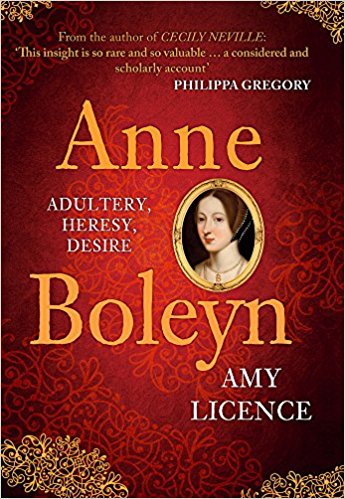
HISTORICAL BOOK REVIEW SERIES: ‘Anne Boleyn: Adultery, Heresy, Desire’ by Amy Licence

Anne Boleyn’s unconventional beauty inspired poets ‒ and she so entranced Henry VIII with her wit, allure and style that he was prepared to set aside his wife of over twenty years and risk his immortal soul. Her sister had already been the king’s mistress, but the other Boleyn girl followed a different path. For years the lovers waited; did they really remain chaste? Did Anne love Henry, or was she a calculating femme fatale?

Eventually replacing the long-suffering Catherine of Aragon, Anne enjoyed a magnificent coronation and gave birth to the future Queen Elizabeth, but her triumph was short-lived. Why did she go from beloved consort to adulteress and traitor within a matter of weeks? What role did Thomas Cromwell and Jane Seymour of Wolf Hall play in Anne’s demise? Was her fall one of the biggest sex scandals of her era, or the result of a political coup?

With her usual eye for the telling detail, Amy Licence explores the nuances of this explosive and ultimately deadly relationship to answer an often neglected question: what choice did Anne really have? When she writes to Henry during their protracted courtship, is she addressing a suitor, or her divinely ordained king? This book follows Anne from cradle to grave and beyond. Anne is vividly brought to life amid the colour, drama and unforgiving politics of the Tudor court.

cover and blurb via amazon

~~~

Are you thinking, oh God, another biography of Anne Boleyn? Is there anything else to know? I can tell you that, yes, there is more to know and you should be thrilled to get this one. Amy Licence has practically handed a perfect account of Anne’s life to readers on a silver plate. Come bask in its glory.

Regardless whether you think Anne stole the throne, was a home-wrecking schemer, or she was the king’s love, this book covers all angles, all details and all possibilities. Licence starts with Anne’s family and background, to see how a woman could be so loathed for her background compared to more noble beginnings, despite the fact Anne had a wonderful education abroad, enough for any noble man. The time period of Anne’s life was one where, as a young girl, the royal family of England was relatively stable; Henry married to Katherine, the odd mistress thrown in for good times (his at least). But when Katherine hit menopause and religious opinion was suddenly flexible, Anne’s life could never be the same.

The realities of the time are not romanticised by the author – being a woman was not all gowns and chilling with your lady friends. These people, with their lives dictated by custom, ceremony and family loyalties, were still real people. They loved, they loathed, they hurt like anyone else. The Boleyn family, while not as noble as others (only Anne’s mother was noble born), had their own plans in this world.

Anne served the archduchess of Austria, and Henry’s sister Mary when she was Queen of France. She also then served mighty Katherine, Queen of England. Anne was no fool, no commoner, yet not quite ever noble enough. Her family wanted better, and could you blame them? But the portrayal as the Boleyns as scheming, as pushing daughters forward as whores under the king’s nose has done Anne no favours, and this book can make Anne lovers feel safe she is not portrayed as some witch.

Women routinely became mistresses, as the social order gave this is an avenue, yet was frowned upon (um, who was sleeping with these girls, gentlemen?), and a route Anne’s sister Mary took with Henry, and we shall never know for sure if Mary really wanted the job. But Anne knew, regardless, that she would not do the same thing. She loved Henry Percy, and wanted to have a real marriage, real love, only to have it dashed away thanks to that same social order.

The book delves into Anne’s rise to power as Henry’s paramour, and discusses whether she played him as part of a strategy or whether she was forced into a ridiculous game with no option but to play along. No woman can say so no to a King; Anne had to be his love, his mistress-without-benefits (or did they share a bed? The book discusses), and Henry’s selfish nature sent him down a path Anne couldn’t have imagined. She wanted to be a man’s wife, not whore. Henry, in turn, got Thomas Cromwell to destroy the social order and religious boundaries. Even the most scheming woman couldn’t have predicted that.

Licence uses excellent sources for her biography, and as a person hungry for minor details on certain periods of Anne’s life, I fell upon these pages with great excitement. Anne was smart, she had morals, she had a temper and a strong will, so much so that king chased her long enough to create divorce from the Catholic Church and make her a queen. No one does that for any mistress.

Anne married Henry, and received a coronation with the crown only meant for ordained kings, and gave Henry the Princess Elizabeth. Anne should have had full control of her life by then, only to find she was more helpless than ever. Having given up her virginity but given Henry no son, she fell from favour, and when Henry asked Cromwell to remove Anne to make way for another virgin with a womb, poor Anne was destroyed in a way everyone knows, never learning what a glorious queen her daughter would become. What people didn’t know was the truth over the whole debacle that brought Anne to the executioner’s sword.

As a woman, a spurned one at that, Anne’s history became sullied with lies and cruelty – that she was a femme-fatale who turned into a whore and witch, that she gave birth to a monster child, that she had disfigurements. History was not ready to tell the truth about a smart, powerful woman. Thank God we live in a time where historians like Amy Licence are able to guide readers through Anne’s real history without forcing conclusions on readers.

HISTORICAL BOOK REVIEW SERIES: ‘Jane the Quene’ by Janet Wertman

All Jane Seymour wants is a husband; but when she catches the eye of a volatile king, she is pulled deep into the Tudor court’s realm of plot and intrigue….

England. 1535. Jane Seymour is 27 years old and increasingly desperate for the marriage that will provide her a real place in the world. She gets the perfect opportunity to shine when the court visits Wolf Hall, the Seymour ancestral manor. With new poise born from this event, it seems certain that her efficiency and diligence will shine through and finally attract a suitor.

Meanwhile, King Henry VIII is 45 and increasingly desperate for a son to secure his legacy. He left his first wife, a princess of Spain, changing his country’s religion in the process, to marry Anne Boleyn — but she too has failed to deliver the promised heir. As Henry begins to fear he is cursed, Jane Seymour’s honesty and innocence conjure redemption. Thomas Cromwell, an ambitious clerk who has built a career on strategically satisfying the King’s desires, sees in Jane the perfect vehicle to calm the political unrest that threatens the country: he engineers the plot that ends with Jane becoming the King’s third wife.Jane believes herself virtuous and her actions justified, but early miscarriages shake her confidence and hopes.

How can a woman who has done nothing wrong herself deal with the guilt of how she unseated her predecessor?

~~

Jane’s story begins in 1525, where at age 18 is still unmarried and becomes a maid of honour for mighty Katherine of Aragon. Jane is a quiet girl, keen to be part of the court instead of being a lowly spinster at home. But Jane’s tuition at court is placed in the hands of two other maids to the queen – Anne and Mary Boleyn. They are distant cousins to Jane, but quiet Jane finds the pair to be disingenuous – Mary is already the king’s mistress, and rumours swirl of Anne’s virtue also. Jane, who sees herself as fair and perfect, considers her cousins to be intimidating and foolish, and they care not for the company of boring Jane. Years pass and Jane works in the court, slowly rising in favour until poor Katherine is ousted.
 .
 But then Jane’s cousin Anne Boleyn is finally elevated from mistress to Henry’s side as queen. Jane is still unwed, a seemingly boring woman in the company of Queen Anne, who sees nothing in her lady. But trouble soon comes when Anne gives birth to a daughter for Henry.
 .
Jane isn’t the only Seymour at court; her young sister Elizabeth found a husband quickly and the Seymours decide to swap out Jane for another sister, Dorothy. Quiet Jane needs a plan; she goes home to Wolf Hall, where the king plans to stay on summer progress, to host the royal party, and in return her brother will find her a decent husband.
 But while everyone thinks they know Jane Seymour, quiet Jane is a totally new woman. Only she can interest Henry; not brash like Anne Boleyn, but no weakling as her family assumes. Jane has a plan all of her own. Jane goes into training; she will be no whore, and she will be no Anne Boleyn either. Jane wants better for herself and she is no pawn any longer. Jane is ready to stand up, and play her part at court, all to claim what she wants – the crown itself.
 .
Jane is always written as the boring queen and I enjoyed reading a book where she was anything but. Jane plays the games at court well, ready to scheme her way onto the throne, rather than being shoved on by her brother. Her brother Edward is a likable man, a product of his time, and young brother Thomas is a cad, as history suggests. Everyone knows of Edward’s second wife Anne, the bitchy sidekick of her husband. This time, Anne is a kinder woman, while my book-husband Thomas Cromwell is a man who can work with anyone, always ready to come out on top. Cromwell’s POV is used a little too, which was a bonus for me.
 .
 It was fun to read Jane’s perspective, who is sometimes seen as appearing from nowhere to take a king, when she was instead in the background, understanding court politics. And this book is the first in a series, so make room on your shelf!

HISTORICAL BOOK REVIEW SERIES: ‘In the Footsteps of the Six Wives of Henry VIII’ by Sarah Morris and Natalie Grueninger

This book provides a fresh perspective on the lives of Henry VIII’s six wives by embarking on a journey through the manors, castles and palaces in which their lives were played out. This journey traces their steps to the Alhambra in Spain, childhood home of Katherine of Aragon; to the very room at Acton Court where Anne Boleyn and Henry VIII publicly dined; through the cobbled grounds of Hampton Court Palace, which bore witness to both triumph and tragedy for Jane Seymour; into the streets of Düsseldorf in Germany, birthplace of Anne of Cleves; among the ruins and picturesque gardens of St Mary’s Abbey in York where Catherine Howard and Henry VIII rested at the pinnacle of the 1541 progress; and to Gainsborough Old Hall in Lincolnshire, where Katherine Parr lived as daughter-in-law of the irascible Sir Thomas Brough.

Each location is described in a fascinating narrative that unearths the queens’ lives in documents and artefacts, as well as providing practical visitor information based on the authors’ first-hand knowledge of each site. Accompanied by an extensive range of images including timelines, maps, photographs and sketches, this book brings us closer than ever to the women behind the legends, providing a personal and illuminating journey in the footsteps of the six wives of Henry VIII.

cover and blurb via amazon

~~

For everything Henry VIII did, all anyone remembers is the fact he married six times. To be fair, he isn’t all that different to many guys – gets to middle-age and freaks out and wants to date younger women, usually blondes. And like most of these scenarios, who the women are doesn’t matter so much, but to those of us who do know these women, they are far more fascinating than the man they married.

Whether or not you know your Annes from your Katherines from your Jane, this book is a different take on the six queens of England. Morris and Grueninger, rather than writing the history of these women, have instead mapped out their lives, detailing the places where they lived their extraordinary lives, a tour of their time as queens.

Katherine no.1 was England’s queen, but she began her life in Spain, and the authors have included this history in the detail of her life, such as the details of the Alcazar in Seville and in the incredible Alcazar in Cordoba, and naturally, the Alhambra. On the other side of her life, Katherine’s time pushed aside as a forgotten wife is even detailed, something I found invaluable.

Anne Boleyn’s life gets a vivid recreation at Hever Castle, before she headed to Flanders and France. Of course, her time in the Tower before execution is all laid out (in fact, there is a whole extra book!). Jane Seymour led a more simple life, but the now well-known Wolf Hall is there, along with Mercer’s Hall and Chester Place in London.

Next came Anne no.2, one of my personal favourites, and what a varied life Anne of Cleves lived. She grew up by the Rhine in Düsseldorf; she and her sister were painted by Holbein himself at Schloss Hambach. Anne travelled through Antwerp, staying at England House, and onto Bruges, Calais, before she passed through Deal and Dover Castles in Kent. Anne lived in many beautiful places before being given The King’s Manor, a 100-room palace in Dartford. Oh, to see what Anne of Cleves saw in her time!

Katherine no.2, little Katherine Howard, started her life at Norfolk House in London and Horsham, where many of her problems began. Katherine’s young eyes take readers to Oatlands Palace, Grimsthorpe Castle in Lincolnshire, north into York and more before she ended her days in the Tower. Katherine no.3, the intelligent Katherine Parr, had been married and widowed twice before the king all-but forced her into marriage. She started life at Rye House in Hertfordshire, before moving between castles in Lincolnshire, Cumbia and North Yorkshire. As queen, Katherine lived in Woking Place in Surrey, including when she ruled as regent in Henry’s absence while fighting in France. The now-mythical Nonsuch Palace in Surrey also makes an entry.

I can’t tell you how many places are meticulously detailed in this book. The level of  information and attention is unquestionable in this beautiful book and there is absolutely no book which can give readers insight such as this one. I cannot thank the authors enough for this book, I originally got a copy at the library but went and ordered a copy for myself straight away.