Wolf Hall 2: The Mirror and the Light – Thomas ‘Call-me Risley’ Wriothesley, the True Traitor of Thomas Cromwell


Playground Entertainment/Nick Briggs

Welcome back to Wolf Hall 2: The Mirror and the Light true details about scenes in the latest episode, where Cromwell is arrested as a traitor to England.

In reality, in May 1540, King Henry was up to his usual tricks; hating on his own wife, romancing another lady (well, child) at court, and messing with religion just enough to upset literally everyone at home and abroad. In an inopportune turn of events, just as Cromwell’s chance to turn on the Catholic bishops had arrived, the king called Cromwell to court on 6 June, where Henry confessed his impotency with Queen Anna. Henry confessed this only to Cromwell and friend-turned-foe William Fitzwilliam. Cromwell had listened to Henry complain of his marriage to Anna multiple times over Easter, and again through Whitsun week in mid-May, but confirmation of the lack of consummation and Henry’s suggestion of annulment could not wait any longer, no matter Cromwell’s opinion. The alliance between England and Germany was non-existent, and the Emperor and France were not looking to go against England. Henry had no reason to hold on to a woman he did not like, no matter how much Anna was liked by others, or how suitable and well-chosen she was for England. King Henry had also been sneaking out of court to spend time with Lady Kathryn Howard at Stephen Gardiner’s Winchester Palace.

Cromwell travelled home to Austin Friars, where Thomas Wriothesley met him; Cromwell appeared exhausted and worn out by events. In Wriothesley’s own words, he asked Cromwell, ‘what one thing rested in his head which troubled him’. Cromwell, believing his home would afford him privacy, told Wriothesley the king’s marriage remained unconsummated. Wriothesley pushed the belief they could solve Henry’s issue, or ‘they should all smart for it’, but Cromwell replied it was a ‘great matter’. Wriothesley kept pushing his master, and Cromwell replied again it was a great matter, but stopped himself from revealing impotence. Still, the damage was done.

While Cromwell was at home feeling despondent and disillusioned, Stephen Gardiner prepared his attack. Since returning to England, he had reconnected with Thomas Wriothesley. Wriothesley claimed to be utterly loyal to Cromwell since late 1535 but was no such thing. Given how many people openly detested Wriothesley, it came as no surprise he would easily swap to old allegiances. Another Cromwell man, Edmund Bonner, who had bonded with Gardiner over their shared disastrous times as French ambassadors, turned against Cromwell, though, like Wriothesley, there appears to be no incident which caused a shift. Bonner’s position was likely his religious beliefs; Wriothesley was likely greedy. Wriothesley knew who else was close to the king and was happy to turn against Cromwell; William Fitzwilliam and his brother Anthony Browne, Master of the Horse. Both men were on the Privy Council and the king would readily listen to their opinions. With Wriothesley fresh appointed co-secretary to the king, and Fitzwilliam the only other person aware of the impotence besides Cromwell, Gardiner could easily collude with these men to destroy the new Earl of Essex.

Thomas Wriothesley, who had been just another man in Wolsey’s household, plucked to work alongside Stephen Gardiner, and then taken into the Cromwell household as one of his own, was only too eager to betray his noble master. Thomas Cromwell had overseen the grandest changes of Henry VIII’s reign. He destroyed the Catholic hold over England and ended the monasteries in favour of reformist colleges. He found the way to bring down Queen Katherine of Aragon. He beheaded Anne Boleyn so Henry could bat his eyelashes at Jane Seymour. Cromwell created the Church of England and made King Henry the supreme leader, ended paying taxes to Rome, and saw off threats from the Pope and Emperor Charles. Cromwell had engineered the execution of countless men, clergy and laity, when they did not agree with the king’s current mood, regardless of their innocence or guilt. He ensured the beheadings of noblemen who died for the king’s ever-grasping power and enriched Henry in a way not thought possible. Cromwell spent years in the background, learning, studying, and working with his legal skills while other courtiers fluttered around the king and whatever woman had Henry’s fancy. The English Bible was a reality because of all the endless work by Cromwell and Cranmer, two great men of learning trying to help the people of England, Wales, and Ireland. Cromwell endured years of taunts as a man walking around like Wolsey’s ghost behind the king, suspected of being a heretic for his learning, and was openly called a traitor for trying to advance the king’s desires. King Henry heard all these taunts, and defended Cromwell, even when 40,000 rebels called for Cromwell’s head. For over half of Cromwell’s time at court, he gained almost no personal advantage to himself, despite the enormous upheavals he created.

Yet one whisper of almost-impotence to Wriothesley at Austin Friars was enough for King Henry to forget every single one of Cromwell’s good deeds in His Highness’ name and sign an arrest warrant. Only Ambassador Marillac’s letters remain on the detail of the arrest of Thomas Lord Crumwell. On 10 June, it was recorded Cromwell arrived late to a Privy Council meeting after a morning in parliament. There was no reason for Cromwell to be late, it is more likely the Council was summoned slightly early without his knowledge. Among those in the Council were those close to Cromwell’s heart; Ralph Sadler, Thomas Cranmer, Thomas Audley, John Gage and John Russell. There were men there who had made Cromwell godfather to their children, the Duke of Suffolk, Edward Seymour, and Robert Radcliffe. Many enemies were present; Stephen Gardiner, the Duke of Norfolk, William Fitzwilliam, and traitor Wriothesley. Men who were like brothers or sons to Cromwell could only sit and watch as the nightmare unfolded. Sir William Kingston from the Tower was there with four guards to arrest Cromwell on arrival. Still dressed formally for parliament, wearing his Garter ribbons, collar of St George and his sable fur robes, Cromwell never got to say a word, nor realised anything was untoward before Kingston announced the arrest.

Shocked, Cromwell ripped his black cap from his head and threw it on the table and cried, ‘I am no traitor! Is this the reward for good service done unto His Majesty the King? I put it to your consciences; am I a traitor as your accusations imply? Well, no matter, for I renounce all pardons or grace needed, for I never offended the King, and it matters only if   the King himself thinks me a traitor, and he would never have me linger long!’ The words were not dissimilar to Wolsey’s eleven years earlier.

Fitzwilliam untied Cromwell’s garter from his leg while Norfolk took Cromwell’s golden collar. The intention was clear; an attainted man could not be a member of the Garter. This was not a spur-of-the-moment plan; Norfolk had spoken to King Francis in Paris of the plan to destroy Cromwell back in February. Cromwell was taken from a water gate at Whitehall to the Tower with relative anonymity and housed in the Queen’s apartments, just as Anne Boleyn had been four years earlier.

Wriothesley began the Council’s letters for around England and Europe, sharing the news before anyone at court or parliament even knew the arrest occurred.  In London, news of the arrest spread when Sir Thomas Cheyney (uncle of wife Jane Wriothesley) arrived at Austin Friars to confiscate the entire property. Cheyney had two dozen archers at his back for the occasion, despite the fact there would be no resistance at the surprise invasion. At the time, Mercy Prior still lived at the property, as did John and Joan Williamson and their children. The Williams and Wellyfed siblings likely had rooms at the house, as did loyal personal servants like Thomas Thacker. All would now be homeless, unable to access any of their belongings. All the servants, falconers, gardeners, dog handlers, stable hands for Cromwell’s 100 horses, would be left in limbo. The private items belonging to Gregory, his lost mother and sisters, and Cardinal Wolsey would be taken for their value. Cromwell’s daughter, Jane Cromwell, was hopefully away at Leeds Castle at the time of the arrest, though poor Gregory would have been in London for parliament and was likely staying at Austin Friars. Cheyney’s men knew what they wanted, and what they needed to find. Cromwell had 7,000l (almost £3,000,000 today) in coin on the property, plus silver plate and jewels all through the house. Rooms were decimated, from the linens, to bejewelled church relics in storage, to the vast armoury, whose inventory boasted 400 pikes, 272 handguns, 459 hooked halberds, 759 bows and armour for at least 600 men. Cromwell had shown Ambassador Castillion the armoury and boasted of his power; now it could look like a plan to destroy Henry.

Thomas Wriothesley was the King’s new secretary, and only because Cromwell had given him the role. Without Cromwell, Wriothesley had nothing, and yet had chosen to slither back to Gardiner and topple Cromwell for his own ends. Stephen Gardiner and Thomas Howard Duke of Norfolk had been dripping poison in the king’s ears for years about Cromwell, but one inferred comment about the king’s penis was enough for Henry to arrest his finest minister.

Wriothesley is portrayed as a quiet attendant with a hideous spotted fur over his shoulder in The Mirror and the Light, but in reality was a middling man of no special talent, who happened to fail upwards at the right moment, like so many around him. He went on to achieve little other than be the man to torture Anne Askew at the Tower, be sidelined by Edward IV, and then died alone, away from court. He lied about his allegiances and religious views at every turn, and yet history tends of forget all his bad deeds.

All sources come from The Private Life of Thomas CromwellMy publisher might come for you if you plagiarise.

Wolf Hall 2: The Mirror and the Light – How Dinner with Stephen Gardiner Destroyed Thomas Cromwell

BBC/Playground Entertainment/Nick Briggs

In episode 5 of The Mirror and the Light, it is all coming part for Thomas Cromwell. After finally finding a woman willing to marry King Henry, Anne of Cleves is delayed as she gets to England, and is not stunned into undying love when she sees her sub-par new husband. Henry’s ego is hurt, and the year is off to a bad start.

In reality, Henry not liking Anna of Cleves was borne out of fear, not Anna’s appearance. Her brother was Wilhelm of Cleves, who had just declared war against Emperor Charles over the German duchy of Guelders. By marrying Anna, Henry was essentially making himself an ally against the Emperor in war. Trade with the Low Countries had already been halted, and Cromwell had traded Eustace Chapuys for Thomas Wriothesley, Stephen Vaughan and Edward Kerne, who were held hostage by the Emperor’s sister, Queen Mary of the Netherlands. Marrying and sleeping with Anna meant preparing to go to war against Emperor Charles, and after Anna had not been particularly chatty or enamoured with Henry, he was livid at having married the beautiful, young duchess. Henry was trying to make the best of it, Anna was well-liked by everyone but her husband, and Cromwell was busy infuriating the Duke of Norfolk by closing Thetford Priory, where the Howard ancestors were all buried.

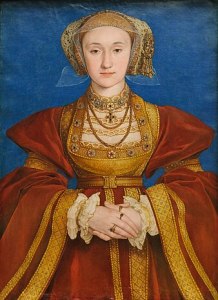
Anna of Cleves, 16th century hottie. Hans Holbein, Louvre INV 1348

The English bible was out and it was the law to preach the reformed religion in England. Henry, Cromwell and Cranmer all graced the cover of the new bible. But getting everyone to obey the reforms was near impossible. In March 1540, Bishop Stephen Gardiner had been preaching the old doctrine at St Paul’s. Days later, Cromwell’s old friend Robert Barnes did the same, preaching the reformed doctrine. King Henry heard of these outbursts and ordered Gardiner and Barnes to appear before him to explain themselves. It was not simply two men forced to explain themselves, as the king was ‘scandalised’ by their words. It was Gardiner’s words against Cromwell’s words, Barnes simply the mouthpiece. Henry, unhappy with his German marriage, could turn his anger against the Reformation instead of its real target, bringing Cromwell and Gardiner’s long-running feud to its bitter end. Everyone needed to be silent to appease the king’s current mood, so Barnes recanted his words in late March, and Cromwell made a concession; he invited Stephen Gardiner to dinner at Austin Friars.

If the Lambeth Palace banquet with the Duke of Norfolk was a flashpoint in Cromwell’s fortune, the Austin Friars dinner party would go one step further. What should have been two men finding a truce, instead turned into a bitter dispute, free of the civility of court. Rumours were already flying; people believed Cromwell would lose the Vice-Gerent and Lord Privy Seal positions. With Henry turning from the Reformation due to his marital bed problems with Queen Anna, Cromwell needed to defend all he had done, just as Gardiner felt he needed to defend the papacy.

A withering and acrimonious shouting match ensued at Austin Friars, with Cromwell screaming at Gardiner, ‘if the King would turn (from the Reformation), yet I would not turn! And if the King did turn, and all his people, I would fight in the field in my person, with my sword in my hand, against him and all others’. Cromwell, holding a knife (claimed Gardiner), added, ‘if this dagger was not thrust into my heart in battle, and if I would not die in that quarrel against them all, and I live one year or two, it shall not be in the King’s power to resist me’.

Cromwell had made a huge mistake, not unlike several inappropriate outbursts over recent months. A man who could have his enemies cornered before they realised the hunt had begun, suddenly began making missteps for no apparent reason. Cromwell was discussing a theological battle, not an actual war, and if he had a knife, it would have been no more than a dinner knife. The lack of actual danger to Henry must have been apparent, as  Gardiner kept this treasonous argument quiet, and Cromwell needed to get ahead of him. Cromwell surrendered the position of Secretary of State to the king, a job he held in an official capacity for six years. Secretary Cromwell was no more. The position that gave so much power beside the throne slipped away, but only just. The position would be divided between two people, a plan used regularly in the future, separating the immense power of the position. Ralph Sadler and Thomas Wriothesley were both given the job.

For a moment, things seemed to calm again but French Ambassador Marillac thought Cromwell was in trouble; Gardiner had not said anything, but Marillac, either listening to bad sources or simply sharing lies, wrote to King Francis, ‘Cromwell is tottering’. Marillac could not have been more wrong. On 17 April, King Henry astounded Cromwell and his friends and foes, telling him that he would become the 16th Earl of Essex (1st Earl, sixth creation), accompanied with a list of lands and manors five pages long. Henry Bouchier, whose family had held the Essex titles for eighty years, broke his neck after coming off his horse a month earlier, a sudden opportunity for Cromwell to be elevated. One day after this shock announcement, Cromwell was again bestowed with glory: the title of Lord Great Chamberlain, head of the royal household. The Earls of Oxford had held the role for the past 400 years, but John De Vere had died at home just a week after Henry Bouchier, leaving a vacancy at court.

But Gardiner had these words, spoken in anger at Austin Friars, coupled with the Duke of Norfolk’s French plan to remove Cromwell, were lying in wait, as the final traitor was about to reveal himself.

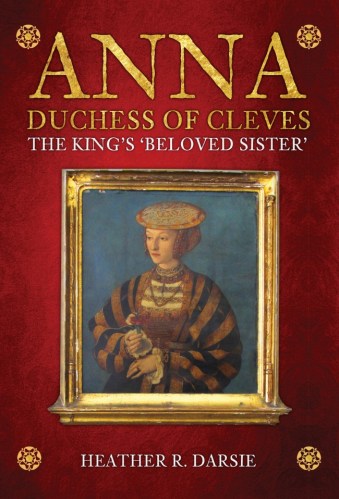
HISTORICAL BOOK REVIEW SERIES: “Anna, Duchess of Cleves” by Heather R. Darsie

Anna was the ‘last woman standing’ of Henry VIII’s wives ‒ and the only one buried in Westminster Abbey. How did she manage it?

Anna, Duchess of Cleves: The King’s ‘Beloved Sister’ looks at Anna from a new perspective, as a woman from the Holy Roman Empire and not as a woman living almost by accident in England. Starting with what Anna’s life as a child and young woman was like, the author describes the climate of the Cleves court, and the achievements of Anna’s siblings. It looks at the political issues on the Continent that transformed Anna’s native land of Cleves ‒ notably the court of Anna’s brother-in-law, and its influence on Lutheranism ‒ and Anna’s blighted marriage. Finally, Heather Darsie explores ways in which Anna influenced her step-daughters Elizabeth and Mary, and the evidence of their good relationships with her.

Was the Duchess Anna in fact a political refugee, supported by Henry VIII? Was she a role model for Elizabeth I? Why was the marriage doomed from the outset? By returning to the primary sources and visiting archives and museums all over Europe (the author is fluent in German, and proficient in French and Spanish) a very different figure emerges to the ‘Flanders Mare’.

Cover and blurb via Amberley

~~

There is a piece of fiction out right now, which suggests that Henry VIII was right, Anna of Cleves was no virgin. I will not be reviewing that work, as I only publish five-star reviews, and leave the rest in privacy. Instead, I am here to show you THE book on Anna of Cleves, a piece of written beauty.

Anna of Cleves starts out with a look at Anna’s childhood, her family, its history, and life in Germany at the time. The book has researched German life and child-rearing for those in Anna’s rich position. No music, dancing and sewing days for Anna – girls were taught by women to learn finance, in order to run a home worth of a duchy. Yes, Anna could sew, with her fine embroidery and needlework on clothing, but could also read, write, understand money and German customs, values and politics. While all that is great, Anna learnt a German way of life, and the German language, one of her original problems in England.

The book tells us of Anna’s early life, rather than only focusing on her once she was purchased as a queen. The Cleves Court was an intriguing place, with a wholly different look at politics and customs of the time period. Without giving away spoilers, the stark difference between Germany and England shows just how much Anna had to go through upon her marriage and carefully negotiated life.

Germany, of course, was in the process of the Reformation, leaning Protestant, just how my personal beloved Thomas Cromwell wanted for England. Between the changes of Germany and the power still held by the Holy Roman Empire at the time, Anna marrying into England would have massive repercussions, and as someone who had to write the death of Thomas Cromwell, the book was an immense eye-opener on how Anna of Cleves’ marriage brought down England’s greatest minister of all time.  The situation was never as simple as Henry thinking Anna was ugly. No spoilers, but damn!!!

Anna of Cleves is an extraordinary woman. She managed to survive an annulment from Henry after only a few months (and didn’t have to sleep with him), and became the king’s ‘sister.’ Anna made friends with the grandest of women in England, Henry’s daughters Lady Mary and Lady Elizabeth, and also the exciting Catherine Willoughby, Duchess of Suffolk. Anna managed all this in England, living a longer life than any other Henry wife, but never had to let go of who she was.  It has been a long time since I found a book with so much new information; we just needed to wait for Darsie to deliver such brilliance. History has relegated Anna to a role of being the ugly foreign wife Cromwell brought to England. A woman so repulsive Henry became impotent (though, come on, none of us ever believed that was her fault). A woman married for an alliance not wanted or needed, and disposed of for a pretty teenager. Anna was beautiful, educated, kind, clever and resourceful. Thank you for this wonderful book!