HISTORICAL BOOK REVIEW SERIES: ‘In the Footsteps of the Six Wives of Henry VIII’ by Sarah Morris and Natalie Grueninger

This book provides a fresh perspective on the lives of Henry VIII’s six wives by embarking on a journey through the manors, castles and palaces in which their lives were played out. This journey traces their steps to the Alhambra in Spain, childhood home of Katherine of Aragon; to the very room at Acton Court where Anne Boleyn and Henry VIII publicly dined; through the cobbled grounds of Hampton Court Palace, which bore witness to both triumph and tragedy for Jane Seymour; into the streets of Düsseldorf in Germany, birthplace of Anne of Cleves; among the ruins and picturesque gardens of St Mary’s Abbey in York where Catherine Howard and Henry VIII rested at the pinnacle of the 1541 progress; and to Gainsborough Old Hall in Lincolnshire, where Katherine Parr lived as daughter-in-law of the irascible Sir Thomas Brough.

Each location is described in a fascinating narrative that unearths the queens’ lives in documents and artefacts, as well as providing practical visitor information based on the authors’ first-hand knowledge of each site. Accompanied by an extensive range of images including timelines, maps, photographs and sketches, this book brings us closer than ever to the women behind the legends, providing a personal and illuminating journey in the footsteps of the six wives of Henry VIII.

cover and blurb via amazon

~~

For everything Henry VIII did, all anyone remembers is the fact he married six times. To be fair, he isn’t all that different to many guys – gets to middle-age and freaks out and wants to date younger women, usually blondes. And like most of these scenarios, who the women are doesn’t matter so much, but to those of us who do know these women, they are far more fascinating than the man they married.

Whether or not you know your Annes from your Katherines from your Jane, this book is a different take on the six queens of England. Morris and Grueninger, rather than writing the history of these women, have instead mapped out their lives, detailing the places where they lived their extraordinary lives, a tour of their time as queens.

Katherine no.1 was England’s queen, but she began her life in Spain, and the authors have included this history in the detail of her life, such as the details of the Alcazar in Seville and in the incredible Alcazar in Cordoba, and naturally, the Alhambra. On the other side of her life, Katherine’s time pushed aside as a forgotten wife is even detailed, something I found invaluable.

Anne Boleyn’s life gets a vivid recreation at Hever Castle, before she headed to Flanders and France. Of course, her time in the Tower before execution is all laid out (in fact, there is a whole extra book!). Jane Seymour led a more simple life, but the now well-known Wolf Hall is there, along with Mercer’s Hall and Chester Place in London.

Next came Anne no.2, one of my personal favourites, and what a varied life Anne of Cleves lived. She grew up by the Rhine in Düsseldorf; she and her sister were painted by Holbein himself at Schloss Hambach. Anne travelled through Antwerp, staying at England House, and onto Bruges, Calais, before she passed through Deal and Dover Castles in Kent. Anne lived in many beautiful places before being given The King’s Manor, a 100-room palace in Dartford. Oh, to see what Anne of Cleves saw in her time!

Katherine no.2, little Katherine Howard, started her life at Norfolk House in London and Horsham, where many of her problems began. Katherine’s young eyes take readers to Oatlands Palace, Grimsthorpe Castle in Lincolnshire, north into York and more before she ended her days in the Tower. Katherine no.3, the intelligent Katherine Parr, had been married and widowed twice before the king all-but forced her into marriage. She started life at Rye House in Hertfordshire, before moving between castles in Lincolnshire, Cumbia and North Yorkshire. As queen, Katherine lived in Woking Place in Surrey, including when she ruled as regent in Henry’s absence while fighting in France. The now-mythical Nonsuch Palace in Surrey also makes an entry.

I can’t tell you how many places are meticulously detailed in this book. The level of  information and attention is unquestionable in this beautiful book and there is absolutely no book which can give readers insight such as this one. I cannot thank the authors enough for this book, I originally got a copy at the library but went and ordered a copy for myself straight away.
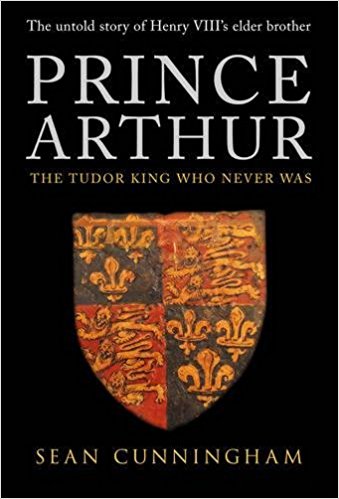
HISTORICAL BOOK REVIEW SERIES: ‘Prince Arthur – The King Who Never Was’ by Sean Cunningham

During the early part of the sixteenth century England should have been ruled by King Arthur Tudor, not Henry VIII. Had the first-born son of Henry VII lived into adulthood, his younger brother Henry would never have become King Henry VIII. The subsequent history of England would have been very different; the massive religious, social and political changes of Henry VIII’s reign might not have been necessary at all.

In naming his eldest son Arthur, Henry VII was making an impressive statement about what the Tudors hoped to achieve as rulers within Britain. Since the story of Arthur as a British hero was very well known to all ranks of the Crown’s subjects, the name alone gave the young prince a great deal to live up to. Arthur’s education and exposure to power and responsibility, not to mention his marriage to a Spanish princess in Catherine of Aragon, all indicate that the young prince was being shaped into a paragon of kingship that all of Britain could admire.

This book explores all of these aspects of Prince Arthur’s life, together with his relationship with his brother, and assesses what type of king he would have been.

cover and blurb via amazon

~~

Henry VIII is far from the only man who took a throne and went mad. Some tend to be hard on him, as if he was the only angry ruler the world saw, making it easy to say ‘what would have happened if Arthur had never died?’

Henry VIII was the king who shouldn’t have been, making Prince Arthur the king who never was. Here is the book to answer all your questions had King Arthur I taken his place in history.

Arthur was born to role. The first child of his parents, Henry VII and Elizabeth of York. Much has been made of little Arthur; some claim him fragile since birth, others draw the opposite conclusion. From a young age, Prince Arthur was given a top education, given a reigning position as Prince of Wales, close to his father the king.

Arthur was treated like a precious jewel, the king who would reign after the bloody battles of the War of the Roses. Arthur was the blood of the house of Lancaster and York combined; his existence alone suggested constant unity and peace. Given an education both in practical subjects, plus religion and humanism, Arthur got involved in local matters as a child, at his father’s side, completely prepared to take over England when the time came. Arthur had siblings, first a sister Margaret, then the spare heir Henry, and little Mary, to be followed by Elizabeth, Edmund and Katherine who all did not survive infancy. Henry and the girls were kept with their mother while Arthur was cradled for brilliance.

Officially married in 1501 after four years of being married by proxy, 15-year-old Arthur was to move to his castle in Ludlow, to rule over Wales, as his title suggested. Princess Katherine of Aragon was at his side, a Spanish princess there to ensure that Arthur’s future children would be recognised as the sole rulers of England, to soothe Henry VII’s constant fears of being usurped. Arthur boasted of bedding his new bride, words that would live for all time.

Only a few months into the marriage, Prince Arthur died at Ludlow Castle, of possible sweating sickness, leaving a widow not pregnant with the future heir. While spoiled little Henry would take the crown seven years later, along with the princess, England never got their perfect king. Queen Elizabeth died only a year after Arthur, and Henry kept his son hidden away, in the fear something might happen to his remaining son. Little Henry should have been given Arthur’s education, yet received nothing.

It is easy to suggest that Arthur’s reign would have been different. Naturally, there would have been differences. Henry broke from Catholicism in order to get rid of his wife of twenty years, on the grounds that Katherine had slept with Arthur, which she denied all her days. It is easy to say the Protestant Reformation would have never occurred in England without Henry’s need for divorce. Reformation would have come to England without Henry’s divorce, but simply would have taken a different route, as it did with other nations. Henry divorced to gain an heir with another woman, the exact same pressure Arthur would have faced if he couldn’t produce a son to inherit. For all his kindness and intelligence, Arthur could have suffered the same infertility problems as his little brother.

Cunningham’s book gives you an insight to the life of King Arthur I. It is impossible to tell for certain, but here is a good best-case scenario, with a fine leader on the throne, and a stable dynasty as a result.

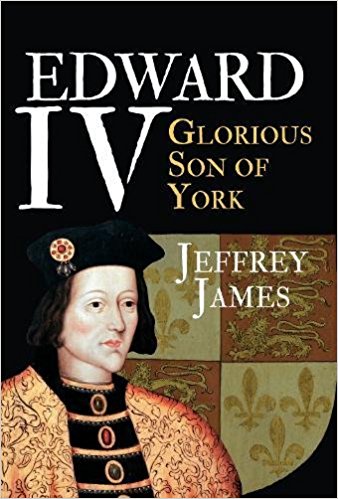
HISTORICAL BOOK REVIEW SERIES: ‘Edward IV: Glorious Son of York’ by Jeffrey James

Few English monarchs had to fight harder for the right to rule than King Edward IV – Shakespeare’s glorious son of York. Cast in the true Plantagenet mould, over six feet tall, he was a naturally charismatic leader. Edward had the knack of seizing the initiative and winning battles and is free from the unflattering characterisations that plagued his brother, Richard III, having been portrayed as a good-looking and formidable military tactician. Described sometimes as reckless and profligate, all sources remark on his personal bravery. In the eleven years between 1460 and 1471 he fought five major battles in the Wars of the Roses. Three of them – Towton, Barnet and Tewkesbury – rank among the most decisive of the medieval period. This book covers Edward’s family background, the Yorkist takeover and the drift to war. It charts the tensions created by the controversial Woodville marriage and Edward’s deposition by the Earl of Warwick and subsequent exile. The return of the king brought with it battles anew and Edward’s decisive campaigns against Warwick and Margaret of Anjou. Finally, Edward’s sudden death heralded the demise of the House of York and the triumph of the Tudors against Richard III. This is a history of Edward IV’s struggle to gain and retain the kingship of England during a period of sustained dynastic turmoil during the Wars of the Roses.

cover and blurb via amazon

~~

Edward IV had a great claim to be England’s king, sadly, he was not the only one. The author starts easily, giving us the background of Edward’s family claim to the throne. A monster of man in those days, at 6′ 4″, Edward took the throne in 1461, and reigned over nearly a decade which had some of the most bloody battles of the War of the Roses.

While Edward was in line to claim the throne, overthrowing a sitting monarch, betraying his greatest ally and marrying for love (lust?) instead of gain did Edward no favours. For a man with battlefield experience, and political knowledge, he made errors during these dangerous years, racking up local enemies like no one else.

Edward had no trouble winning battles; Towton, then Barnet and Tewkesbury are just some of the battles he needed to fight in order to hold the throne, and this book tells the tale more like a story rather than a military strategy. Included are illustrations of the locations pivotal in Edward’s life.

One of Edward’s largest mistakes was the marriage to Elizabeth Woodville. However, had Edward married as his allies wanted, things could have still fallen apart, but without the Woodville family, doubtless lives may have been saved.

The book flies though these troublesome years until Edward’s overthrow in 1470, only to win his crown back again in six months, shortly before the death of Henry VI in prison. While the second half of Edward’s reign was far quieter, having killed the vast majority of his enemies and relations, Edward still fought in France, killed one of his brothers and grew chubby and lazy. His death in 1483 was still a great loss; while the War of the Roses saw much blood under his rule, at least some peace had begun to settle in. It would be only two years before all Edward fought for would be erased, his two sons killed and his precious brother Richard deposed by the last remaining Lancastrian enemy, Henry Tudor. But not all was lost; Edward’s daughter Elizabeth became queen, there as peace reigned in England (mostly), and their children became king of England, queen of Scotland, and (briefly) queen of France.

What I like about this book is that, while accurate, it doesn’t flow like a non-fiction biography, rather more of a story of a man who thought he was the rightful king. Trouble was, everyone thought themselves the rightful king.

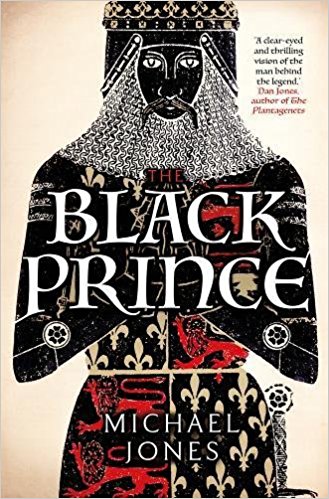
HISTORICAL BOOK REVIEW SERIES: ‘The Black Prince’ by Michael Jones

As a child he was given his own suit of armour; in 1346, at the age of 16, he helped defeat the French at Crécy; and in 1356 he captured the King of France at Poitiers. For the chronicler Jean Froissart, ‘He was the flower of all chivalry’; for the Chandos Herald, who fought with him, he was ‘the embodiment of all valour’. Edward of Woodstock, eldest son and heir of Edward III of England, better known as ‘the Black Prince’, was England’s pre-eminent military leader during the first phase of the Hundred Years War.

Michael Jones uses contemporary chronicles and documentary material, including the Prince’s own letters and those of his closest followers, to tell the tale of an authentic English hero and to paint a memorable portrait of warfare and society in the tumultuous fourteenth century.

cover and blurb via amazon

~~

My area is the 1400s and 1500s, so Edward, The Black Prince, hasn’t really been on my radar. So when I wanted to make a start on this legendary man, I came across this book, which stuck out. With my head already swimming with countless heavy academic books to read, it was a relief to find such an informative but easy to read book.

Edward of Woodstock (cool name) was born in 1330, was an earl while still in medieval nappies, and the first ever English duke, Duke of Cornwall, by age 7. King Edward III would have a slew of healthy sons, somethings all kings would dream of, but Edward was the first, the heir England needed. Young Edward was at his father’s side, and educated 1300s style – jousting, warfare and a touch of chivalry, which was on its way out. As a child, Edward had to attend council meetings and was Prince of Wales by age 13.

But it was the battlefield where Edward would reign, and get that nickname. The Crecy campaign of 1346 in France let Edward get taste for blood, winning the battle by his father’s side. The English had much of Normandy and had Calais, and then went to defend the sea between England and France from the Castilian soon after.

Battles in Aquitaine raged constantly and the Poitiers Campaign ravaged the French in 1356, and now the English had roughly a third of France in their control, making black-clad Edward a formidable soldier who could also be a great leader. Edward also sided with Pedro the Cruel in Spain to attempt victory in the Najera Campaign of 1366 which was a bad move, as Pedro more than lived up to his name, and Edward wasted his time in Aragon.

Edward’s name and reputation suggests a vicious man, cold and ready to use violence, but the author has shown a different man; a man loved by his countrymen, educated and cultured. Edward married his cousin Joan, the Fair Maid of Kent, in 1361, and only just into his thirties, started to suffer an unknown affliction where he began to waste away, possibly of liver or kidney failure, or a number of infections picked up on numerous battlefields. Edward and Joan gained two precious sons, Edward and Richard, only to lose Edward at a young age, leaving waif-like Richard as the heir to the throne.

By 1371, Edward was again fighting to hold onto power in Aquitaine, but needed to return home with illness. He attempted one more battle into France with his father but had to return home again. He spent the remainder of his life suffering until an early death in 1376, aged only 45, his heir Richard only nine.

Edward was buried in Canterbury Cathedral, and wasn’t called The Black Prince until a century and a half later, a result of his black armour and his ability to kill French people in Aquitaine, winning two of three major campaigns England made into France (the other is Agincourt 14515 btw). Edward III would have been devastated at the death of his son, and Richard went on to be a useless king, which caused death and battles among Edward III’s remaining heirs, all of which might have been avoided.

The Black Prince is the king who never was, and I am so glad I chose this book to start with learning more about the royals of the 1300s. You don’t need to be an expert to read this fluid piece of work, well laid out, and solid on the details. Much credit to the author for this book; I am glad to have it in my collection.

HISTORICAL BOOK REVIEW SERIES: ‘The Templars’ by Dan Jones

Jerusalem 1119. A small group of knights seeking a purpose in the violent aftermath of the First Crusade decides to set up a new order. These are the first Knights of Templar, a band of elite warriors prepared to give their lives to protect Christian pilgrims to the Holy Land. Over the next two hundred years, the Templars would become the most powerful religious order of the medieval world. Their legend has inspired fervent speculation ever since. But who were they really and what actually happened?

In this groundbreaking narrative history, the bestselling author of The Plantagenets tells the true story of the Templars for the first time in a generation, drawing on extensive original sources to build a gripping account of these Christian holy warriors whose heroism and depravity have so often been shrouded in myth. The Templars were protected by the pope and sworn to strict vows of celibacy. They fought the forces of Islam in hand-to-hand combat on the sun-baked hills where Jesus lived and died, finding their nemesis in Saladin, who vowed to drive all Christians from the lands of Islam. They were experts at channeling money across borders. They established the medieval world’s first global bank and waged private wars against anyone who threatened their interests.

Then in 1307 the Templars fell foul of a vindictive King of France, whose lawyers built a meticulous case against them. On Friday October 13, hundreds of brothers were arrested, imprisoned and tortured, and the order was disbanded amid lurid accusations of sexual misconduct and heresy. They were tried by the Pope in secret proceedings and publicly humiliated. But were they heretics or victims of a ruthlessly repressive state? Dan Jones goes back to the sources to bring their dramatic tale, so relevant to our own times, in a book that is at once authoritative and compulsively readable.

cover and blurb via amazon

~~

The thing about the Knights Templar is that you mention them, you get a reply that suggests they are well-known. But if you were to ask the where-when-why etc, you get a blank expression or something a little garbled and fishy. The Knights Templar has built up an aura of men in full amour, wielding swords, holding limitless power and having some sort of personal line to God. Finally, here is a book you can trust.

The cultish-like Templars started in Jerusalem, living rather plain lives, much like Spaniards  before the Moors came to town and made everything better. The Templars took their name from a palace in the centre city named Temple of the Lord. The Templars believed in Christian values, which even today is a sketchy ambition and usually means harming those who don’t agree with you. This is relevant to this tale, as the Templars were a Catholic military unit founded around 1119. From their basic levels in Jerusalem, over the next thirty years, the Templars spread themselves out over Christendom, killing in order to make sure everyone stayed Christian – their appointed version of Christianity. They were, by this time, famous, rich and considered battle warriors against heretics and infidels.

In a time of typically violent crusades between Christians and Muslims, the Templars rose to be seen as heroes. The victory in Jerusalem came in June 1187, winning against a Muslim attack thanks to the fund received from King Henry II, who had paid their church as penance for a huge misdeed. Again in 1191, the Templars rose to defeat the Saracen and their leader Saladin, in name of King Richard I the Lionheart.

The battles fought by the Templars raged throughout 1200’s but by the early 14th century, the Templars had established an iron will, refusing any kind of diplomacy and lack of understanding of values in the areas where they wielded their butchery. The Templars also remained strict to one another, sometimes even serving punishment to each other like eating like a dog for a year.

Jones’ work is accurate and yet reads like a drama as the Templars are turned upon by the French in the 1300’s when the king got heavily indebted to the Templars. Propaganda really got its legs when churches started disparaging the Templars. Their Grand Masters, combat robes, secret ceremonies, the vast wealth all started to slip away, as did their victories in the crusades. They lost Jerusalem by the mid 1200’s, moved on from modern-day Israel and Syria soon after, moved from Cyprus by 1303. Their cells through Europe continued, but when the Pope and the French king wanted them eliminated, the Templars met the fate on Friday 13, 1307, when they were set upon and formally denounced. By 1312, all the cells had been quashed and writs from the Pope wiped the Templars from Christendom.

Jones’ book is a wonderful read and dispels the myths of the Templars as well as giving the reader a clear picture of those murky times during the crusades. As always, Dan Jones has delivered.