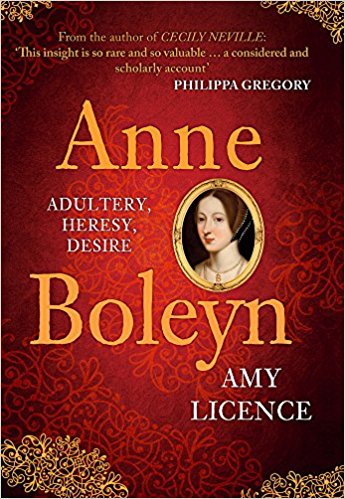
HISTORICAL BOOK REVIEW SERIES: ‘Anne Boleyn: Adultery, Heresy, Desire’ by Amy Licence

Anne Boleyn’s unconventional beauty inspired poets ‒ and she so entranced Henry VIII with her wit, allure and style that he was prepared to set aside his wife of over twenty years and risk his immortal soul. Her sister had already been the king’s mistress, but the other Boleyn girl followed a different path. For years the lovers waited; did they really remain chaste? Did Anne love Henry, or was she a calculating femme fatale?

Eventually replacing the long-suffering Catherine of Aragon, Anne enjoyed a magnificent coronation and gave birth to the future Queen Elizabeth, but her triumph was short-lived. Why did she go from beloved consort to adulteress and traitor within a matter of weeks? What role did Thomas Cromwell and Jane Seymour of Wolf Hall play in Anne’s demise? Was her fall one of the biggest sex scandals of her era, or the result of a political coup?

With her usual eye for the telling detail, Amy Licence explores the nuances of this explosive and ultimately deadly relationship to answer an often neglected question: what choice did Anne really have? When she writes to Henry during their protracted courtship, is she addressing a suitor, or her divinely ordained king? This book follows Anne from cradle to grave and beyond. Anne is vividly brought to life amid the colour, drama and unforgiving politics of the Tudor court.

cover and blurb via amazon

~~~

Are you thinking, oh God, another biography of Anne Boleyn? Is there anything else to know? I can tell you that, yes, there is more to know and you should be thrilled to get this one. Amy Licence has practically handed a perfect account of Anne’s life to readers on a silver plate. Come bask in its glory.

Regardless whether you think Anne stole the throne, was a home-wrecking schemer, or she was the king’s love, this book covers all angles, all details and all possibilities. Licence starts with Anne’s family and background, to see how a woman could be so loathed for her background compared to more noble beginnings, despite the fact Anne had a wonderful education abroad, enough for any noble man. The time period of Anne’s life was one where, as a young girl, the royal family of England was relatively stable; Henry married to Katherine, the odd mistress thrown in for good times (his at least). But when Katherine hit menopause and religious opinion was suddenly flexible, Anne’s life could never be the same.

The realities of the time are not romanticised by the author – being a woman was not all gowns and chilling with your lady friends. These people, with their lives dictated by custom, ceremony and family loyalties, were still real people. They loved, they loathed, they hurt like anyone else. The Boleyn family, while not as noble as others (only Anne’s mother was noble born), had their own plans in this world.

Anne served the archduchess of Austria, and Henry’s sister Mary when she was Queen of France. She also then served mighty Katherine, Queen of England. Anne was no fool, no commoner, yet not quite ever noble enough. Her family wanted better, and could you blame them? But the portrayal as the Boleyns as scheming, as pushing daughters forward as whores under the king’s nose has done Anne no favours, and this book can make Anne lovers feel safe she is not portrayed as some witch.

Women routinely became mistresses, as the social order gave this is an avenue, yet was frowned upon (um, who was sleeping with these girls, gentlemen?), and a route Anne’s sister Mary took with Henry, and we shall never know for sure if Mary really wanted the job. But Anne knew, regardless, that she would not do the same thing. She loved Henry Percy, and wanted to have a real marriage, real love, only to have it dashed away thanks to that same social order.

The book delves into Anne’s rise to power as Henry’s paramour, and discusses whether she played him as part of a strategy or whether she was forced into a ridiculous game with no option but to play along. No woman can say so no to a King; Anne had to be his love, his mistress-without-benefits (or did they share a bed? The book discusses), and Henry’s selfish nature sent him down a path Anne couldn’t have imagined. She wanted to be a man’s wife, not whore. Henry, in turn, got Thomas Cromwell to destroy the social order and religious boundaries. Even the most scheming woman couldn’t have predicted that.

Licence uses excellent sources for her biography, and as a person hungry for minor details on certain periods of Anne’s life, I fell upon these pages with great excitement. Anne was smart, she had morals, she had a temper and a strong will, so much so that king chased her long enough to create divorce from the Catholic Church and make her a queen. No one does that for any mistress.

Anne married Henry, and received a coronation with the crown only meant for ordained kings, and gave Henry the Princess Elizabeth. Anne should have had full control of her life by then, only to find she was more helpless than ever. Having given up her virginity but given Henry no son, she fell from favour, and when Henry asked Cromwell to remove Anne to make way for another virgin with a womb, poor Anne was destroyed in a way everyone knows, never learning what a glorious queen her daughter would become. What people didn’t know was the truth over the whole debacle that brought Anne to the executioner’s sword.

As a woman, a spurned one at that, Anne’s history became sullied with lies and cruelty – that she was a femme-fatale who turned into a whore and witch, that she gave birth to a monster child, that she had disfigurements. History was not ready to tell the truth about a smart, powerful woman. Thank God we live in a time where historians like Amy Licence are able to guide readers through Anne’s real history without forcing conclusions on readers.

HISTORICAL BOOK REVIEW SERIES: ‘Edward II the Man – A Doomed Inheritance’ by Stephen Spinks

Edward II is one of the most controversial kings of English history. On numerous occasions he brought England to the brink of civil war.

Author Stephen Spinks argues that Edward and the later murdered Piers Gaveston were lovers, not merely ‘brothers-in-arms’. Influenced by successive royal favourites and with a desire for personal vengeance, his rule became highly polarised and unstable. His own wife took a lover and invaded his kingdom resulting in his forced abdication; the first in British history. Edward’s prevailing legacy remains the warning that all kings can fall from power.

And yet … war, debt and baronial oppression before 1307 ensured that Edward II inherited a toxic legacy that any successor would have found almost impossible to wrestle with. Stephen Spinks explores that legacy using contemporary and later sources. By focusing on Edward’s early years as much as on his reign, and exploring the conflicting influences of those around him, Stephen shows the human side of this tale against a backdrop of political intrigues and betrayals. He peels back the layers to reveal the man who wore the crown. Edward’s belief in his unchallengable right to rule, increasingly at odds with those at his court, and his undeniable thirst for revenge, creates a fourteenth-century tragedy on a grand scale.

cover and blurb via amazon

~~

Poor Edward II; he constantly gets spoken of in negative terms. I confessed to not knowing Edward II in much detail, so to receive this book was much appreciated.

The rule of Edward II suffered from war, famine and betrayal, though Edward inherited a troubled kingdom from his father, Edward I, in 1307. By the time he became king, Edward was already very close to Piers Gaveston, long considered to be Edward’s lover. The incredible closeness of the pair would trouble Edward for many years.

Edward’s troubles increased when he married Isabella of France when she was just 12. Edward was able to continue loving his buddy Piers, and also women of his court, before Isabella was old enough to bear their first child at around the age of 16. The author uses primary sources to discuss these issues, and while nothing can ever be proved around Edward’s sexuality, the author’s suggestion of a homosexual relationship seems very likely.

Edward’s initial troubles came from within, barons around the country pushing against his plans to reform the country and secure money and favour. Edward and Gaveston effectively ruled together, and the nobles disliked the king’s lover. The book tells the story of Gaveston’s eventual capture and murder in 1312 in detail.

Edward forged on without Gaveston, seeking peace with France and money from various sources, only to face war against Robert the Bruce in 1314, followed by bad weather which crippled and starved England for seven long years. Many saw this as a punishment from God, and civil war broke out in 1321, and by the time this was quashed, the Scots were at it again, followed by the French.

By late 1326, Edward had fallen from his wife’s favour, thanks to having to flee the Scots and the ever-rising power of Hugh le Despenser at court (and his also-horrid son of the same name). With Edward in a relationship with the horrible younger Hugh, Isabella set off to France on a mission and would not come home. Isabella fell in love with Roger Mortimer and they prepared to invade England from France, succeeding in 1327 when Edward’s support collapsed. The Despenser father was killed, and Edward’s lover Hugh the Younger was castrated and beheaded. Edward was imprisoned while Isabella and Mortimer ruled, with many nobles executed.

Edward II died imprisoned in September 1327, and Isabella and Mortimer continued to rule with her son Edward III named as king. By 1330, young Edward had disposed Mortimer from his place of wealth and power and executed. Rumours of Edward II’s murder swirled, with graphic depictions of torture. While this dramatic life is written up, the book tells the story of Edward as a person rather than simply a ruler. The book ends with copies of letters written by Edward II to his son and the king of France, and a letter written about the suspected survival of Edward after his supposed death.

The author has gone into great detail to tell the story of Edward II as the facts and evidence present themselves. While history is littered with speculation, the author leaves his own assumptions out, leaving the reader to decide based on facts, not opinion. Congratulations to Stephen Spinks on a wonderful read.

HISTORICAL BOOK REVIEW SERIES: ‘Elizabeth’s Rival: The Tumultuous Tale of Lettice Knollys, Countess of Leicester’ by Nicola Tallis

The first biography of Lettice Knollys, one of the most prominent women of the Elizabethan era.

Cousin to Elizabeth I – and very likely also Henry VIII’s illegitimate granddaughter – Lettice Knollys had a life of dizzying highs and pitiful lows. Darling of the court, entangled in a love triangle with Robert Dudley and Elizabeth I, banished from court, plagued by scandals of affairs and murder, embroiled in treason, Lettice would go on to lose a husband and beloved son to the executioner’s axe. Living to the astonishing age of ninety-one, Lettice’s tale gives us a remarkable, personal lens on to the grand sweep of the Tudor Age, with those closest to her often at the heart of the events that defined it.

In the first ever biography of this extraordinary woman, Nicola Tallis’s dramatic narrative takes us through those events, including the religious turmoil, plots and intrigues of Mary, Queen of Scots, attempted coups, and bloody Irish conflicts, among others. Surviving well into the reign of Charles I, Lettice truly was the last of the great Elizabethans.

cover and blurb via amazon

~~

Lettice Knollys is such an interesting person, a life filled with enough drama and excitement that anyone would envy her. One of the few women of the English court not to be named Katherine, Anne, Elizabeth or Mary, Lettice Knollys was the daughter of Catherine Carey, the so-called love child of Henry VIII and Mary Boleyn.

While Catherine Carey wasn’t formally recognised as Henry’s love-child, the odds are high, making Carey the half-sister of Queen Elizabeth, and thus Lettice was Elizabeth’s niece, rather than cousin. The two women looked much alike, and as Lettice was only 10 years younger than her aunt, she was the younger gorgeous redhead. Dressed in clothes of the period, Queen Elizabeth and Lettice look much alike, same hair, face, smile. The author of this book leans closely to the fact that Henry VIII was Lettice’s grandfather, and had she been male, would have been an illegitimate heir to the throne. Lettice was a Tudor, something fast disappearing from the world.

Lettice married well at 17 to Walter Devereux, Viscount Hereford and bore him four surviving children (out of five, pretty good). Lettice was young, happy and known as the most beautiful woman at the English court. Elizabeth, ever-vain, needed to be centre stage and could have been annoyed, but yet she and Lettice were close. Elizabeth had her own love – Robert Dudley, Earl of Leicester, whom she could not marry. This is how two Tudor women became bitter rivals.

Lettice’s husband, now Earl of Essex, shipped out to Ireland at the queen’s behest in 1573, and Lettice started an affair with the queens’ favourite, Dudley. While nothing could be confirmed and most accounts are long-lost, the book tells of how rumours swirled of the affair and Lettice carrying and bearing children while her husband was away. Devereux came home after two and half years away, having heard all about his wife’s behavior. But Devereux left for Ireland again six months later, only to die soon after of dysentery while complaining about women being frail.

Lettice fought hard for an inheritance for herself and her children, and her affair with Dudley continued despite him being Elizabeth’s favourite. Dudley had wanted to marry Elizabeth, but was unable to for many reasons, and so had instead gone to the bed of the younger Tudor model. He married Lettice in secret in 1578, two years after she was widowed, he himself a widower for some 18 years at this point. Just two days later, Lettice sat with the queen at dinner, the secret safe, as it would be for  years, with Lettice and Dudley moving about regularly, usually separated. Lettice lost a  baby in 1580, gave birth to a son in 1581, and lost another in 1582. Their precious only son died in 1584, causing great grief to the pair.

But in 1583, all hell had broken loose. Elizabeth found out her favourite had married Lettice, and was living openly with her in his own home. A bond which had almost certainly begun in childhood was broken; Lettice was banished from Elizabeth’s presence, furious the man she wouldn’t marry had married someone else. Dudley was sent on several trips abroad, before he fell ill, possibly with malaria in September 1588 and he died with Lettice at his side.

Lettice remained out of favour with the queen, living a country life with a new husband, a young soldier named Sir Christopher Blount, former attendant to her late second husband. She struggled with the loss of her eldest son and suffered many financial troubles, and did not see her queen again until 1598, where the meeting remained icy a decade after Dudley’s death. The love triangle between Dudley and the two red-headed Tudor women never healed.

Thanks to the Essex revolt of 1601, Queen Elizabeth beheaded Lettice’s precious remaining son and her new husband , both for treason. She spent much time fighting over inheritances with a bastard son of Robert Dudley, and then lived with her daughters and their children, outliving them. She lived quietly under King James and King Charles, dying at her grandson Robert’s home in December 1634, aged 91, a symbol of  bygone age.

Lettice’s life, born under Henry VIII, a bastard grandchild to the great king, grew up under him, King Edward, Queen Mary, lived through Queen Elizabeth’s reign, then King James and King Charles, is a story of wonder, drama, intrigue, heartache and love. Why there aren’t many books on such an incredible woman is a mystery. Thank you so much to Nicola Tallis for the book I have been waiting for, a perfect read on a riveting subject.

HISTORICAL BOOK REVIEW SERIES: ‘Joan of Arc and The Great Pity of the Land of France’ by Moya Longstaffe

Joan of Arc’s life and death mark a turning point in the destiny both of France and England and the history of their monarchies. ‘It is a great shame,’ wrote Étienne Pasquier in the late sixteenth century, ‘for no one ever came to the help of France so opportunely and with such success as that girl, and never was the memory of a woman so torn to shreds.’

Biographers have crossed swords furiously about her inspiration, each according to the personal conviction of the writer. As Moya Longstaffe points out: ‘She has been claimed as an icon by zealous combatants of every shade of opinion, clericals, anticlericals, nationalists, republicans, socialists, conspiracy theorists, feminists, yesterday’s communists, today’s Front National, everyone with a need for a figurehead. As George Bernard Shaw said, in the prologue to his play, “The question raised by Joan’s burning is a burning question still.”’

By returning to the original sources and employing her expertise in languages, the author brings La Pucelle alive and does not duck the most difficult question: was she deluded, unbalanced, fraudulent ‒ or indeed a great visionary, to be compared to Catherine of Siena or Francis of Assisi?

cover and blurb via amazon

~~

Everyone has heard of Joan of Arc, the girl dressed as a man, who heard godly voices telling her to run an army. But ask for more, the where, when and why, then the story becomes murkier. So a comprehensive book on Joan is perfect for anyone.

Joan, or Jeanette, was a woman, so naturally has been written in a less than ideal light throughout time. A saint, a lunatic, a heretic, a liar, witch, a leader. Poor Joan has been labelled it all. But who is Joan of Arc?

The book starts off with the detail of the country of Joan’s birth. ‘The Great Pity of the Land of France’ was the phrase, the pity being the sorry state of the country and the suffering of its people. First came civil war between the leaders of Orleans and Burgundy in the early 1400’s, before the English then  invaded France, with the massive battles of Harfleur, Agincourt and Rouen with King Henry V in 1415-1419. France was on its knees – a crazed leader, a dead dauphin, a ragged army and struggles for the people. Battles between France and England through the Hundred Years’ War, ending in 1453, is explained through this book, to give clarity to the life and situation that gave rise to such a heroine.

The book delves into Joan’s early life, the family who raised her, and what made her believe she was called by God to save her country. Joan of Arc was no great-sized warrior. An average girl of average height, her hair cut short like a soldier, the clothes of a soldier. Joan was not the first French woman to ride into battle but none before her had the qualities of young Joan. With God on her side, Joan was a unique figure. She set out from her home in Domrémy, where she had seen visions of  Saint Michael, Saint Catherine, and Saint Margaret from the age of 13. Leaving home at about 16 in 1428, Joan believed she had to drive the English out of France, and bring the King Charles to Reims where he would be crowned. Joan travelled to Vaucouleurs and petitioned an army commander with her tales of divine intervention. Joan told the men of tales of battle at Rouvray days before word spread to the area about the battle, convincing the army of her visions. What began was an extraordinary change in favour for the French army.

Joan was sent to meet with King Charles in 1429, age 17. Joan was sent on a relief mission to Orleans, all in donated armour, to be a message of hope to battling soldiers losing to the English. Some say Joan fought in battles, others say she merely sat in on military meetings and planning. Either way, for a young woman, any involvement is extraordinary for the time. But soon after Joan’s arrival, the French beat back the English, took Reims after other successful battles, and Joan’s family were ennobled. Her presence, her visions, her tales changed the war.

A year on and a truce with England collapsed and Joan was again at war and captured by Burgundy. She jumped from a tower up to 21 metres high to escape and had to be moved to a secure location. Then Joan was put on trial for heresy, a classic move when an enemy wanted to bring someone down. The English and the Burgundians wanted Joan gone. Not only guilty of heresy by claiming to hear saints, Joan was charged with cross-dressing, something only hated after she was caught. As a soldier, Joan was welcome to dress as a man, for necessity. Her male outfit also saved her chastity, and as soon as she was forced into a dress, an English lord attempted to rape her, allowing her back into male clothing.

The religious court lacked honesty or jurisdiction, and the English and Burgundians won out. Joan was found guilty of her charges, the penalty death at the stake. Joan was burned 30 May 1431 in Vieux-Marché in Rouen, and then her charred body was pulled from the ash and burned twice more to ensure her death. Both French King Charles and English boy-King Henry continued to claim hold over France, and the war carried on. It was not until 1452 did poor Joan get a retrial, ending in an innocent verdict in 1456, just as the wars finally ended in France’s favour.

I have to confess I did not know the detail of Joan of Arc’s life, so this book was of great interest. Someone interested in Joan may know all the facts as they are already known, but to me, the book is a treasure trove of detail on a great woman of history. Congratulations to the author for the wide research and careful construction of this great heroine.


HISTORICAL BOOK REVIEW SERIES: ‘The White King: Charles I, Traitor, Murderer, Martyr’ by Leanda de Lisle

From the New York Times bestselling author and master of narrative nonfiction comes the tragic story of Charles I, his warrior queen, Britain’s civil wars and the trial for his life.
Less than forty years after England’s golden age under Elizabeth I, the country was at war with itself. Split between loyalty to the Crown or to Parliament, war raged on English soil. The English Civil War would set family against family, friend against friend, and its casualties were immense–a greater proportion of the population died than in World War I.
At the head of the disintegrating kingdom was King Charles I. In this vivid portrait–informed by previously unseen manuscripts, including royal correspondence between the king and his queen–Leanda de Lisle depicts a man who was principled and brave, but fatally blinkered.
Charles never understood his own subjects or court intrigue. At the heart of the drama were the Janus-faced cousins who befriended and betrayed him–Henry Holland, his peacocking servant whose brother, the New England colonialist Robert Warwick, engineered the king’s fall; and Lucy Carlisle, the magnetic ‘last Boleyn girl’ and faithless favorite of Charles’s maligned and fearless queen.
The tragedy of Charles I was that he fell not as a consequence of vice or wickedness, but of his human flaws and misjudgments. The White King is a story for our times, of populist politicians and religious war, of manipulative media and the reshaping of nations. For Charles it ended on the scaffold, condemned as a traitor and murderer, yet lauded also as a martyr, his reign destined to sow the seeds of democracy in Britain and the New World.

cover and blurb via amazon

~~

I don’t know much about Charles I; he is not in my time period of “expertise”, but since de Lisle is such a good author, I thought it was time to extend my knowledge. A quick internet search of Charles I tells of a somewhat brutal and foolish guy, where things all went wrong around him. But this book doesn’t tell that story. Charles was a man who took his duty as king most seriously, his kingship and his religion were held to the highest of esteem, he cared about his people and honour was his greatest value to maintain.

Charles I was a Protestant man, yet was not harsh on Catholics like rulers before him. It come have been Charles’ lack of will that caused him trouble. His relationship with Archbishop Laud made Charles’ subjects believe he was a Catholic sympathiser, when in fact, his Protestant beliefs were firm in his heart. When the French princess, Henrietta-Marie, a  Catholic, was chosen as queen, these rumours only grew worse.

While the book talks of a man worthy of being king, Charles’ personality did not automatically translate into him being a good leader. He liked to compromise – to the point where he would be on the losing side, but also could be stubborn and refuse to give in when it was in England’s best interest. Charles, ultimately, was a stiff and difficult king, and seemed to want to be seen as a strong leader while still also a protector. Yet it was his stubbornness that would be remembered, as inflexibility caused his people harm.

Married to French Henrietta-Marie, it has been said that Charles was dominated by this woman. Yet that is a combination of male historians and old attitudes assuming any woman with a will and an opinion must be a domineering wench. Henrietta-Marie was a smart woman, trained to be a queen. Perhaps things would have gone differently had Charles listened to his wife more often. The author uses letters which have not been used before, to show what the royal marriage was like, and showed that this prime political match had sense of love to it also. Charles’ mother-in-law was the powerful Marie de Medici, the Dowager Queen of France. Marie was considered the human body of the counter-reformation, a strong Catholic firmly against Protestantism, only to have her daughter marry Charles, leader of Protestant England. Charles and Henrietta-Marie would have had the most fraught and lively marriage one could imagine.

There were figures in Charles’ life which I had never heard of – the Rich brothers. Henry,  1st Earl of Holland, and Robert, 3rd Earl of Warwick, stood in Charles’ way as he looked for the funds to start a war, as decided upon in parliament. Charles needed to protect Protestant needs throughout Europe as the Catholics fought back more than in previous generations. Also rearing its head was Oliver Cromwell’s desire for civil war and to rule in the monarchy’s place. Between the Rich brothers and their cousin named Lucy Percy, Countess of Carlisle, they rose in power as Charles did his fumbling best to save his true religion and his country.

Of course, that genocidal killer, Oliver Cromwell, was doing is best to embrace an England without a monarchy, and after civil wars, poor Charles I was captured and beheaded for high treason in 1649, after 24 years as king. After plenty more fighting, and England spending a decade free of a monarchy, Charles’ son, also Charles, took the throne in his place. How much easier English history would be if Catholic and Protestant factions could just co-exist, even if just within the confines of the royal line!

While I know little about the time period of Charles I, I enjoyed this book, as de Lisle is a wonderful author, creating another book that is fun to read while laced with information you can trust and enjoy. All books by Leanda de Lisle are a must-buy.