HISTORICAL BOOK REVIEW SERIES: ‘Elizabeth’s Rival: The Tumultuous Tale of Lettice Knollys, Countess of Leicester’ by Nicola Tallis

The first biography of Lettice Knollys, one of the most prominent women of the Elizabethan era.

Cousin to Elizabeth I – and very likely also Henry VIII’s illegitimate granddaughter – Lettice Knollys had a life of dizzying highs and pitiful lows. Darling of the court, entangled in a love triangle with Robert Dudley and Elizabeth I, banished from court, plagued by scandals of affairs and murder, embroiled in treason, Lettice would go on to lose a husband and beloved son to the executioner’s axe. Living to the astonishing age of ninety-one, Lettice’s tale gives us a remarkable, personal lens on to the grand sweep of the Tudor Age, with those closest to her often at the heart of the events that defined it.

In the first ever biography of this extraordinary woman, Nicola Tallis’s dramatic narrative takes us through those events, including the religious turmoil, plots and intrigues of Mary, Queen of Scots, attempted coups, and bloody Irish conflicts, among others. Surviving well into the reign of Charles I, Lettice truly was the last of the great Elizabethans.

cover and blurb via amazon

~~

Lettice Knollys is such an interesting person, a life filled with enough drama and excitement that anyone would envy her. One of the few women of the English court not to be named Katherine, Anne, Elizabeth or Mary, Lettice Knollys was the daughter of Catherine Carey, the so-called love child of Henry VIII and Mary Boleyn.

While Catherine Carey wasn’t formally recognised as Henry’s love-child, the odds are high, making Carey the half-sister of Queen Elizabeth, and thus Lettice was Elizabeth’s niece, rather than cousin. The two women looked much alike, and as Lettice was only 10 years younger than her aunt, she was the younger gorgeous redhead. Dressed in clothes of the period, Queen Elizabeth and Lettice look much alike, same hair, face, smile. The author of this book leans closely to the fact that Henry VIII was Lettice’s grandfather, and had she been male, would have been an illegitimate heir to the throne. Lettice was a Tudor, something fast disappearing from the world.

Lettice married well at 17 to Walter Devereux, Viscount Hereford and bore him four surviving children (out of five, pretty good). Lettice was young, happy and known as the most beautiful woman at the English court. Elizabeth, ever-vain, needed to be centre stage and could have been annoyed, but yet she and Lettice were close. Elizabeth had her own love – Robert Dudley, Earl of Leicester, whom she could not marry. This is how two Tudor women became bitter rivals.

Lettice’s husband, now Earl of Essex, shipped out to Ireland at the queen’s behest in 1573, and Lettice started an affair with the queens’ favourite, Dudley. While nothing could be confirmed and most accounts are long-lost, the book tells of how rumours swirled of the affair and Lettice carrying and bearing children while her husband was away. Devereux came home after two and half years away, having heard all about his wife’s behavior. But Devereux left for Ireland again six months later, only to die soon after of dysentery while complaining about women being frail.

Lettice fought hard for an inheritance for herself and her children, and her affair with Dudley continued despite him being Elizabeth’s favourite. Dudley had wanted to marry Elizabeth, but was unable to for many reasons, and so had instead gone to the bed of the younger Tudor model. He married Lettice in secret in 1578, two years after she was widowed, he himself a widower for some 18 years at this point. Just two days later, Lettice sat with the queen at dinner, the secret safe, as it would be for  years, with Lettice and Dudley moving about regularly, usually separated. Lettice lost a  baby in 1580, gave birth to a son in 1581, and lost another in 1582. Their precious only son died in 1584, causing great grief to the pair.

But in 1583, all hell had broken loose. Elizabeth found out her favourite had married Lettice, and was living openly with her in his own home. A bond which had almost certainly begun in childhood was broken; Lettice was banished from Elizabeth’s presence, furious the man she wouldn’t marry had married someone else. Dudley was sent on several trips abroad, before he fell ill, possibly with malaria in September 1588 and he died with Lettice at his side.

Lettice remained out of favour with the queen, living a country life with a new husband, a young soldier named Sir Christopher Blount, former attendant to her late second husband. She struggled with the loss of her eldest son and suffered many financial troubles, and did not see her queen again until 1598, where the meeting remained icy a decade after Dudley’s death. The love triangle between Dudley and the two red-headed Tudor women never healed.

Thanks to the Essex revolt of 1601, Queen Elizabeth beheaded Lettice’s precious remaining son and her new husband , both for treason. She spent much time fighting over inheritances with a bastard son of Robert Dudley, and then lived with her daughters and their children, outliving them. She lived quietly under King James and King Charles, dying at her grandson Robert’s home in December 1634, aged 91, a symbol of  bygone age.

Lettice’s life, born under Henry VIII, a bastard grandchild to the great king, grew up under him, King Edward, Queen Mary, lived through Queen Elizabeth’s reign, then King James and King Charles, is a story of wonder, drama, intrigue, heartache and love. Why there aren’t many books on such an incredible woman is a mystery. Thank you so much to Nicola Tallis for the book I have been waiting for, a perfect read on a riveting subject.

HISTORICAL BOOK REVIEW SERIES: ‘Joan of Arc and The Great Pity of the Land of France’ by Moya Longstaffe

Joan of Arc’s life and death mark a turning point in the destiny both of France and England and the history of their monarchies. ‘It is a great shame,’ wrote Étienne Pasquier in the late sixteenth century, ‘for no one ever came to the help of France so opportunely and with such success as that girl, and never was the memory of a woman so torn to shreds.’

Biographers have crossed swords furiously about her inspiration, each according to the personal conviction of the writer. As Moya Longstaffe points out: ‘She has been claimed as an icon by zealous combatants of every shade of opinion, clericals, anticlericals, nationalists, republicans, socialists, conspiracy theorists, feminists, yesterday’s communists, today’s Front National, everyone with a need for a figurehead. As George Bernard Shaw said, in the prologue to his play, “The question raised by Joan’s burning is a burning question still.”’

By returning to the original sources and employing her expertise in languages, the author brings La Pucelle alive and does not duck the most difficult question: was she deluded, unbalanced, fraudulent ‒ or indeed a great visionary, to be compared to Catherine of Siena or Francis of Assisi?

cover and blurb via amazon

~~

Everyone has heard of Joan of Arc, the girl dressed as a man, who heard godly voices telling her to run an army. But ask for more, the where, when and why, then the story becomes murkier. So a comprehensive book on Joan is perfect for anyone.

Joan, or Jeanette, was a woman, so naturally has been written in a less than ideal light throughout time. A saint, a lunatic, a heretic, a liar, witch, a leader. Poor Joan has been labelled it all. But who is Joan of Arc?

The book starts off with the detail of the country of Joan’s birth. ‘The Great Pity of the Land of France’ was the phrase, the pity being the sorry state of the country and the suffering of its people. First came civil war between the leaders of Orleans and Burgundy in the early 1400’s, before the English then  invaded France, with the massive battles of Harfleur, Agincourt and Rouen with King Henry V in 1415-1419. France was on its knees – a crazed leader, a dead dauphin, a ragged army and struggles for the people. Battles between France and England through the Hundred Years’ War, ending in 1453, is explained through this book, to give clarity to the life and situation that gave rise to such a heroine.

The book delves into Joan’s early life, the family who raised her, and what made her believe she was called by God to save her country. Joan of Arc was no great-sized warrior. An average girl of average height, her hair cut short like a soldier, the clothes of a soldier. Joan was not the first French woman to ride into battle but none before her had the qualities of young Joan. With God on her side, Joan was a unique figure. She set out from her home in Domrémy, where she had seen visions of  Saint Michael, Saint Catherine, and Saint Margaret from the age of 13. Leaving home at about 16 in 1428, Joan believed she had to drive the English out of France, and bring the King Charles to Reims where he would be crowned. Joan travelled to Vaucouleurs and petitioned an army commander with her tales of divine intervention. Joan told the men of tales of battle at Rouvray days before word spread to the area about the battle, convincing the army of her visions. What began was an extraordinary change in favour for the French army.

Joan was sent to meet with King Charles in 1429, age 17. Joan was sent on a relief mission to Orleans, all in donated armour, to be a message of hope to battling soldiers losing to the English. Some say Joan fought in battles, others say she merely sat in on military meetings and planning. Either way, for a young woman, any involvement is extraordinary for the time. But soon after Joan’s arrival, the French beat back the English, took Reims after other successful battles, and Joan’s family were ennobled. Her presence, her visions, her tales changed the war.

A year on and a truce with England collapsed and Joan was again at war and captured by Burgundy. She jumped from a tower up to 21 metres high to escape and had to be moved to a secure location. Then Joan was put on trial for heresy, a classic move when an enemy wanted to bring someone down. The English and the Burgundians wanted Joan gone. Not only guilty of heresy by claiming to hear saints, Joan was charged with cross-dressing, something only hated after she was caught. As a soldier, Joan was welcome to dress as a man, for necessity. Her male outfit also saved her chastity, and as soon as she was forced into a dress, an English lord attempted to rape her, allowing her back into male clothing.

The religious court lacked honesty or jurisdiction, and the English and Burgundians won out. Joan was found guilty of her charges, the penalty death at the stake. Joan was burned 30 May 1431 in Vieux-Marché in Rouen, and then her charred body was pulled from the ash and burned twice more to ensure her death. Both French King Charles and English boy-King Henry continued to claim hold over France, and the war carried on. It was not until 1452 did poor Joan get a retrial, ending in an innocent verdict in 1456, just as the wars finally ended in France’s favour.

I have to confess I did not know the detail of Joan of Arc’s life, so this book was of great interest. Someone interested in Joan may know all the facts as they are already known, but to me, the book is a treasure trove of detail on a great woman of history. Congratulations to the author for the wide research and careful construction of this great heroine.


HISTORICAL BOOK REVIEW SERIES: ‘Owen Tudor’ by Terry Breverton

For generations, the ancestors of Welshmen Owen Tudor had fought Romans, Irish Picts, Vikings, Saxons, Mercians and Normans. His uncles had been executed in the Glyndwr Welsh War of Independence, his father pardoned, but his estates stripped from him. Owen’s now landless father took him to London to try and find employment, and Owen fought for Henry V in France. He entered the service of Henry’s queen, Catherine of Valois, and soon after the king’s death he secretly married her, the mother of the eight-month-old Henry VI. Owen and Catherine would have two boys together, hidden from the world and the boy-king Henry VI by the Bishops of London and Ely. Henry VI would go on to ennoble them as Edmund Earl of Richmond, and Jasper Earl of Pembroke, but upon Catherine’s death Owen was imprisoned. Escaping twice, Owen was thrown into the beginnings of the Wars of the Roses with his two sons. Edmund died in Wales, and Jasper became the only lord who fought throughout the civil wars until his nephew, Edmund’s son Henry Tudor, was established on the English throne as Henry VII. When Jasper led the Lancastrian forces at Mortimer’s Cross in 1461, the aging Owen led a wing of the defeated army, was captured and executed. Without the secret marriage for love, there would have been no Tudor dynasty.

cover and blurb via amazon

~~

I have to admit I had only read fiction about Owen Tudor until I picked up this book. The author has written a bountiful amount of Tudor works, so before reading the books on Jasper Tudor and Henry VII, I decided to start with Owen Tudor.

Tudor was, of course, a Welshman, from a family fraught after the Welsh Independence wars. Tudor, born Owain ap Maredudd ap Tudur, left for England for a new start. Tudor got a job, working for Queen Katherine de Valois, the bride Henry V took from France in return for peace. While Shakespeare wrote of Henry’s love for Katherine, all he did was basically purchase her, get her pregnant and then die. Katherine was left in England with a tiny baby who was king at nine months old, and all alone.

But all was not lost. Katherine had fallen in love with Owen Tudor, who had been working in her household on behalf of the king’s steward. Katherine and Tudor secretly married, and had up to six children – two sons who survived, Edmund and Jasper, plus Edward and Margaret ( who may or may not have entered the church and died young), and possibly two more, unknown, who did not survive (it’s a murky situation. For an author researching, a bit of  nightmare really). Sadly, Katherine passed away in 1437, aged only 35, leaving her kingly son in the Lord Protector’s hands and Tudor with the boys. Tudor was lucky not to be imprisoned or worse for secretly marrying a queen, as a law was in place that she could not marry without the king’s permission. There was no proof Katherine and Tudor ever legally married, and could have been nullified anyway. Tudor had all his possessions and lands seized but did keep his head and children.

Once Henry VI grew up a little, he treated his half-brothers well and kept Tudor on a good salary. Poor Tudor however was captured in Hereford during the Battle of Mortimer’s Cross in 1461 when his son Jasper’s army was defeated. Tudor was beheaded, his last words about Katherine. The bastard son he had fathered two years earlier had a headstone placed on his father’s grave years later.

Owen Tudor must be a hard man to write about, as he was not born royal and has a murky history, along with his family, given the lack of evidence about his life. What we do know is that Edmund died, leaving a pregnant Margaret Beaufort behind, who had Henry VII, and of course, had his bloodline through the royals ever since. I am definitely going to read the other books written by Terry Breverton.

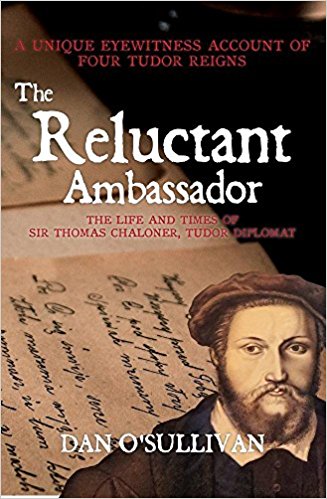
HISTORICAL BOOK REVIEW SERIES: ‘ The Reluctant Ambassador’ by Dan O’Sullivan

Sir Thomas Chaloner achieved much during his short life. As someone at the heart of four Tudor courts, his experience is fascinating.

Serving in the household of Thomas Cromwell after university, he later was entrusted with delicate diplomatic missions in France, Scotland, Flanders and finally Spain, where he was resident ambassador at the court of Philip II. His career was helped by his close friendship with William Cecil, whom he got to know at Oxford. He managed to stay employed during the religious and political upheavals of four reigns, while many close to him lost their positions and even their lives.

Chaloner was an intellectual and a humanist. He had a close circle of literary friends with whom he collaborated in the staging of court masques and other productions. He produced reams of verse and also translated several works from Latin, among them The Praise of Folly by Erasmus.

In Spain, Chaloner devoted much energy toward trying to save dozens of English sailors who had found themselves imprisoned as a result of bitter trade disputes between England and Spain. The stresses of his job weakened him physically, and he died soon after his recall, leaving a wife and young son.

Dan O’Sullivan explores the life of Chaloner and delves into the intricacies of European court life during the time of the Tudors. Chaloner, a reluctant ambassador who longed for his home in England, is a fascinating but little-known character who is here brought to life in vivid detail.

cover and blurb via amazon

~~

In 1541, Holy Roman Emperor Charles, who ruled much of Europe, went to war against the Turks and the Barbary pirates. He planned to besiege Algiers to free Christians from pirates, but could not attack Constantinople, as he did not have the numbers. One of these men onboard was Thomas Chaloner, on his first trip abroad from England. The fleet was caught in a storm, resulting in the loss of 8,000 lives as ships sank.

Chaloner was lucky; he could swim, unlike most. In fact, he had much luck in his early life. With a wealthy merchant father, Chaloner went to Cambridge and was given a job in Thomas Cromwell’s house. Still in his teen years, Chaloner could ready himself for life at court, learn politics and Latin, Italian and French. At St Johns College, he made a friend named William Cecil, which would help Chaloner again later in life.

Chaloner had sailed abroad as a diplomat, there to represent England while Charles V took on the Turks, and was one of the few who survived the Mediterranean storms. He went home to a new England – wife number five of Henry, Katherine Howard, was about to die. But change helped, as Chaloner gained a place on the privy council as a clerk, and as Henry failed to rule his country properly, or had Thomas Cromwell to fall back on, Chaloner was there with the men who ran England, while still in his early twenties.

.

Chaloner had languages, and this made him key as a diplomat, both with overseas missions as England forged wars, and at home. By 1547, Chaloner was negotiating with the Scots to stop fighting and help gain a royal marriage for his young new king. Chaloner felt high in esteem at court, already wealthy with his inheritance and marriage to a wealthy widow. He was a humanist, enjoying the Protestant reformation.

Edward IV died in 1553 and while Chaloner’s school friend, William Cecil, and countless more fled to Europe, Chaloner decided to try to stay working for the government through the Catholic changes brought by Queen Mary. Chaloner wrote poems for Jane Grey, beheaded after her nine days as queen, but quietly managed to stay alive and work for Mary.

By by 1558, Mary was dead, and many flocked home to their Protestant princess as she was crowned Elizabeth I. Constant Chaloner was sent to meet the Holy Roman Emperor  to discuss marriage for Elizabeth, her most difficult issue throughout her reign. Chaloner then travelled to the Netherlands on Her Majesty’s behalf, only to learn his school friend, William Cecil, now Elizabeth’s right-hand man, had selected him to be ambassador to Spain.
.
Chaloner hated Spain, with its Catholic soul and its intense heat. He hated Madrid with a passion; it cost too much, he never got much time with the king, and the Spanish didn’t let him be part of their secret conversations. Chaloner seemed to worry about everything, especially about being robbed of his wage as ambassador. Trouble came when Chaloner told the Spanish court that England would not support the Huguenots in France during civil war, only to find out the English had headed to battle.
.
One thing fell into place for Chaloner; he couldn’t sleep in Spain and the food made him ill. Because of this, he had many nights awake, when he got write Latin poems. The poems told much of Chaloner’s time in Spain; after four years, he was convinced he would die and worried about everything.
.
It was a bad time to be at the Spanish court. England was not popular with Spain, ships constantly were embattled, bureaucracy was, well, Spanish, the inquisitions were in full swing. Chaloner ended up with kidney stones from Spanish wine mixed with lime and chalk. His only bright spot was a woman named Audrey Frodsham, who travelled to Spain from England with a view to marry Chaloner once his first wife died. The trip must have gone well, because Audrey went home pregnant.
.
After arguing with the Spanish government over English sailors in Spanish prisons for several years, Chaloner was finally allowed to return home to England. In 1565, he landed in England to find Audrey in his house, with a young baby in tow, named Thomas jnr. Chaloner married Audrey and then died a month later of illness.
.
 Chaloner was a man able to serve in four royal households in a time when many lost their head. As much as he liked to complain, Chaloner must have been doing something right, even if it did make him into a hypochondriac. I had never even heard of Chaloner until I read this book, and a big thanks to the author for a vivid book about a lesser-known Tudor figure.

HISTORICAL BOOK REVIEW SERIES: ‘ The Nevills of Middleham’ by K.L Clark

At a time when family name was everything, the Nevills were the most influential people in England. They saw the Wars of the Roses from both sides—Yorkist and Lancastrian—but mainly from their own. Their men lived and died violently, and the Nevill women married leading players on both sides. Their bitter and violent rivalry with the Percy family tumbled into the wider political unrest that resulted in the Wars of the Roses, the ongoing feud between York and Lancaster that deposed two kings. This is the first definitive history of a fascinating family, and is essential reading for anyone with an interest in the Wars of the Roses.

~~

Richard Neville was one of the famous descendants of the Beaufort dynasty, and by 1465, he was one of the most powerful men in England. He was the 16th Earl of Warwick and nicknamed the Kingmaker, with good cause. Married to the wealthy Anne Beauchamp, Neville was constantly at King Edward IV’s side. He was not the only powerful Neville – brother George Neville was Archbishop of York and John Neville, Marquess of Montagu, was a famed soldier. Sister Katherine had married into the powerful Hastings family, and Cecily was a duchess, Alice a Countess, just a sample of the all-powerful Neville empire.

While Richard Neville stood at the side of a York king, the Neville name harks back to Lancastrian kings, due to being linked by blood to Joan Beaufort in the late 1300’s. The Nevilles moved toward the York arm of the royal names before spending time in exile and rebellion, before Anne Neville took the throne at Richard III’s side. The Neville name then started to fade from the annuls of history.

This book takes on a complex family and helpfully provides a way through the many branches of the family tree. While the Kingmaker is the most studied Neville, there are many more to learn about and the author has encompassed them all.

Warwick the Kingmaker was a man like any other when in power; he was a selfish . He saw fit to execute many enemies, his own brother dispatched to take part on many killings. He was revered by the men he kept on his side and a villain to anyone be opposed. Like most in the War of the Roses, Richard Neville was neither hero or villain, he was both. I found this to be the most comprehensive book on this family.