
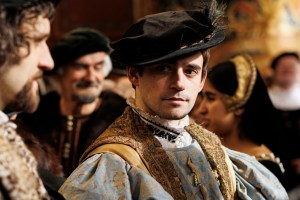
Gregory Cromwell (c. 1520–1551) was probably the antithesis of his intelligent, well-travelled and fervent father. The character certainly got a glow-up of sorts in The Mirror and the Light.
Born around 1520, Gregory was the eldest of the Cromwell children, with Anne born c.1523 and Grace c.1527. The Cromwells lived in the heart of the Italian quarter of London on Fenchurch Street, before the family moved a few blocks north into Austin Friars in early 1523. It was a big household – Gregory’s grandmother Mercy Prior lived there, along with his paternal aunt and uncle Elizabeth and William Wellyfed and their three children Christopher, William, and Alice, and his maternal aunt and uncle Joan and John Williamson, and their daughter Joan. Also in the household were the Williams children Richard, Gregory and Walter with their father Morgan Williams, though they also had their own household as well until 1528. Added to that was Thomas Cromwell’s ward Ralph Sadler and his younger brother Nicholas. Gregory got to grow up in a large and wealthy family environment, and was away in Cambridge when sweating sickness struck London, killing his mother, and also away one year later when his sisters died. For Gregory, like his father, being away from home likely saved his life.
At age 7, Gregory, with his cousins Christopher Wellyfed and Nicholas Sadler, being similar in age were grouped together for their formal education, starting at home with John Palgrave, then moving to live with Prioress Vernon and being taught by John Chekying in Cambridge. Gregory’s years in education were largely unremarkable (except when Christopher Wellyfed was setting thigs on fire, costing his uncle a small fortune). By the time that Cromwell had got Anne Boleyn on the throne, it was obvious Gregory needed a different life away from formal education at Cambridge. Gregory began an annual routine of spending months away from home at a time, travelling the country and staying with friends of his father, visiting the countryside all around England and the Welsh marshes, a lifestyle similar to the king’s illegitimate son Henry Fitzroy. He even stayed with the Duke of Norfolk for a summer when the duke and Cromwell were briefly attempting to get along in 1536.
One of the most significant events in Gregory’s life was his marriage to Elizabeth Seymour in 1537. Elizabeth was the sister of Jane Seymour, Henry VIII’s third wife, making Gregory the king’s brother-in-law by marriage. He had his own household set up and paid for by his father, and it included Gregory’s half-sister Jane Cromwell, who had been born in 1530 to an unknown mother. Jane had grown up in the large Cromwell household at Austin Friars, but from 1537 onwards, lived with Gregory, alongside his new wife Elizabeth.
In late 1538, Thomas Cromwell had to deal with Gregory being punished by the church for sexual crimes. The event wasn’t hushed up, rather handled by clergymen who had no interest in embarrassing Elizabeth, the king’s sister-in-law. Gregory and Elizabeth were living at Lewes Priory, where Cromwell had set up them up with lands and manors that were large enough to host the king on progress, and his reputation was destroyed. Pregnant Elizabeth Cromwell and her infant son Henry were brought close to Cromwell at Mortlake, while Gregory lived separately from his wife, though they reconciled before Edward Cromwell was born in early 1539. They could not return to Sussex.
Gregory spent no time at court or worked for his father. Cromwell kept his adoptive sons Ralph Sadler and Richard Cromwell close, yet Gregory had no part in his father’s business. The only role Gregory had was to attend Queen Jane Seymour’s funeral, ride ahead of Cromwell’s mustered troops in 1539, and later welcome Queen Anna of Cleves to England, but these roles were also minor. When Cromwell was arrested in 1540, Gregory and Elizabeth Cromwell were at Leeds Castle, where Cromwell had set up a new life for them in 1539, where baby Thomas Cromwell was born in 1540.
King Henry was not in the habit of punishing the families of traitors (the Pole family excluded obviously). Gregory’s marriage to Elizabeth secured his social standing and protected him when his father fell from grace. Elizabeth wrote to her former brother-in-law the king, denouncing Thomas Cromwell after his downfall, and she and Gregory were allowed Launde Abbey, bought by Thomas Cromwell several years earlier. Gregory was also made 1st Baron Cromwell, making him appear worthy of the position of Prince Edward’s uncle, as he could not inherit any of his father’s titles or money.
Gregory and Elizabeth stayed quietly at Launde, having two more children, Katherine in 1541, and Frances in 1542. Gregory diligently attended parliament each year but achieved nothing, though did amass a large amount of lands, enough to make a tidy living. If anything, Gregory was one of those peers Cromwell never liked; those who were rewarded for their status rather than their effort. Gregory was also given permission to not fight in France when hostilities broke out, claiming his health was poor. Gregory has no political or religious beliefs or affiliations that linked to any cause.
In the late 1540s, Gregory’s fortunes continued to improve under the reign of Edward VI, who was influenced by Protestant reformers. He maintained his position as a member of the gentry, though he did not seek high office. Gregory was made a Knight of the Bath in 1547 by his nephew King Edward, but he spent no time at court. But the disease that claimed his mother and sisters, sweating sickness, remerged in 1551, killing Gregory at age thirty, and also his son Edward, not yet a teenager.
Elizabeth quickly remarried, and young Henry Cromwell married his stepsister Mary Paulet, a granddaughter of one of the Grey sisters Cromwell once served, and produced a line of Irish Cromwells who lived with mixed success. Thomas Cromwell the younger went into English politics with Ralph Sadler and a friend, Seymour servant William Cecil, and served Queen Elizabeth with the level of skill, respect and intelligence shown by his grandfather. Thomas became a parliamentary historian, creating papers still useful in studying the Elizabethan era today. Of the Cromwellian grand-daughters, Katherine married John Strode of Devon and had six children. Frances Cromwell married a cousin of her sister’s husband, Robert Strode, but she sadly died after giving birth to her son, aged only 20.
After what happened in the mighty rise and fall of Thomas Cromwell, it is not surprising his sons and grandchildren were not so prepared to stick out their neck.
 CAROLINE ANGUS