
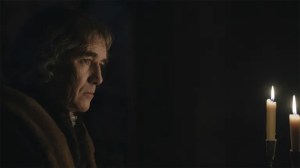
By now, you will have seen the final episode of The Mirror and the Light, when Thomas Cromwell was beheaded at Tower Hill, though if you haven’t seen it yet, and feel a bit squeamish, don’t fear. Cromwell’s execution has long been written about and portrayed (including by myself in fiction) as a bloody and botched execution. Fortunately, for those of us who love Cromwell, reality isn’t so awful. Here is a passage from my book on Cromwell’s letters, explaining the real execution –
While primary sources writing about 28 July 1540 offer sketchy detail, the works of Foxe, Hume, Cox, Galter, Herbert, and Hall all offer insights to the execution of a man completely dominate only two months prior. Cromwell may have only learned of his style of execution on the morning of 28 July from William Laxton and Martin Bowes, two sheriffs at the Tower, who came to him after breakfast, which he had just after dawn on a sunny summer’s day. Hume wrote that one thousand halberdiers were there to flank Cromwell’s short walk from the Tower to the scaffold on the hill, because of an unfounded fear that Cromwellians would mount an escape bid among the immense crowd.
At Tower Hill, Cromwell met Walter Lord Hungerford, also destined to die, but for crimes of incest, buggery, and wife-beating, and had possibly lost his mind by the time of his death. A theory suggests that someone scheduled Hungerford’s death on the same day to bring shame to Cromwell, by dying beside such a horrid man, though Hungerford is a footnote in the tale. The men knew one another through their work for the king, and Foxe wrote that Cromwell tried to comfort the distraught Hungerford, saying, ‘there is no cause for you to fear. If you repent and be heartily sorry for what you have done, there is, for you, mercy enough from the Lord, who for Christ’s sake, will forgive you. Therefore, be not dismayed and though the breakfast which we are going to be sharp, trusting in the mercy of the Lord, we shall have a joyful dinner.’
Cromwell had to deliver a speech to cement his legacy and save his son Gregory, daughter-in-law Elizabeth and their three sons, Henry, Edward, and infant Thomas. Also foremost on his mind would be his nephew Richard, now in King Henry’s privy chamber, and Richard’s wife Frances, and their sons Henry and Francis. Also, Sir Ralph and Lady Ellen Sadler and their children Thomas, Edward, Henry, Anne, and Mary. On top of them were also Cromwell’s wide extended family, the Williams’, the Wellyfeds, and the Williamsons, Cromwell’s mother-in-law, Mercy Prior, and young Jane Cromwell.
Despite appearances, King Henry had granted the mercy Cromwell begged for; while a pardon could set a precedent and undermining the law of attainder, but rather than being burned as a heretic, or hanged, drawn, and quartered as a traitor, they would behead Cromwell at Tower Hill. The King would not afford a commoner such a death; Henry saw Cromwell as the earl he was, not the man he was born. In another act of mercy, Cromwell did not have to die alone; Henry allowed Sir Thomas Wyatt to walk up onto the scaffold behind Cromwell, Wyatt devastated to lose his friend. John Foxe chronicled Cromwell’s last words, in a similar vein to Edward Hall:
‘I am come hither to die, and not to purge myself, as some think peradventure that I will. For if I should so do, I were a very wretch and a Miser. I am by the Law condemned to die, and thank my Lord God, that hath appointed me this death for mine Offence. For since the time that I have had years of discretion, I have lived a sinner, and offended my Lord God, for the which I ask him heartily forgiveness. And it is not unknown to many of you, that I have been a great Traveller in this World, and being but of a base degree, was called to high estate, and since the time I came thereunto I have offended my Prince, for the which I ask him heartily forgiveness, and beseech you all to pray to God with me, that he will forgive me. And now I pray you that be here, to bear me record, I die in the Catholic Faith, not doubting in any Article of my Faith, no nor doubting in any Sacrament of the Church. Many have slandered me and reported that I have been a bearer of such as have maintained evil Opinions, which is untrue. But I confess, that like as God by his holy Spirit doth instruct us in the Truth, so the Devil is ready to seduce us, and I have been seduced; but bear me witness that I die in the Catholic Faith of the holy Church; and I heartily desire you to pray for the King’s Grace, that he may long live with you in health and prosperity; and that after him his Son Prince Edward that goodly Imp may long Reign over you. And once again I desire you to pray for me, that so long as life remains in this flesh, I waver nothing in my Faith.
Cromwell then went on to pray:
‘O Lord Jesus, which are the only health of all men living, and the everlasting life of them which die in thee; I wretched sinner do submit myself wholly unto thy most blessed will, and being sure that the thing cannot Perish which is committed unto thy mercy, willingly now I leave this frail and wicked flesh, in sure hope that thou wilt in better wise restore it to me again at the last day in the resurrection of the just. I beseech thee most merciful Lord Jesus Christ, that thou wilt by thy grace make strong my Soul against all temptations and defend me with the Buckler of thy mercy against all the assaults of the Devil. I see and knowledge that there is in myself no hope of Salvation, but all my confidence, hope and trust is in thy most merciful goodness. I have no merits nor good works which I may allege before thee. Of sins and evil works, alas, I see a great heap; but yet through thy mercy I trust to be in the number of them to whom thou wilt not impute their sins; but wilt take and accept me for righteous and just, and to be the inheritor of everlasting life. Thou merciful Lord wert born for my sake, thou didst suffer both hunger and thirst for my sake; thou didst teach, pray, and fast for my sake; all thy holy Actions and Works thou wrought for my sake; thou suffered most grievous Pains and Torments for my sake; finally, thou gavest thy most precious Body and thy Blood to be shed on the Cross for my sake. Now, most merciful Saviour, let all these things profit me, which hast given thy self also for me. Let thy Blood cleanse and wash away the spots and fulness of my sins. Let thy righteousness hide and cover my unrighteousness. Let the merit of thy Passion and blood shedding be satisfaction for my sins. Give me, Lord, thy grace, that the Faith of my salvation in thy Blood waver not in me but may ever be firm and constant. That the hope of thy mercy and life everlasting never decay in me, that love wax not cold in me. Finally, that the weakness of my flesh be not overcome with the fear of death. Grant me, merciful Saviour, that when death hath shut up the eyes of my Body, yet the eyes of my Soul may still behold and look upon thee, and when death hath taken away the use of my Tongue, yet my heart may cry and say unto thee, Lord into thy hands I commend my Soul, Lord Jesus receive my spirit, Amen.’
Cox wrote that Cromwell then turned to Wyatt and said, ‘fare you well, Wyatt,’ his friend deeply upset at this stage, and Cromwell added, ‘gentle Wyatt, pray for me.’ Cromwell removed his gown, gave forgiveness to his executioner, and prayed him to take his head with a single blow. Conflicting reports exist of what came next.

The news of the execution travelled Europe, changing with every letter. Hume wrote Cromwell’s head came off with a single blow. But Galton wrote that the axeman was a ‘ragged and butcherly wretch’ and that the first blow instead hit Cromwell’s skull, and that it took half an hour to cut through Cromwell’s neck, an impossible reality. But that story was what Cromwell’s enemies wanted to hear, of a horrid death, and the story has stuck, despite no eyewitness accounts stating there was anything except a straightforward beheading.
French Ambassador Marillac wrote at once after Cromwell’s death, telling Constable Montmorency, ‘Mr. Thomas Cromwell, heretofore condemned by Parliament, this morning was executed in the usual place for such executions,’ without any mention of a horrid execution.
From Madrid, Francisco de los Cobos, High Commander of Leon, wrote to Pedro Fernández Manrique, Marquess de Aguilar in Rome, that ‘the king of England beheaded Cromwell, who was his favourite. The cause was, they say, because he urged him to be a Lutheran. Please God, it may be a beginning of the King’s coming to a knowledge of his duty.’
On 16 August, Philip Melanchthon was woefully ill-informed in Germany, writing to two separate people that Cromwell had been hanged, quartered and burned by ‘the English tyrant, the English Nero.’
On 11 September, Cromwell’s long-time enemy Reginald Pole wrote to his secretary Ludovico Beccadelli, claiming, ‘I fear I was wrong in writing of Cromwell coming to his senses, for his last words as printed do not give the same impression as the narrative of those who told of his end and last words. The judgement of men belongs to Christ, who knows the hidden things of the heart.’
On 3 March 1541, Ambassador Marillac wrote to Paris, saying he and Ambassador Chapuys worried for King Henry, whose leg caused him anguish, that he ate and drank continually, leading to immense weight gain, and his mood had become ‘contrary even to itself’. Men fell foul for seeing through the king’s instructions, as instructions could change within the same day. The king blamed his ministers for all his troubles, and on occasions even, ‘reproaches with Crumwell’s death, saying that, upon light pretexts, by false accusations, they made him put to death the most faithful servant he ever had’.
All texts and sources come from The Letters and Remembrances of Thomas Cromwell. My publisher might come for you if you plagiarise.
 CAROLINE ANGUS