
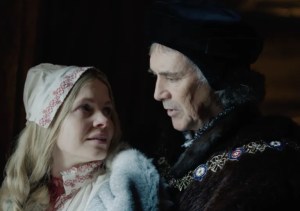
Welcome to part 3 of Wolf Hall 2: The Mirror and the Light recap of the facts around Thomas Cromwell and the events in season 2, where Jane has given birth to Prince Edward.
Did Thomas Cromwell have feelings for Jane Seymour? This is a question that is impossible to answer. There is absolutely no evidence of any link between Thomas Cromwell and Jane Seymour, and (in my opinion) is a delightful fictional addition to Cromwell’s life story to add drama to a book/show. Those of us who work in Cromwell fiction need to add romantic details, because simply, Cromwell had none in his own life. I’m working on another Cromwell fiction myself at the moment, and there is again zero source evidence to work with. Nothing in Italy, nothing in the Low Countries, and then a marriage to Elizabeth Wyckes which was simply a convenience when she became a widow and they met through Morgan Williams (Richard Cromwell’s father). By all accounts, Cromwell and his wife were happy enough, but after she died, (apart from the quick grief rebound he had with ‘Elizabeth Gregory’), Cromwell never looked to any woman again. He was not a man into women at all.
At no stage was Cromwell ever rumoured to be in negotiations for a wife at any stage, and there were never any mistresses whispered about either. The lies about him being interested in Princess Mary and Margaret Douglas (I will do a sperate post on those rumours) bore no evidence, and if Cromwell ever muttered anything about Jane Seymour or anyone else, we simply don’t know. It does make for convenient fiction, though.
As for Jane Seymour, she was very limited in her options as well. Only one mention of a match comes up in Cromwell’s records, as a possible match for her, when Cromwell wrote (italics mine), ‘To speak with the King for Mr. Seymour’s daughter (Jane?) for (Sir Richard?) Elderton’ on 16 November 1532. Sir Richard Elrington, (often misspelled Elderton, and sometimes listed as Ralph) was the brother Edward Elrington, who had married one of the distant Seymour cousins, Grace (surname unknown), the illegitimate wealthy heiress of London Lord Mayor Thomas Seymour. Sir Richard/Ralph was twenty years older than Jane Seymour, which tracks with the astonishingly bad marriage made for Jane’s sister Elizabeth. Luckily for Jane, the marriage was never mentioned again.
Rumours of a marriage negotiations between Jane and Sir William Dormer came up in 1534, which the Dormer family quickly quashed. Sir William Dormer worked for Cromwell and went on work in royal service and parliament, and was married to Lady Mary Sidney in 1534, putting an end to overtures made by the Seymour family. Sir William’s sister Lady Jane Dormer recounted the negotiations in her autobiography that the Dormers did not wish to be linked to a scandalous family like the Seymours (meaning the scandal of Edward Seymour’s first wife cuckolding her husband twice with sons of unknown parentage).
Jane came to King Henry’s attention in late 1535 after the death of her father, who Henry had visited only months earlier on progress to Wolf Hall (his death is mistakenly listed as 1536). Edward Seymour was in the royal privy chambers by this stage, and the single Seymour sister was suddenly thrust into the royal marriage spotlight when Anne Boleyn lost her third child in January 1536.
Much like Thomas Cromwell, Jane Seymour’s romantic interests, or lack thereof, were never recorded. Marriages were rarely made in the interests of attraction to one another, making the king rare in his rash choices of some of his wives. Any kind of romantic overtures, those from men towards certain women were mentioned in letters from time to time, but women’s feelings generally go unnoticed. The people of the Tudor court were human, they would have had feelings of romance, lust, romance, affection like everyone else. But many didn’t have the financial security of being able to act on their feelings, and women’s feelings, to the men of court, didn’t seem to exist or matter at all.
As for whether Jane Seymour discussed having to handle sex with King Henry with Cromwell is entirely conjecture (but Cromwell did have an uncomfortable conversation with Anne of Cleves, so it’s not impossible). Jane’s sex life was unfortunately a public topic, as an heir meant everything to the court. Jane didn’t get pregnant until January 1537, a long time to wait with a king who was desperate for a son but no good in bed. Poor Jane indeed.
Cromwell was writing to discuss new brides for King Henry on 27 October, three days after her death. For all Henry’s kind words for Jane, and admiration for Prince Edward, there were mere days between Jane’s death and handling the security of the realm. By Christmas 1537, Cromwell had a suitable lists of brides from French princess to Dutch and German duchesses, and ready to discuss negotiations. King Henry did not need to be cajoled into these negotiations, he initiated them at every stage.
All sources from The Private life of Thomas Cromwell, The Letters and Remembrances of Thomas Cromwell, and Planning the Murder of Anne Boleyn
 CAROLINE ANGUS