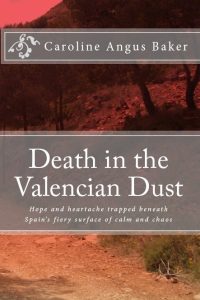
Is this it! The final book in the Secrets of Spain trilogy. When I first came up with the idea of Luna Montgomery in October 2009, I really had no idea what would happen. I mucked about with the character for a while, and took a break from her to create Canna Medici, who was ready to be published. But Luna Montgomery and her search for her grandfather in Spain was the very first fiction idea I ever had. Blood in the Valencian Soil (BITVS) was created throughout 2012, released in November that year. Vengeance in the Valencian Water (VITVW) was more of a revelation – I had never intended to write more than one book on Luna, but Valencia’s history deserved more. But Death in the Valencian Dust made its way into my mind and heart before VITVW was even finished.
So, here we are, with the Q+A for this book. I again have lumped together similar questions to cover as many as possible. I will try to avoid as many spoilers as possible. Let’s start in an easy place –
What is Death in the Valencian Dust (DITVD) all about?
DITVD is unique in the series in that it doesn’t start where the last book left off. BITVS and VITVW were a continuation of one another, but DITVD jumps forward four years to 2014, to give an insight to the lives of Luna Montgomery and Cayetano Beltrán. As the book shows the reader early on, the four years after the events in the last book have been huge for the new Beltrán family, with births, deaths and marriages. But family aside, Spain has changed, even for the wealthy Beltráns. Cayetano is now in his mid-40’s and his bullfighting career is coming to its natural end, much to his reluctance. His whole life is about to change, and those around him are already adjusting to a world where Cayetano Beltrán Morales isn’t having his name cheered by the crowds, or the tabloids following him around Spain. Luna has had her own ambitions pinned back to support Cayetano, but it is not a situation that can continue; Luna is not cut-out for the celebrity Madrileño wife lifestyle. One of the series’ more popular characters, Paco, has been through a huge transition in the four years since we last saw him, and time is running out to solve the mysteries of his family, Luna’s family, and the bodies Luna dug up at Escondrijo.
The alternative storyline is 1975, and Spain’s dictator Franco is close to death. In September that year, eleven men and women are up for execution, and Spain is a real mess, with draconian crackdowns on basic freedoms over the whole populace. Jaime Morales, Cayetano’s uncle, is about to have his perfect life come crashing down when he meets Alzane Mariñelarena, a young woman living in Valencia, where Paco is bullfighting. A chance meeting leads to a difficult friendship which awakens ugly truths, and no one really wants the answers to what Jaime and Alazne learn. Jaime is a sword handler, working for Paco on the bullfighting circuit, and living at Rebelión, a millionaire lifestyle. Alazne is a bastard child and dirt poor. Yet when the reality of Spain’s new laws, and Jaime’s father past, come together, Jaime and Alazne can run together, or die alone.
DITVD is a satisfying conclusion to the story of the Montgomery-Ortega-Beltrán-Morales family history. With luck, readers will have all the answers to the family saga from 1939 until 2015. Every character gets their day in the sun. Cayetano makes huge changes, and Luna needs to decide if she can stand as the leader of the entire family. Luna holds the secrets and fates of everyone in her hands, and has to live the burden, while still trying to live her own life.
Okay, that was really hard to explain. Sorry if I sound vague, but I don’t want to post spoilers!
Where does the book travel in Spain?
Again, Valencia city and Escondrijo in the Valencian mountains, plus Madrid and La Moraleja, the celebrity suburb outside the city. Rebelión, the Morales bull-breeding farm, which is about 50km east of Madrid, gets a lot of story time again. Plus the Beltrán family homes in Cuenca provide another backdrop. There are many other places visited and mentioned – Seville, Hoy de Manzanares and Mallorca all receive bullfights as Cayetano travels the country. Honestly, it is exhausting keeping up with a bullfighter’s schedule!
Why do you write about some as disgusting with bullfighting? Why do you condone cruelty to animals? Why do you promote animal cruelty? How can you justify being a fan of bullfighting? etc,etc,etc…
I have answered this before, and will provide the same answer again…
I have heard it all. I have three things that attract internet trolls – bullfighting, supporting cycling (in NZ) and being a feminist. Bullfighting tends to bring out the animal in people themselves. I have been told I am vile, I am cruel, I don’t deserve to be a parent, I am disgusting, my family deserves to be hurt… the list goes on. Are all these people interesting in the way their meat was raised and processed? Bulls raised on ganaderías and sent to bull fights are treated like kings. Quality healthcare, exercise regimes, carefully controlled diets… none of those things are taken into consideration for the chicken or pork in your fridge. Yes, bulls are taunted and exhausted in the ring, surrounded by the real beast of bullfighting – the crowd – who hungers for the animal to die. Is that degrading? Yes – that is without question. Do I feel sorry for the bulls while they stand disoriented and weakened as they get stabbed to death? Absolutely! The combination of watching the animal die, combined with sitting beside people who love to watch the event is not a nice feeling at all. Am I trying to promote bullfighting? I’m not sure if that is even possible – people can make up their minds about the corrida long before they get there. Many argue on the side of tradition, and I can identify with that. Bullfighting is more than killing an animal. The toreros are fascinating men and their dance with death is something I could write about forever. They are brave, proud and skilled. They have a talent that is frowned upon in the modern age, and stand in the ring to cheat death of its right to claim them, and are both reviled and revered every time they do so. (Numbers of men wanting to be toreros is up, not down as expected). I have great respect for these men, but I have no desire to promote cruelty to animals. I don’t plan on opening minds to both sides of the argument – many minds cannot be opened. The bull is the orchestra, the torero is the conductor. The crowd chants for a kill. I don’t write to glamourise the event – in fact, if you read, you’ll find the books regularly grapple with the subject, and show there is more to a torero than his sword.
Are there new characters added to the series?
All the major characters were seen in the previous books, with their histories opened wider this time. While they may seem new, they have all already been introduced to readers. There are a few minor characters which come and go, but most link to previous encounters.
What did you research for the book? How accurate is the storyline? Are the characters based on real people?
I stress that the characters are fictional, which is true. I have had inspiration from real-life people but I model the characters on no one. The storyline follows real-life events, especially the 1975 storyline. Both BITVS and VITVW both followed real-life, real-time events, and DITVD is exactly the same. The storyline and details of the 1975 executions are all totally accurate; I didn’t have to invent anything. I studied the last weeks and months of Franco’s life, his movements, even his exact words used. The timeline is all accurate; the characters are living in the history I studied. The laws which govern the characters in both 1975 and 2014 are all real, I don’t need to make up anything, Spain provides all the craziness on its own.
I knew much about the last years of the Franco reign, leading up to the dictator’s death. But I dug further and had the whole story mapped out in weeks. I studied the September 26 executions, the who’s, when’s, where’s, and why Franco acted the way he did. I also studied the actions of (then) Prince Juan Carlos, and also the reactions to the economic and social state of the nation in those final months of 1975. I tried to get as much detail as possible on the death of Franco, his funeral and the coronation of Juan Carlos, which wasn’t hard to come by. All these things are real, with fictional characters reacting to what was real life.
The 2014 storyline is more a world of the character’s making. Cayetano’s sister is on the rise politically, and what she does is a representation of several people in present day Spain. Also, the shaky future of the historical memory association, which Luna gains help from while digging up her family, is also based on truth. To see more abut the association, click on the link at the top of the right hand sidebar.
Was this book hard to write? Was it hard to let go of the series?
No and YES. DITVD wasn’t a hard book to write, because I always knew what would happen, who would live and who would die. I wrote 41 chapters in 43 days. As for finishing the series, while writing, I wasn’t sad to let the characters go, because I was happy with how it ended (more or less). But while editing, it started to hit me that characters I have lived with for years were about to embark on their own lives without me, and it does make me sad. I will never write Luna Montgomery again. I can only hope I have given her a good life. The woman can take anything I can throw at her.
(Potential spoiler alert ) Has Luna recovered from her injuries?
Luna has recovered as much as she ever will. Both Cayetano and Darren hover around her, endlessly concerned. I think it would be unrealistic for Luna to make a full recovery.
Do people really dig up bodies of relatives from the civil war and dictatorship period in Spain?
Yes – look right here Association for the Recovery of Historical Memory for information, photos and ways to support the association.
Why write about Spain?
Give me another country where a family can survive – civil war, then years of starvation, a brutal dictator’s rule, inequality, home grown terrorists, bleak poverty, then the death of dictator and new king, emergence of democracy without a war, blinding corruption and now a crippling recession – and all still be alive to tell the tale of the 75-80 years which has passed. Who can have members of a secret police force living happily, while their victims families have to live nearby in silence? Where the nation has endless centuries of strict traditions alongside a modern lifestyle? Add stunning landscapes, vibrant cities, incredible food, energetic people, quirky customs, plus a plethora of vastly different areas, languages and cultures within one nation. Give me all that somewhere else and I may consider writing about that country. (You can’t, Spain became my favourite place ten years ago).
Were there any hard parts to write in DITVD? Did you ever want to quit the series?
Quit the series? Nearly every day! I took an extended break between writing and editing this book, which got me over the finish line with great enthusiasm. Having time away from anything writing or Spain related gave me a real sense of urgency to get back to work when my other jobs died down (see Sorry, Readers, I Ran Away With The Circus). I always wanted the series finished, and finished well, and that is what I have done.
Are you sure the series is over? Will you miss your characters?
Yes, it is finished – for now, at least. Who knows, maybe I’ll revive Luna and Cayetano one day, but I have no immediate plans. I do have a few more books related to the series – stand-alone tales, one with Cayetano Ortega in the 30’s, one based with a young Paco Beltrán in the 40’s, and another one with José Morales in the early 60’s. These three books will have the characters everyone loves, but will be solely based in their respective time periods, and not involve Luna Montgomery in present day.
Why make Cayetano and Luna rich? Is that accurate of everyday Spanish life?
No, not at all, and I debated this at length. I could have made them struggle – and Luna didn’t live a fancy life to begin with, even though she wasn’t poor. I couldn’t resist making Cayetano rich and glamorous. It’s fun! Plus, the money of the family played a role in the storyline. Where Cayetano lives in La Moraleja is the best of the best – check out an example of life in La Moraleja here – Homes in La Moraleja. The home in Rebelión is a pure castle surrounded by bulls and olives. The wealth is part of the lifestyle fought for by the Beltráns.
Do you need to read BITVS and VITVW to understand this new book?
Yes and no. You could get by without them. The 1975 storyline has no relation to the previous books, so you would be fine. I make sure there is enough background in the 2014 storyline to make sure new readers are not lost, but regulars are not bored. I’m careful about that.
The book name suggests death. Should we be worried?
Of course, when did I ever write a book without a disaster or two?
Who is your favourite character of the series?
Eek – that’s tough. I would have to pick Paco Beltrán. That man has seen it all. Paco has an old-world charm about him.
Do you have characters which you hate to write?
No, I understand each of them and their motives. Sometimes I write things, like José explaining the need for rape in women’s prisons, and I hate the man, but he is who he is. I write his words, but they do not follow my personal beliefs. Villains gotta villain, you know?
Do we get a lot of sex in this book?
No, sorry. If you’re looking for sex, I have books with sex, but this one is light on that particular subject.
Is the series suitable for children?
No, no, no. I would say no younger than 16 and even then, depending on the young adult. Be careful with letting children read, the series has sex, and violence, and general grisly behaviour you don’t want children to see. VITVW is high on violence, death and even rape. BITVS has sex but isn’t particularly vicious. DITVD is the least adult of the three, but still, check the books to see if they are in line with what your young adults are ready to see.
What are you going to write now?
My next book is The Invisible Anarchist, based around the Spanish Civil War in Madrid, Barcelona, Valencia and Teruel. I don’t have a release date yet, but the book is already underway. The book has 100% new characters.
Do you have a favourite book of the three in the Secrets of Spain series?
I don’t know if I could play favourites. I loved the story of Luna and her grandfather in BITVS; it was the entire foundation the series was built on, but my writing has vastly improved since the book was released. VITVW was a favourite; the research was meticulous on the subject of the Valencian flood and the church baby-stealing affairs. I’m proud of the work. DITVD tidies up all the loose ends while providing a new mystery as well. Each book plays its role well.
What is your favourite part of DITVD?
Near the end of the book, Cayetano has to make a speech and he talks about his father, Paco. That’s my favourite. It was so easy to write, since I know the characters so well, I can make them recall their childhoods with ease.
Any chance of a free book?
The most asked question! Yes, BITVS and VITVW will be free for four days starting May 7. Check your timezone (midnight PST, 7pm NZT, 9am Spain time) and go onto any Amazon site worldwide to download these two books for free!


 CAROLINE ANGUS